Saint Therese of the Child Jesus
of the Holy Face
Entries by Maureen O'Riordan (558)
The Solemn Translation of St. Therese's Relics from the Town Cemetery to the Lisieux Carmel, March 26, 1923

[On March 26, 1923, in view of the approaching beatification of the Venerable Therese of the Child Jesus, her relics were transferred ("translated") from the Carmelite plot in the municipal cemetery at Lisieux to the shrine which had been prepared for them in the chapel of the Carmelite monastery of Lisieux, where they remain to this day. We thank the Archives of the Lisieux Carmel, which graciously permitted us to translate this contemporaneous account of the events of that day into English and to publish it].
Extracted from a brown leather-edged, but very thin top, bound book stored in the Glorification cabinet. Title on the edge: St. Th EJ her beatification [1]
Across the City
LISIEUX had never before known such excitement as existed within its walls on the morning of March 26, 1923, Monday of Holy Week. Since yesterday, travelers from every direction had been pouring relentlessly out of the train station . . . Read more
 Maureen O'Riordan
Note that the exhumation had to be authorized by the Mayor of Lisieux, who tried to charge the Carmel a vast sum of money in exchange:
THE MAYOR OF LISIEUX AND SISTER TERESA.
"The body of the Venerable Sister Teresa was solemnly transferred on March 26 from the cemetery of Lisieux," says a writer in the "Journal des Debats," "to the chapel of the convent, where she gave so much edification and of which she will remain the glory." This translation, continues the writer, nearly caused a revolution at Lisieux. The Mayor, whose authorisation for the transference of the body of the venerable Sister was necessary, does not share the sentiments of his colleagues for Sister Teresa. He has only seen the mercantile side of the great fetes for which the beatification has been the occasion. For his signature he tried to obtain a price which defied all competition. Never before has the decree which authorised exhumations been so ingeniously turned to account. A petition was presented to the municipal council, the Mayor was cross-examined, and, after replying in mystic language, he capitulated. Finally, all was arranged on reasonable terms and the translation took place at the appointed time.
THE MAYOR OF LISIEUX AND SISTER TERESA. (1923, July 13). Southern Cross (Adelaide, SA : 1889 - 1954), p. 3. Retrieved April 2, 2017, from http://nla.gov.au/nla.news-article167741770
Maureen O'Riordan
in Lisieux Carmel, March 26 1923, St. Therese's relics return to Carmel, cause of St. Therese of Lisieux, events related to St. Therese of Lisieux, relics of St. Therese, solemn translation of St. Therese's relics
|
 Post a Comment
|
Post a Comment
|  Email
|
Email
|  Print
Print
125 Years Ago With Saint Therese: the death of Mother Genevieve, founder of the Lisieux Carmel, on December 5, 1891
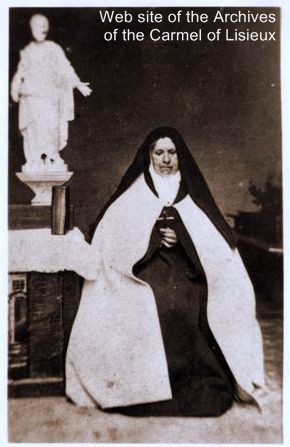 Mother Genevieve of St. Teresa about 1860
On Saturday, December 5, 1891, Mother Genevieve of St. Therese, venerated as the founder of the Lisieux Carmel, died. Therese recalls the experience of her death in Story of a Soul.
About Mother Genevieve
The future Mother Genevieve was born Claire-Marie-Radegonde Bertrand on July 5, 1805 in Poitiers. In 1830, at age 24, she entered the Carmel of Poitiers.1 About seven years later the Gosselin sisters, who wished to establish a Carmel with their family fortune, entered the community at Poitiers to make their novitiate. In 1838, when the two sisters returned to Lisieux, they were accompanied by nuns from Poitiers, including the prioress of the new house, Mother Elizabeth of St. Louis, and the subprioress and novice mistress, Mother Genevieve of St. Therese. A few years later Mother Elizabeth died. Mother Genevieve succeeded her, and so it was she who was considered the "foundress." Her sisters, who loved her very much, elected her prioress as often as the Rule allowed until her health prevented her fulfilling the office any more
Mother Genevieve and the Martin sisters
Pauline Martin's entrance on October 2, 1882 fell during one of the periods when Mother Genevieve was not eligible to be elected a third term; Mother Marie de Gonzague was prioress at the time. On January 31, 1883, Mother Genevieve was re-elected, so she held the office when Pauline received the habit. At the end of 1884, Mother Genevieve became an invalid. When the elections came around on February 3, 1886, it was clear that the 80-year-old founder was not well enough to serve, and Mother Gonzague was elected again. Thus, Mother Gonzague was prioress when Marie Martin entered (October 15, 1886) and when Therese followed (April 9, 1888). Still, a close spiritual bond existed between Mother Genevieve and the Martin sisters, especially Pauline, whom she described as "our angelic novice," and Therese.
Mother Genevieve and Therese
The priest who supervised the Lisieux Carmel, Canon Jean-Baptiste Delatroette, vigorously opposed Therese's entrance. When he was inside the enclosure visiting Mother Genevieve, she bravely (but in vain) asked him to consent to Therese's entrance.
When she came to write her memoir, Therese mentioned Mother Genevieve three times. She speaks of
my good fortune at knowing our holy Mother Geneviève. This certainly was a priceless gift; God, who had given me so many graces, willed that I should live with a saint. Not one that was inimitable, but one who was made holy by the practice of the hidden virtues, the ordinary virtues . . . . I saw the degree to which Jesus was living within her and making her act and speak. Ah! that type of sanctity seems the truest and the most holy to me, and it is the type that I desire because in it one meets with no deceptions.
For a sensitive reflection on the influence of Mother Genevieve on St. Therese, and for the founder's role as a precursor of Therese's way of confidence and love, please see pages 131-133 of Therese of Lisieux: God's Gentle Warrior, by Thomas R. Nevin (New York, New York: Oxford University Press, 2005).2
Mother Genevieve dictated to young Sister Therese certain "secrets" (moments in her spiritual life and recollections of her childhood). Read this "Remembrance of Mother Genevieve."
The death of Mother Genevieve took place at the beginning of a severe winter. An epidemic of influenza, which would shortly claim the lives of three Carmelites, was sweeping over France. Before it hit the community, the nuns joined the Carmelite Order in celebrating the third centenary of the death of St. John of the Cross, who died December 14, 1551. To honor the anniversary, Fr. Deodat de Basly, a Franciscan Recollect of the same order as Fr. Alexis Prou, who had heard Therese's confession in October ("he launched me full sail upon the waves of confidence and love"), preached a triduum from November 23-25. Therese recalls that Bishop Hugonin entered the cloister for this occasion and surrounded her with tenderness. Mother Genevieve received "extreme unction," as the sacrament of the sick was then called, on the last day of the Triduum, November 25. In a letter to Celine on that date, Pauline wrote:
Mother Geneviève was worse at the beginning of the week' now she is better, and, despite everything, she expects to die on Friday! One can tell she is convinced of it . . . how happy our holy Mother is! I find her face is imbued with celestial peace, one can sense that the port is nigh!"
It was early in the morning of Saturday, December 5, 1891, that the Bridegroom came for the 86-year-old founder. This was the first time Therese, now 18, had seen death; she found it a "ravishing spectacle."
I was placed at the foot of the dying saint’s bed, and witnessed her slightest movements . . . . at the moment itself of our saintly Mother Geneviève’s birth in heaven . . . . I experienced an inexpressible joy and fervor; it was as though Mother Geneviève had imparted to me a little of the happiness she was enjoying, for I was convinced she went straight to heaven
Read Therese's full account of the death of Mother Genevieve, together with account of her dream about Mother Genevieve after the latter's death, at the Web site of the Archives of the Carmel of Lisieux.
Mother Genevieve was so revered in the community and in the town that her body was laid out in the choir for a week. See a photo of her body and several portraits taken during her lifetime. She could not be interred immediately, for the local government did not at once consent to her burial within the monastery. The town council eventually consented, and she was buried in the sanctuary of the Carmel chapel, near Father Sauvage, the priest-founder, on December 23, 1891.3
Mother Genevieve was indeed the "grain of wheat" of which Jesus speaks: "if it dies, it bears much fruit." The fruit would become visible in only a few years.
1The details of Mother Genevieve's childhood and her religious life are available in the little book, now happily online, "The Foundation of the Carmel of Lisieux and Its Foundress, Reverend Mother Genevieve of St. Teresa," translated by a religious of the Society of the Holy Child Jesus in 1913. The title page lists as publishers the Carmel of Lisieux; St. Anselm's Society in London; and the Carmelite Convent in Philadelphia. This short book is a valuable resource for those who want to understand the 50-year history of the Carmel Therese entered in 1888. It points out that Mother Genevieve was considered the mother of the Carmels of Caen, Coutances, and Saigon (all founded from Lisieux), as well as of all the Carmels of the Far East, which were founded from Saigon.
2 [Note that a purchase through the link supports this Web site].
3 Sainte Therese de Lisieux (1873-1897), by Guy Gaucher, O.C.D. Paris: Editions du Cerf, 2011, p. 349.
The English text of the speech by Bishop Germain which Therese of Lisieux, a pilgrim at Montmartre, heard on November 6, 1887
The Martin family pilgrimage to the Basilica of the Sacred Heart at Montmartre: November 6, 1887
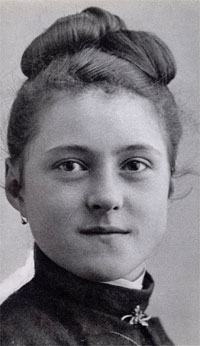 Therese in April 1888, aged 15, five months after her visit to Montmartre
Today, on the anniversary of Therese's visit to the Basilica of the Sacred Heart at Montmartre, I have, thanks to the generosity of the Basilica, the joy of presenting for the first time an English translation of the speech she heard the bishop of Coutances give to the pilgrims that morning. To relive the occasion with Therese, read on:
On Sunday, November 6, 1887, the 14-year-old Therese Martin, with her father, St. Louis Martin, and her 18-year-old sister, Celine, came to the Basilica of the Sacred Heart in Montmartre, on a hill outside Paris, to assemble, together with 194 other persons with whom they were to go on a pilgrimage to Rome. The pilgrimage had been organized by the diocese of Coutances in honor of the 50th anniversary of the priestly ordination of Pope Leo XIII. It was widely seen as a demonstration of the loyalty of the French church to the Pope, who was more or less a prisoner in the Vatican, and it was covered in the French and Italian press.
Mgr Abel-Anastase Germain, bishop of Coutances. Photo credit: Wikipedia
The bishop of Coutances, Mgr Abel-Anastase Germain, accompanied the priests and lay persons from his diocese to Rome. Bishop Germain, who strongly encouraged exterior manifestations of the faith such as pilgrimages and processions, was known as an eloquent preacher. The pilgrimage was directed by his vicar-general, abbé Legroux. Therese’s own diocese, that of Bayeux and Lisieux, also participated in this pilgrimage as a diocese. Her bishop was represented by his vicar-general, Msgr. Reverony. Therese hoped that Msgr. Reverony might intercede with Bishop Hugonin to obtain permission for her to enter Carmel at the age of fifteen.
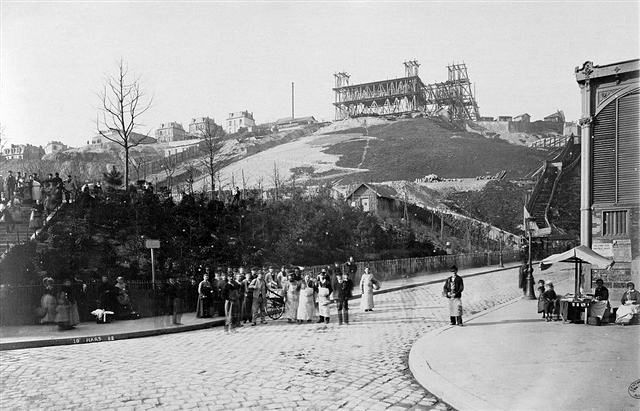 Construction of the Basilica of the Sacred Heart at Montmartre in 1882, five years before Therese arrived. Photo credit: Wikipedia.This assembly at Montmartre, where only the crypt of the basilica was completed, was the first time that all the pilgrims had come together. The Basilica of the Sacred Heart, a massive undertaking that took nearly 50 years to complete, was the fruit of a "national vow" made by the French Catholics after the defeat of France in the Franco-Prussian war of 1870. Read the story here.
The Martins had arrived in Paris early on Friday morning, November 4, and Louis had spent two days showing his two youngest daughters the sights of the capital. Therese remembered chiefly visiting the Shrine of Notre Dame des Victoires, where she received an important Marian grace.
Discovering What the Pilgrims Did in the Basilica That Day
I knew that all the pilgrims had participated in Mass and other ceremonies at Montmartre on Sunday, November 6, and had been consecrated to the Sacred Heart there before leaving Paris the next morning. I had often wondered whether any record of the ceremony existed, and I wrote to the Secretariat of the Basilica at Montmartre to inquire. To my amazement, the Basilica had a copy of the November 10, 1887 issue of the Bulletin Mensuel de l’Oeuvre du Voeu National au Sacré Coeur de Jésus (Quartorzieme Annee) [Monthly Bulletin of the Work of the National Vow to the Sacred Heart of Jesus, Fourteenth Year], T. XII, No. 11. See the cover below:
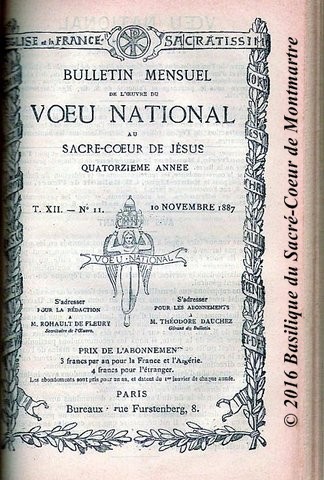 Monthly Bulletin of the Work of the National Vow to the Sacred Heart of Jesus, published November 10, 1887, four days after Therese's visit
Recovering Bishop Germain's Speech to the Pilgrims
The November 1887 issue contained a detailed description of the ceremony and the speech, verbatim, that Mgr Germain addressed to the pilgrims. With the utmost kindness the Basilica sent it to me with permission to publish it and other illustrations. I thank the Basilica for the honor of allowing you to read the very words heard by Therese on that Sunday 129 years ago. First, see the original in French below:
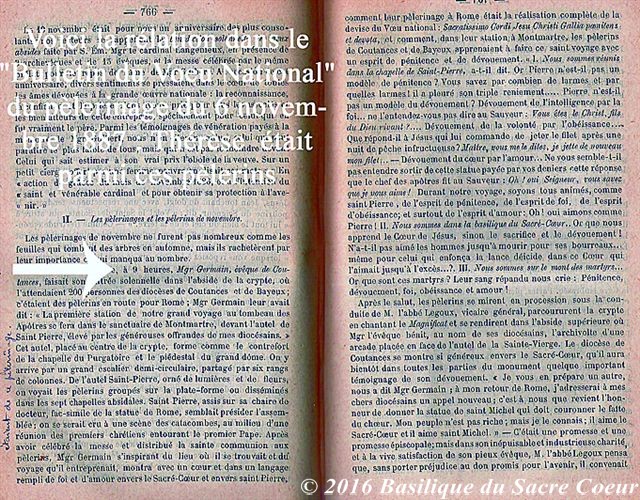
Detailed description of the ceremony and transcript of Bishop Germain's speech
Next, the English translation, which is copyright 2016 by Maureen O'Riordan. All rights reserved.
"II. November’s pilgrimages and pilgrims
November’s pilgrimages were not as numerous as the autumn leaves falling from the trees, but they made up in their importance for what they lacked in numbers.
On November 6, 1887, at 9 o’clock in the morning, Mgr Germain, Bishop of Coutances, made his solemn entry into the apse of the crypt where 200 people of the dioceses of Coutances and Bayeux awaited him; these were pilgrims en route to Rome. Mgr Germain had told them “The first station of our great voyage to the tomb of the Apostles will take place in the sanctuary of Montmartre, at the altar of St Peter, erected by the generous gifts of the people of my diocese.”
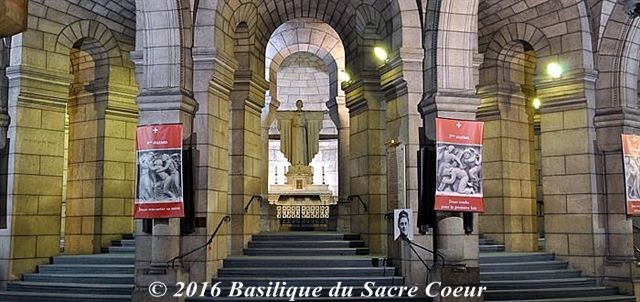
This altar, placed in the center of the crypt, in a form like the buttress of the Chapel of Purgatory and the pedestal of the great dome. One reaches it via a great semi-circular stairway shared by six ranks of columns. From the altar of St Peter, ornamented with lights and flowers, one sees the pilgrims grouped on the platform or scattered among the seven side chapels.
Statue of St. Peter, seated, at the Basilica of the Sacred Heart of Montmartre. Photo credit: TripAdvisor.
St Peter, seated at his doctoral rostrum, a facsimile of the statue in Rome, seems to preside over the assembly; one might believe oneself part of a scene in the catacombs amidst a meeting of the first Christians around the first Pope.
After celebrating Mass and distributing Holy Communion to the pilgrims, Mgr Germain, inspired by the place where he found himself, with a heart and in a language full of faith and love for the Sacred Heart and for St Peter, showed how their pilgrimage to Rome was the complete realization of the motto of the national Vow: Sacratissimo Cordi Jesu Cristi Gallix poenitens et devota ["France penitent and devoted to the Most Sacred Heart of Jesus Christ"], and how, in their station at Montmartre, the pilgrims from Coutances and Bayeux would learn to make this holy voyage with a spirit of penitence and devotion.
“1. We are gathered in the chapel of St Peter, he said. Isn’t Peter a model of penitence? You know [it] by how many tears, and what tears! He cried during his triple denial… Wasn’t Peter a model of devotions?
---Devotion of Knowledge by faith…. Don’t you hear him say to the Lord: You are the Christ, living son of God?...
--Devotion of the will by obedience… What does he respond to Jesus who commands him to toss out his net after a fruitless night of fishing? Master, you tell me and I throw out my net again.
----Devotion of the heart through love… Don’t you seem to hear coming from this statue paid for by your pennies this response made by the head of the Apostles to the Savior: “Oh, yes, Lord, you know that I love you!”
“During our voyage let us all be moved, like St Peter, by the spirit of penitence, the spirit of faith, the spirit of obedience, and above all by the spirit of love: Oh! Yes, let us love like Peter!
II We are in the Basilica of the Sacred Heart.. What shall we learn from the Heart of Jesus if not sacrifice and devotion! Didn’t he love men so much that he died for their torturers… even for the one who plunged the god-killing lance into the Heart of Him who loved him to excess?
III We are on the Martyrs' Hill… Now, who were these martyrs? Their spilled blood cries to us: Penitence, devotion, faith, obedience and love!”
Detail of the procession singing the Magnificat, November 6, 1887
After the greeting, the pilgrims organized themselves into a procession under the leadership of the Abbé Legoux, vicar general. They wandered throughout the crypt singing the Magnificat and proceeded into the upper apse [in the open air] where Monseigneur the Bishop blessed, in the name of the people of his diocese, the decorative molding of an arch placed before the altar of the Holy Virgin. The diocese of Coutances proves itself so generous to the Sacred Heart that there would soon be in all parts of the monument some important evidence of its devotion.
Procession of pilgrims singing the Magnificat, November 6, 1887
“I am preparing another one for you,” Mgr Germain told us: “upon my return from Rome, I will address my dear diocesans with a new appeal: it will be our honor to donate the statue of St Michael which will crown the pinnacle of the choir. My people are not rich, but I know them: they love the Sacred Heart. and they love St Michael.”
This was a promise, and an episcopal promise, but in his inexhaustible and industrious charity, and with the lively satisfaction of his pious bishop, Abbé Legoux thought that, without prejudice to the promised gift for the future, ……
Can We Find the Missing Page of this 1887 Article?
Here the account breaks off, for, miraculous as it is that this record has been preserved, the next page is missing. The Bulletin Mensuel, which was published from Paris, showed, in 1887, subscription prices for France, Algeria, and foreign countries. If any of you can find a copy of the November 10, 1887 edition that contains the complete account (perhaps in a library or in the archives of a religious order that subscribed), please do let me know, for I hope to publish the complete article in English and to restore it to the Basilica in French.
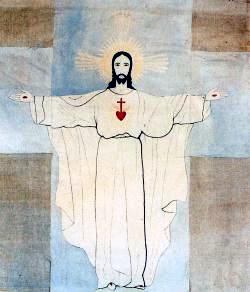 Image of the Sacred Heart of Jesus in the chapel of St. Pierre in the Basilica of the Sacred Heart at Montmartre
The Chapel of St. Peter at Montmartre
We know that the Martin family received Communion at this Mass at Montmartre. I believe that they participated in the Mass from the Chapel of St. Peter. Although this art was not there in 1887, that chapel today contains an image of the Sacred Heart based on the one Charles de Foucauld had in his chapel at Beni-Abbes.
The Consecration to the Sacred Heart
Before leaving the Basilica for lunch, all the pilgrims were consecrated to the Sacred Heart and given small badges of the Sacred Heart. Below is a sketch of Therese at the moment of consecration.
Therese kneeling in the Basilica at Montmartre at the moment of her consecration to the Sacred Heart
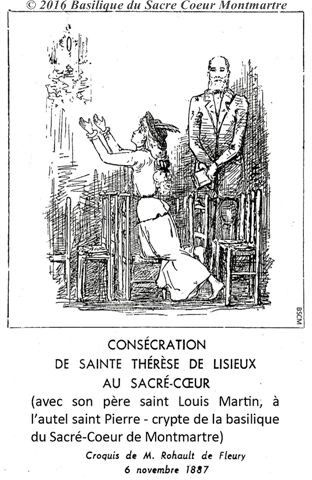
Therese wrote that she had asked for a special grace, "the grace," for her cousin, Jeanne Guerin. We do not know what this grace was. For more about the devotion to the Sacred Heart at that time and for Therese's unique experience of the Heart of Jesus, which departed radically from the accepted interpretation of the "Sacred Heart devotion," please read my article "The Abysses of Love and Mercy of the Heart of Jesus: St. Therese of Lisieux and the Sacred Heart."
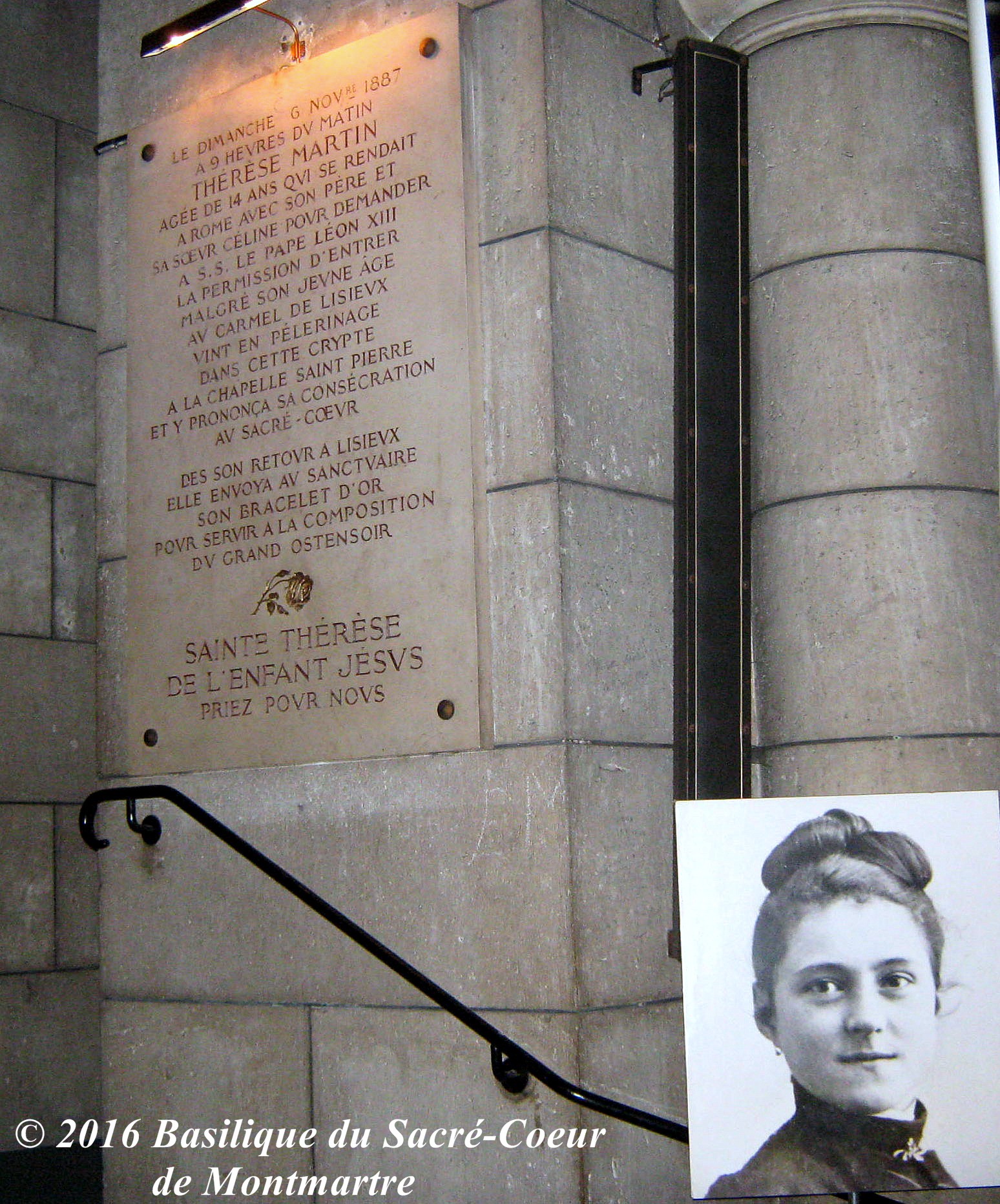
A plaque on the wall near the altar of St. Peter commemorates the visit of St. Therese, Celine, and St. Louis.
Therese Offered Her Gold Bracelet for a Monstrance for the Basilica
The plaque mentions that when Therese, the jeweler's daughter, returned to Lisieux, she sent her gold bracelet to the chaplains of Montmartre to be melted down in order to form part of the great monstrance for the basilica, a sacramental sign of her desire to keep vigil near the Eucharist day and night. That monstrance is pictured below:
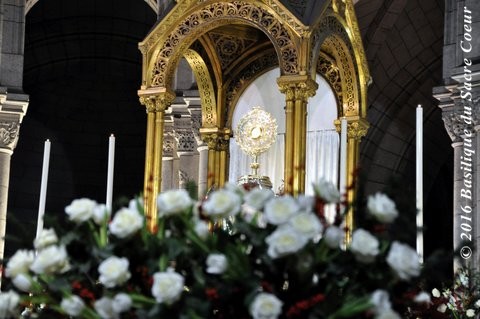 The gold monstrance for which St. Therese sent her gold bracelet
Perpetual Adoration of the Eucharist at the Basilica of the Sacred Heart at Montmartre
Perpetual adoration of the Eucharist in the basilica has continued day and night since 1885, two years before Therese's visit.
 Perpetual adoration of the Eucharist in the Basilica of the Sacred Heart at Montmartre. Photo credit: TripAdvisor.
If you go: following in the footsteps of St. Therese at Montmartre
Although Therese did not have the chance to adore the Eucharist in the Basilica at night, pilgrims now have that opportunity. If you are staying elsewhere in Paris, you can do so just by getting a ticket at a certain time in the evening that will admit you to the basilica after it closes for the night. If you are seeking a more complete retreat experience, you may stay overnight at the guest house operated by the Benedictine Sisters of Perpetual Adoration of Montmartre, whose vocation is to animate the spiritual experience of the pilgrims to the Basilica. You will have the opportunity to sign up for your chosen time of adoration. This is a powerful way to follow in the footsteps of St. Therese in Paris and also to honor her father, St. Louis Martin, and her uncle, Isidore Guerin, who were leaders in the movement of nocturnal adoration at Alencon and at Lisieux. Night and daytime pilgrimages are offered to individuals and to groups.
A Carmelite monastery on Montmartre
The friends of St. Therese will be happy to know that there is also a Carmelite monastery on Montmartre. It was founded in 1927.
I was delighted to see that the Basilica has now described the November 6, 1887 ceremony on its Web site in French.
The relics of St. Therese venerated at the Basilica of the Sacred Heart at Montmartre
Several times the relics of St. Therese have visited the Basilica of the Sacred Heart at Montmartre in November to commemorate her visit in 1887. See photos and videos of the visit in 2015. Could the devout teenage girl have guessed in 1887 that "she would return, more than a century later, in the form of relics offered for the veneration of the faithful?'
I renew my fervent gratitude to the Basilica for permitting me to share with you these precious texts and images. Please pray for the flowering of the great work of prayer and adoration that takes place there. And please add a prayer for my own ministry for the Martin family, too. If you can visit Montmartre, please share your experience there with me by clicking "e-mail me" at the left side of the Web site. Thank you.
Maureen O'Riordan
in Basilica of the Sacred Heart, Basilique du Sacre-Coeur, Bishop Germain, Montmartre, Therese of Lisieux, Therese visits Montmartre
|
Post a Comment
| Email
| Print
125 Years Ago With Saint Therese - Her Liberating Encounter with Father Alexis Prou and Its Surprising Sequel - Part 1 of 7 - "Retreats at Carmel" - October 30, 2016
 St. Therese as a novice in January 1889; Father Alexis Prou. Photo of St. Therese courtesy of the Web site of the Archives of the Carmel of Lisieux; photo of Fr. Prou courtesy of the Archives provinciales des Franciscains de France-Belgique (APFB)
A hundred and twenty-five years ago this month, St. Therese experienced a watershed moment in her personal development when, in October 1891, Franciscan Father Alexis Prou came to her Carmelite monastery to preach the annual community retreat. In her memoir, Story of a Soul, she describes the great grace she received when he heard her confession. That passage is quite famous. Less well known is what happened in the days immediately afterward. In honor of this anniversary, I will explore the context of this liberating encounter, its effects, and the surprising sequel, including “reported words” of Therese that, I believe, appear in English here for the first time. This article is being published in seven parts.
Part 1 of 7– Retreats at Carmel during Therese’s lifetime
Private retreats at Carmel
n Therese’s time, each Carmelite made a private retreat to prepare for her reception of the habit and later to prepare for the profession of her vows. Each nun usually made two annual retreats: a private retreat lasting ten days, near the anniversary of her profession, and a retreat with the community, lasting about a week, to prepare for the feast of St. Teresa of Avila, the reformer of Carmel, on October 15. Since Therese had made her vows on September 8, 1890, she usually made her private retreat in September. It was during her private retreat in September 1896 that she wrote the beautiful manuscript in which she says “my vocation is Love!”
The letter of Sister Marie of the Eucharist (Therese’s cousin Marie Guerin) to her parents on March 13, 1897, as she was about to start a private retreat for her Profession, gives an idea:
At ½ past 7 tomorrow evening I’m going to enter into deep solitude. I will be with Jesus all alone until the fine day of my Profession. Oh! Pray hard for me during these days of retreat, so that I might be attentive to the voice of the One who will soon become my Divine Spouse. Ask Him for his graces [lv°] and understanding, and may the fine day of my Profession be the starting point for a thorough conversion, a very deep generosity and humility, and above all, a love for God that recoils before no sacrifice. You know how hard your poor little daughter will pray for you, and her requests are great and immense, as is the love she has for you.[i]
To this letter the Web site of the Archives of the Carmel of Lisieux adds a note about the customs of the private retreat:
What happened immediately after the death of St. Therese of Lisieux? October 1, 2016
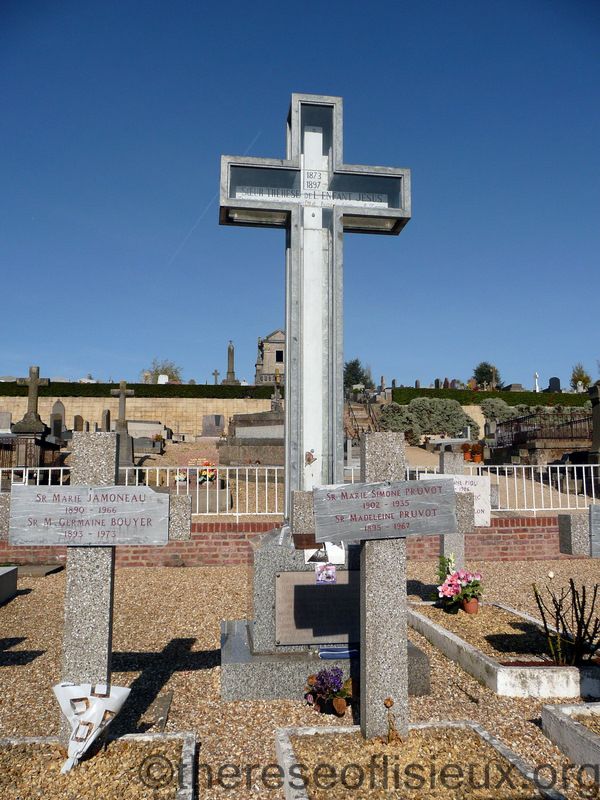 A contemporary photo of the first tomb of St. Therese in the Lisieux cemetery
This article tells you:
- how Therese laughingly rehearsed her own funeral
- why, when she was laid out, her body was dressed in an old, worn-out cap
- how Leonie arranged for the habit, cape, veils, and sandals Therese had worn to be saved
- who deliberately burned another pair of Therese's sandals
- where you can see Therese's obituary in her local newspaper and the invitations to her funeral sent by the Carmelites and separately by her family
I published this article on my Facebook page for St. Therese because there the link displays the first photo of St. Therese in death. If you are not a Facebook member, you will still be able to see it. Facebook may greet you with an invitation to join. To decline that invitation, just click "not now." To see the article, please click on this text link: "What happened immediately after the death of St. Therese of Lisieux?" Thank you.
Maureen O'Riordan
in St. Therese of Lisieux, funeral of St. Therese of Lisieux, obituary of St. Therese of Lisieux
|
Post a Comment
| Email
| Print