Saint Therese of the Child Jesus
of the Holy Face
Entries by Maureen O'Riordan (558)
"Saint Therese of Lisieux, Doctor of the Church," an online article by Michael Novak
Thérèse really is a doctor of the Church. She really does teach, and no writer of theology you have ever read will carry you so unerringly to the living heart of the gospels, so limpidly and beautifully put. . . . Thérèse anticipated the Second Vatican Council and the great pontificate of John Paul II by nearly 100 years, through the love that poured through her as a vessel of light and grace for the scores of millions who repair to her teaching. It is the teaching of the gospels for those who come to them to learn as little children, even though they are much burdened adults, in need of mercy and the love of God.
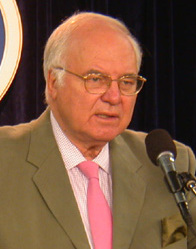
Michael Novak (1933-2017). Photo credit: Wikipedia
In his short article "St. Therese of Lisieux, a Doctor of the Church," (first published in Crisis magazine in 1997), author Michael Novak, who died in February 2017, shares his personal story of the power of Therese's writing and mentions many 20th century figures who were deeply moved by her. Do you agree with his conclusion?

Note about the book Therese and Lisieux:
Michael Novak enthusiastically praises the book Therese and Lisieux, by Pierre Descouvemont and Helmut-Nils Loose (Eerdmans, 1996), with 600 photos of Therese and her milieu. He writes:
Physically and intellectually, it is a beautiful book . . . . it will make an unforgettable gift. It is the sort of book that will change lives. You will not come from it seeing the world the same way. It will open up new worlds of humble possibility to you, and bring you great joy, as it has done for me.
Although it is unfortunately out of print, the good news is that you can now buy a used copy online for considerably less than the original price. Just in case it is never re-issued, order one before available copies become scarce and expensive. To support this one-woman Web site, purchase it through the link below. Thank you.
 Maureen O'Riordan
in Doctor of the Church, Michael Novak, St Therese as Doctor of the Church
|
Maureen O'Riordan
in Doctor of the Church, Michael Novak, St Therese as Doctor of the Church
|
 Post a Comment
|
Post a Comment
|  Email
|
Email
|  Print
Print
"Therese Today" - Bishop Guy Gaucher, O.C.D May 11, 2017
Therese, Doctor of Hope
Monseigneur Guy Gaucher, O.C.D. Photo courtesy of the Discalced Carmelite Friars of Paris
In 1996, before the Vatican announced that Therese was to be made a doctor of the Church, Bishop Guy Gaucher, her great scholar and friend, wrote the short article “Therese Today,” highlighting how she speaks to the world today and prophesying that God would one day allow the Church to recognize her vocation as a Doctor:
Therese's word and prayer frees wounded people, unchains drug-addicted or despairing youth, and constantly raises up priestly, religious, and lay vocations. She goes in search of distant people, insinuates herself into the most unlikely situations, plays an ecumenical role, attracts Muslims, and touches even strangers to the faith, sometimes through a simple look at her real face that photography has made available to us.
With thanks to the Internet Archive, please read Therese Today, a short but important element in establishing the context for our anniversary meditation this year on Therese as a Doctor of Hope.
Maureen O'Riordan
in Guy Gaucher, Therese Doctor of Hope, Therese Today, Therese doctor of the church, events related to St. Therese of Lisieux
|
Post a Comment
| Email
| Print
A new series to celebrate the 20th anniversary of St. Therese's proclamation as a Doctor of the Church on October 19, 1997
Since St. Therese was proclaimed a Doctor of the Church on October 19, 1997, the 20th anniversary falls on October 19, 2017. But the time is not too long to explore a topic so rich. For some weeks I've been musing on how to contribute to the celebration of her first 20 years as a Doctor.
The Holy Spirit seemed to suggest that the celebration could move in two directions, interior and exterior. That is, we can celebrate and honor Therese as a teacher in at least two ways.
- One, attending to our own interior formation: inviting Therese as doctor (both as teacher and as healer) to influence us as individuals and in common, so that her ministry of teaching and miracles may continue to transform not only individuals, families, and communities but also nations, the whole Church, and the whole world. This might draw us to reflecting, meditating, and praying, alone and together, on texts and resources related to Therese's doctorate and to what she teaches us.
- How is that teaching growing and evolving? Therese was considered the greatest saint of modern times and the perfect antidote to Jansenism, excessive fear of God and anxiety over imaginary sins. Now that we are in the post-modern era, when Jansenism is no longer so widespread, we need to bring our contemporary life experience to the text of Therese to draw out how she speaks to new generations, some of whom have grown up in a largely secular environment, and to our personal struggles and societal issues in the present. It is by coming defenseless to the text—prepared to allow the real God and the real Therese to encounter the real me—that I can hope to deepen my knowledge and experience of Therese. We must never dismiss her as a treasure we've already exhausted (let alone treat her as a kind of heavenly cashier who places our orders with God), but always be willing to let her surprise us.
- Second, celebrating the doctorate might call us to a thrust in the other direction. How can we make the Doctor of Merciful Love known, understood, and loved so that she is in a position to help as many souls as possible? To be fruitful, this mission must always be rooted in nourishing our interior life. In practical terms, this could mean moving from enjoying the resources that have formed our knowledge and experience of Therese (and of the Merciful Love of God flowing through her) to exploring how to invite other people to encounter her life and spirituality:
- promoting (both online and in person) various resources, books, and films
- sponsoring webinars, retreats, and programs in parishes and in our local communities;
- incorporating learning about St. Therese into existing programs and curricula;
- circulating Therese's memoir, Story of a Soul and other valuable works
To support the movement to interior formation and to proclaiming the gospel through making Therese known, I propose to present, from now at least through October 2017, a variety of resources:
- articles about Therese’s doctorate to furnish some text and history
- brief excerpts from the papal remarks about Therese as a doctor;
- resources to help us share Therese
- brief texts from Therese that highlight what she has to teach us
- icons, books, films, and other resources
Many of these resources are already on “Saint Therese of Lisieux: A Gateway,” but I hope that presenting them in bite-size chunks during the anniversary year will make it easy for you to enjoy them yourselves and use them for others. For the moment, I hope to post items in this series two or three times a week. They will be distinguished from other articles by a smaller version of the graphic you see above, for which I thank Deb Thurston, and by a focus on Therese as teacher. I expect to offer a smorgasbord of options, so that you can take what appeals to you and leave the rest.
The late Patrick Ahern, auxiliary bishop of New York, was tireless in promoting St. Therese as a prospective Doctor of the Church. Exactly how much he contributed to the process remains unknown. To honor his inexhaustible affection and advocacy for Therese, I open the series with his 1997 article "Therese, a Doctor of the Church," with thanks to the Internet Archive. Enjoy!
Maureen O'Riordan
in 20th anniversary of St. Therese as a Doctor of the Church, Bishop Patrick Ahern, St. Therese Doctor of the Church, resources for St. Therese
|
Post a Comment
| Email
| Print
St. Therese's images of Mary - the statue of Mary before which she recited the Act of Consecration on her First Communion Day, May 8, 1884
 The altar and the statue of Our Lady before which St. Therese, in the name of her companions, recited the Act of Consecration to the Blessed Virgin at the Benedictine Abbey of Notre Dame du Pre in Lisieux, May 8, 1884. Photo credit: The Far East Magazine
I put all my heart into speaking to her, into consecrating myself to her as a child throwing itself into the arms of its mother, asking her to watch over her.
St. Therese's Images of Mary - "Our Lady of Victories" - May 7, 2017
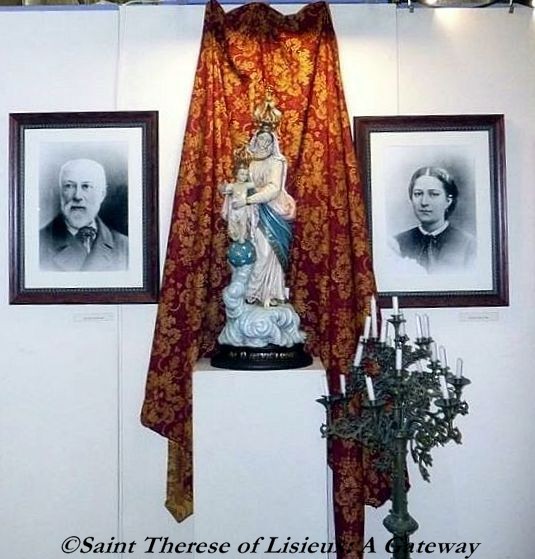 The statue of Our Lady of Victories flanked by the portraits of Saints Louis and Zelie Martin. St. Jacques Church, Lisieux, 2008Therese would have known this statue of "Our Lady of Victories" from her early childhood. Devotion to Mary under the title "Our Lady of Victories" was widespread in France at that time. Although the feast has since been renamed "Our Lady of the Rosary," churches dedicated to "Our Lady of Victories" still exist.

The Church of Notre-Dame des Victoires (Our Lady of Victories) in Paris. By Guilhem Vellut from Amsterdam, Netherlands (Church of Notre-Dame-des-Victoires @ Paris) [CC BY 2.0 (http://creativecommons.org/licenses/by/2.0)], via Wikimedia Commons
The Church of Our Lady of Victories in Paris
In Therese's time the Church of Notre-Dame des Victoires in Paris was already well known as a Marian shrine.
The miracle of 1846
In 1846 Father Charles Desgenettes was pastor. Because the church was located in a business area, he had very few parishioners, and he believed that he had failed in his ministry there. He was on the point of resigning his charge when, on December 3, 1846, during and after Mass, he heard an interior voice say "Consecrate your parish to the holy and immaculate Heart of Mary." With the Archbishop's permission, he consecrated the church to the Immaculate Heart of Mary on the evening of Sunday, December 11, 1846. That morning, fewer than 40 people had been at Mass, but the evening service was attended by more than 500 people. Since then thousands of pilgrims have flocked to the church to give thanks for graces they received through the intercession of Mary.
The church is considered to be dedicated to the Immaculate Heart of Mary, Refuge of Sinners, and the Archconfraternity of the Immaculate Heart Father Desgenettes founded prays especially for the conversion of sinners. Grateful pilgrims have left more than 37,000 votive offerings in thanksgiving. In 1927 the church was elevated to the rank of a minor basilica.
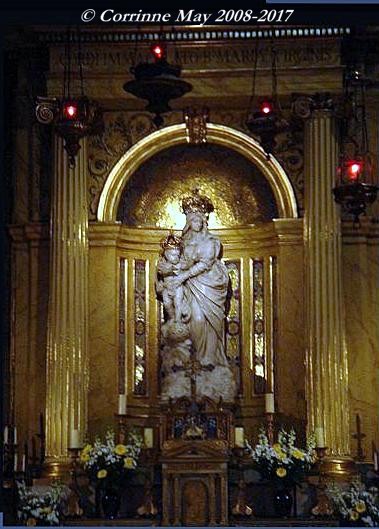 The statue of Our Lady of Victories, in the church of that name in Paris, before which St. Therese was praying when she received a special grace in November 1887. Photo courtesy of Corrinne May (www.corrinnemay.com)
Our Lady of Victories and the Martin family
Sts. Louis and Zelie Martin both loved Our Lady of Victories. When Zelie's brother lived near the church while he studied in Paris, she urged him to go in once a day and say a Hail Mary, promising that the Blessed Virgin would protect him in a particular way. When Louis was in Paris on business, he wrote to Zelie: "I just lit a candle in Our Lady of Victories, which is a little heaven on earth." In 1883, when Therese was seriously ill, Louis gave some money to her older sister, Marie, and asked Marie to write to Notre-Dame des Victoires and ask to have a novena of Masses offered for Therese's cure. Her miraculous cure in response to the prayers she and her sisters offered before their own statue of Mary took place during the novena. In November 1887, when Louis was escorting Celine and Therese on the pilgrimage to Rome, he took them to Paris a few days early and chose a hotel near Notre-Dame des Victoires. A little later in this series we will return to the grace St. Therese received whle praying to Mary there.
Walk in the steps of the Martin family in Paris
Our Lady of Victories is a popular pilgrimage site today. Together with the priests, the Benedictines of Montmartre are responsible for the Church. Daily they pray the divine office, participate in the Masses, lead the rosary, and share, with the pilgrims, in the Eucharistic adoration. For information, visit the English Web site of the Basilica of Our Lady of Victories in Paris at http://www.notredamedesvictoires.com/?lang=en. [Note of 5/17/2022: I'm sorry this link no longer works. To my great regret, the Basilica of Our Lady of Victories has removed their beautifully executed English page].
Maureen O'Riordan
in Louis and Zelie Martin, Notre Dame des Victoires, Our Lady of Victories, events in the life of St. Therese of Lisieux
|
Post a Comment
| Email
| Print