Saint Therese of the Child Jesus
of the Holy Face
Entries by Maureen O'Riordan (558)
St. Therese's Images of Mary - A New Series. For May 6, 2017: "The Virgin of the Smile"
A new series for May 2017:
the images of the Blessed Virgin Mary
St. Therese of Lisieux knew
For May 2017, I am introducing a series to present many of the images of Mary which St. Therese saw at different times in her life. Some will appear in this blog. Others I can present only as links on Facebook, so, to see them all, please use the button at left to "like" the Facebook page "Saint Therese of Lisieux: A Gateway." The images will appear in roughly chronological order, and I hope that seeing them will help you to feel closer to Therese and also to enter into her tender and filial affection for Mary.
The Martin family's treasured statue, "Our Lady of the Smile"
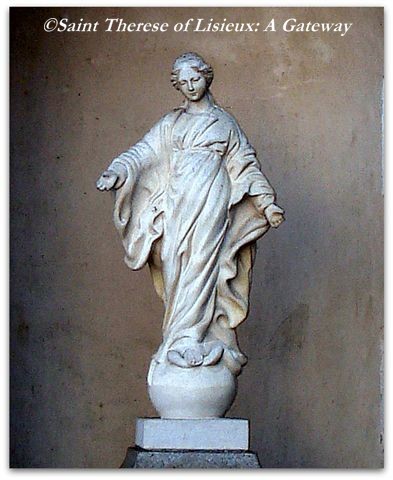 The statue of "Our Lady of the Smile" cherished by Saints Louis and Zelie Martin and their children
The history of the statue
The great French sculptor Edme Bouchardon (1698-1762) created the original of this statue for the Church of Saint-Sulpice in Paris. During the French Revoution it disappeared. Later it was replaced by a similar statue. The statue that came into the possession of St. Louis Martin was modeled after that second statue in Paris. The statue in St. Sulpice is also linked to the image of Mary that was reproduced on the Miraculous Medal.

Replica of the statue of Our Lady given to St. Louis Martin before his marriage by Mlle. Felicite Beaudoin, a saintly elderly woman who invested in his watch-shop. He put it here in the garden of his Pavilion, a small property on the outskirts of Alencon where he prayed, meditated, and kept his fishing tackle.
The gift of Mlle. Fellicite Beaudoin
Mlle. Felicite Beaudoin, a devout elderly woman who set Louis Martin up in business, gave him this statue. In 1857 he bought the Pavilion, a one-room, three-story tower surrounded by a walled garden on the outskirts of Alencon. Here he read, prayed and meditated, and kept his fishing tackle to use in the nearby River Sarthe, and he placed the statue here.
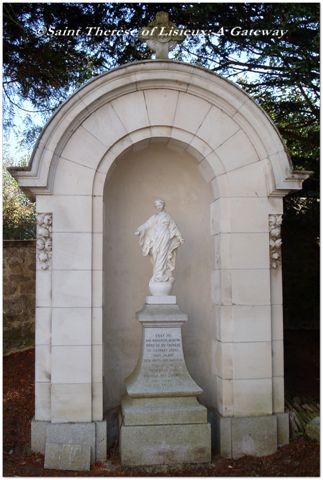 Replica of the Martin family's statue "The Virgin of the Smile" in its original location in the Pavilion in Alencon
The statue in the domestic church of the Martin family
In 1858, Louis married, and his wife, Zelie, who was passionately devoted to the Blessed Virgin, asked him to set the statue up in their home on the Rue Pont-Neuf. He did so, and every evening the Martin family said their evening prayers before it. At the end of prayers, the girls were allowed to kiss the statue's hands. They carried out this little ceremony so fervently that Louis and Zelie had to keep a few extra pairs of hands for the statue around the house.
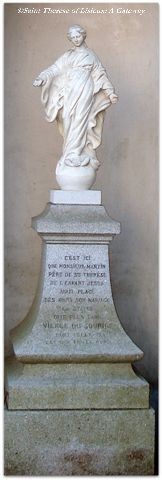 Close-up of St. Louis Martin's statue, later called "Our Lady of the Smile"
"The Blessed Virgin doesn't leave her place"
While she was praying before this statue, Zelie received special graces from Mary. One day, her oldest daughter, Marie, thinking that this statue was too much like a school statue, asked her mother to replace it with a smaller and finer statue. Zelie answered, "When I am dead, you can do as you like, but, while I'm here, the Blessed Virgin doesn't leave her place." Marie said that her mother's May altar was more trouble to make than the one at the church.
'Our Lady of the Smile' in Lisieux
After Zelie's death, when the Martins moved to Lisieux, they took the statue with them, and it occupied a place of honor in their new home, Les Buissonnets. It was only after Therese was cured of a serious illness while she and her sisters were praying before this statue in 1883 that it became known as "the Virgin of the Smile." We will encounter it again in Therese's story.
"Our Lady of the Smile" in the Pavilion at Alencon today
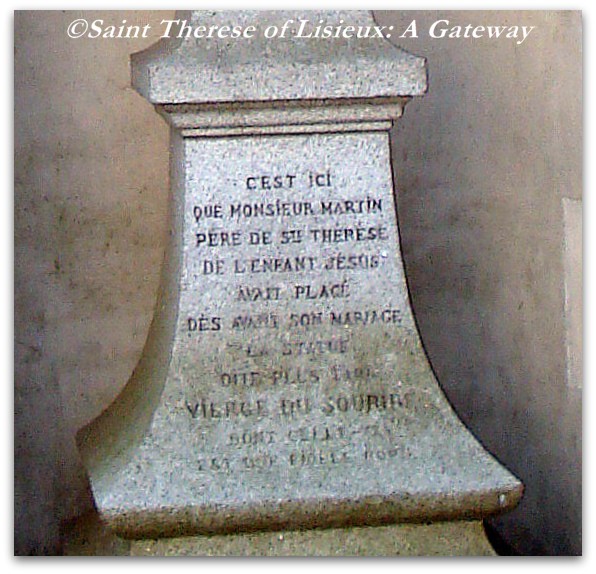 A plaque that reads "It was here that Monsieur Martin, the father of Saint Therese of the Child Jesus, before his marriage had placed the statue later called 'Our Lady of the Smile,' of which this one is a faithful replica."
The actual statue cherished by the Martin family stands today above St. Therese's shrine in the Lisieux Carmel. This replica has been placed in the garden of the Pavilion at Alencon to mark the spot where St. Louis put the statue when Mlle. Beaudoin gave it to him.
At the time of Louis and Zelie's beatification in 2015, the Pavilion came into the possession of the Church, and pilgrims may now visit it. Louis brought his little girls here on outings, and they used to garden here, too. This is only one of the joys that await pilgrims to Alencon, where the roots of the Martin family are.
 Maureen O'Riordan
in Alencon, Edme Bouchardon, Louis and Zelie Martin, St. Therese of Lisieux, pavilion, statue of Our Lady of the Smile
|
Maureen O'Riordan
in Alencon, Edme Bouchardon, Louis and Zelie Martin, St. Therese of Lisieux, pavilion, statue of Our Lady of the Smile
|
 Post a Comment
|
Post a Comment
|  Email
|
Email
|  Print
Print
Anniversary of the beatification of Sister Therese of the Child Jesus (April 29, 1923) - A contemporary newspaper article about the beatification from the Australian newspaper "Southern Cross"
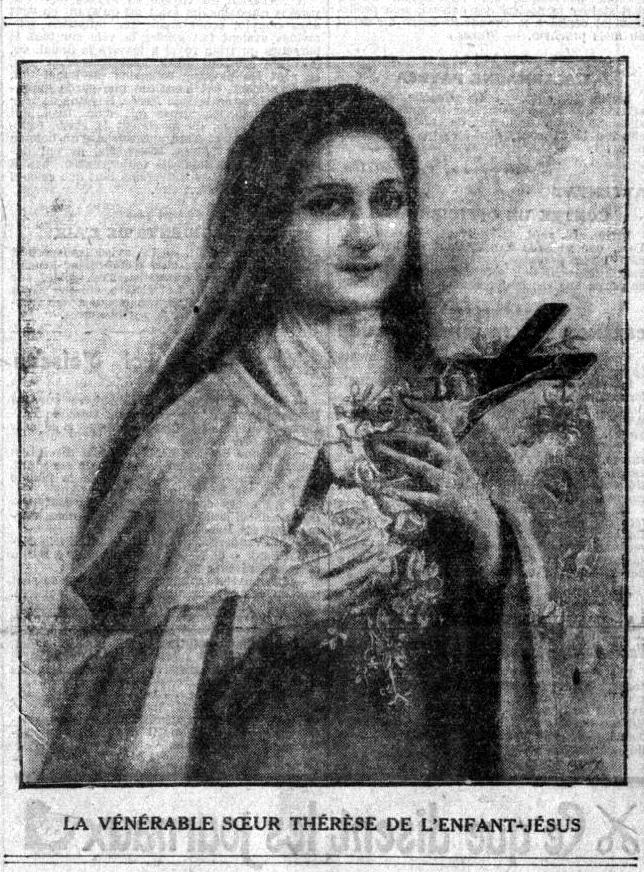
from the Southern Cross (Adelaide, SA : 1889 - 1954), Friday 22 June 1923, page 5
BEATIFICATION OF SOEUR THERESE.
GREAT CEREMONY IN ROME.
(Special from Catholic News Service).
ROME, May 5.—More than 25,000 persons are estimated to have been present at the ceremonies in St. Peter's when the Beatification of Sister Teresa of the Holy Child Jesus (known as the Little Flower) was solemnly proclaimed in the presence of the Cardinals. In this vast crowd were numerous French pilgrims, members of the French episcopate and in the tribune the French Ambassador to the Vatican with the members of his suite.
Cardinal Vico, Prefect of the Sacred Congregation of Rites, presided at the first ceremony, held in the morning. In the canons' stalls in the choir were the members of the Chapter of St. Peter's, with Archpriest Cardinal Merry del Val at their head. It was a ceremony both splendid and brilliant. After the Postulator of the Cause had asked for and received the canonical permission the Canon Archivist of the Vatican Chapter read out the Brief of Pius XI, whereby the Venerable Teresa of Lisieux became Blessed Teresa. As the reading of the document was ended, the relics of the new Beata were uncovered, and the great pictures unrolled. Then the bells clanged out with a mighty peal and the Bishop of Bayeux intoned the Te Deum, during the singing of which he incensed the relics and images of the new Beata.
During the afternoon the second ceremony took place, at which the Holy Father was present in person. Wearing the camail and red stole over his white cassock, and accompanied by the whole of the Pontifical Court, his Holiness entered by way of the Chapel of the Pieta, where he was waited upon by the assembled Cardinals. A flourish on the silver trumpets announced the entry of the Pontiff, who assisted at Benediction of the Blessed Sacrament, and afterwards accepted the special offerings which are customary on such an occasion. The offerings to the Pope were a picture of Blessed Teresa, a handsomely bound life illuminated on parchment, and a very fine gilt reliquary of the 17th century, enclosing a portion of the relics. The acceptance of the offerings ended the Papal ceremony, and the Pope left the basilica, passing on the sedia gestatoria through a double line of the Palatine Guards, who were on duty in gala uniform. As on his entry, the silver trumpets playing Silveri's triumphal march signalised the Pope's departure from St. Peter's, where the crowd lingered on in devotion.
The ceremony was inspiring, though it very naturally lacked the plenitude of a Canonisation—the scenes witnessed at St. Joan of Arc are unforgettable, and all unwillingly invite a comparison. But this Beatification has been a great joy to France, and nothing could have been more moving than the rapt attention and devotion on the faces of the French pilgrims as they assisted whilst Little Teresa of Lisieux was exalted in the Church's hierarchy of the Saints.
Maureen O'Riordan
in beatification of St. Therese of Lisieux
|
Post a Comment
| Email
| Print
April 28: the birthday of Therese's sister, Celine Martin, later Sister Genevieve of the Holy Face

Celine Martin as a young girl
April 28 is the birthday of Celine Martin, St. Therese's sister. Celine, the eighth child of St. Louis and St. Zelie Martin, was born on April 28, 1869 in the house at rue Pont-Neuf in Alencon where all the Martin children except Therese were born. She was baptized on September 5, 1869 at St. Pierre de Monsort, which was the Martin family's parish church in Alencon until they moved to rue St. Blaise in 1871. She was three years and eight months old when, on January 2, 1873, her baby sister, Therese, was born.
Celine and Therese were remarkably intimate; Therese called Celine "the sweet echo of my soul." They were separated for six years, from 1888, when Therese entered the Carmelite monastery, until 1894, when Celine herself entered. A hundred years ago, on April 26, 1892, Therese sent to Celine, for her 23rd birthday, a double daisy (one stem with two flowers) with an important letter explaining the double daisy as a symbol of their two souls knit into one. (from the Web site of the Archives of the Carmel of Lisieux).
When Celine was in Lisieux, she saw her Carmelite sisters in the speakroom every week. In a week in which they had visited, the Carmelites were not usually allowed to write to her, so many of their letters date from times Celine was on vacation or otherwise away. But, when her birthday approached, Celine used to abstain from visiting that week in order to be able to receive a letter from her sisters. Fortunate for us!
125 Years Ago with Saint Therese: the wedding of Henry Maudelonde, Celine's second suitor, in April 1892
Let’s look at the life of Therese and her family 125 years ago, in April 1892.
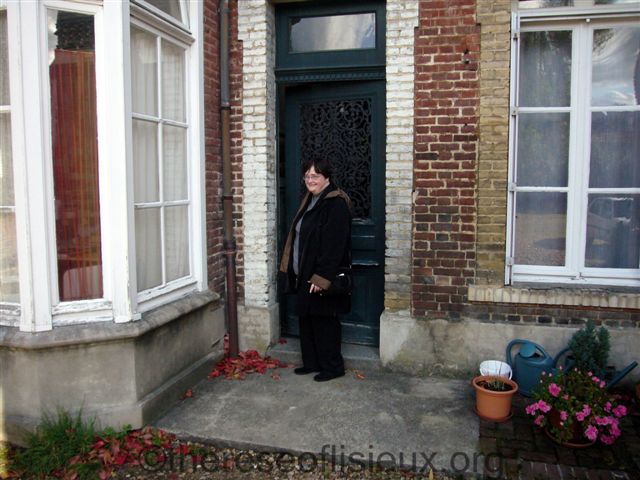 Isidore Guerin's house in Lisieux (rear entrance)
Life in the Lisieux Carmel in early 1892
From the first few months of 1892, few documents have been published. The ranks of the Carmelite monastery had been depleted. On December 5, 1891, Mother Genevieve of St. Teresa,1 the revered foundress, had died. On December 26 the epidemic of influenza that swept over France reached the Carmel. In eight days the three eldest nuns died: the Lisieux Carmel’s first postulant, Sister St. Joseph of Jesus (ACL); the subprioress, Sister Febronie of the Holy Childhood (ACL), who found Therese’s belief that souls who trusted in God’s mercy would not go to purgatory excessively bold; and Sister Madeleine of the Blessed Sacrament (ACL), the senior lay-sister, who had “a heart of gold.” In this crisis, in which all but three of the nuns were bedridden, Therese, who turned 19 on January 2, 1892, showed such presence of mind in arranging the funerals, serving as sacristan for the Masses, and discharging other responsibilities that Canon Delatroette (ACL), the priest appointed ecclesiastical superior of the Carmel, who had thought her too young to enter at age fifteen, changed his mind and said prophetically “She shows great promise for this community.”
Early in the year Father Pierre Faucon (ACL) completed his term as extraordinary confessor (the priest who, under canon law, visited the Carmel occasionally to give the nuns some variety and freedom in choosing a confessor other than their chaplain). He was replaced by Father Eugene-Auguste Baillon (ACL).
The community's triennial elections should have been held in February, but, in view of the circumstances, the Carmelites obtained permission to extend the term of Mother Marie de Gonzague as prioress until February 1893.
The correspondence of the Martin-Guerin family shows that Isidore Guerin had decided that Louis Martin could now return to his family (ACL) from the Bon Sauveur asylum in Caen, where he had been interned since February 12, 1889. He would be brought back to Lisieux on May 10, 1892.
Before that, a big social event happened in the circle of the family of Therese’s uncle and aunt, Isidore and Celine Guerin (ACL): the wedding of Celine’s nephew, Henry Maudelonde (ACL), a former suitor of Therese’s sister Celine.
The life of Leonie and Celine Martin with the Guerin family, beginning in 1889
Therese’s uncle, Isidore Guerin, had married Celine Fournet (ACL), a daughter of the town’s leading family. Her sister Rosalie (ACL) had married Cesar Maudelonde (ACL), with whom she had five children. The Guerin and Maudelonde families were intimate, so that Therese and her sisters grew up as friends of the Maudelonde girls, too. No photo of Henry has been found yet, but the Web site of the archives of the Carmel of Lisieux shows a photograph of the three Maudelonde daughters (ACL) with their mother and members of the Guerin family in 1893.
With the death of Celine Guerin’s cousin, M. David, in 1888, Isidore (through the property laws then in effect, which awarded a married woman’s inheritance to her husband) received a substantial fortune from his wife’s family. This changed his way of life. He sold the pharmacy (ACL), moved from the living quarters over the pharmacy to a bigger house in Lisieux (ACL), and every summer, in a kind of time-share, split with the Maudelondes the use of the Chateau La Musse (ACL), near Evreux. (He had inherited the chateau jointly with them). He gave even more energy to charitable and religious work and to writing to defend the Church.
Isidore’s new position gave him more leisure and placed more social demands on his family. Leonie and Celine Martin became members of his family in May 1889, when they returned from Caen, where they had boarded for a few months at the beginning of Louis’s hospitalization at the Bon Sauveur asylum there. Their uncle’s social position and his intimacy with the Maudelonde family obliged both young women to participate in the rather formal and structured social life then the custom for families like the Guerins. This was in marked contrast to the sheltered life they had led at the little villa of Les Buissonnets, located some way from the center of town, where they had seen few people socially except the Guerins
Henry Maudelonde's courtship of Celine Martin (1890-1891)
In Celine’s memoirs (ACL) at p. 96, she notes that the Maudelonde young people were of an age to be married.
“I arrived in the midst of this group of joyful and charming young people. It was a veritable change from life at Les Buissonnets . . . One of the nieces of my aunt was engaged and there was an exchange of dinners between the two families. . . . We found ourselves, therefore, often in the company of the nephews of my aunt. One of them . . . . developed an affectionate regard for me. Whether at his house, or at our house, he always managed to be close to me. Since he strongly protested when he was not so placed, one finished up finally relenting and placing him next to me at the dinner table so as to avoid making a scene.”
Henry Maudelonde (1864-1937), five years Celine’s senior, was a lawyer at Caen. His pursuit of Celine seems to have dated chiefly from 1890 and the first half of 1891. At the wedding of Celine’s cousin, Jeanne Guerin (ACL), on October 1, 1890, Celine was a maid of honor. Henry spent all day next to her and finally asked her aunt for permission to kiss her. Then, on July 23, 1891, Therese wrote to Celine in terms that suggest that Henry had just made a definite proposal of marriage: “The solicitor [pun on his profession] really made me laugh. One must admit that he is not shy to come seeking the King of heaven’s fiancee.” Letters of Saint Therese of Lisieux, Volume II, tr. John Clarke, OCD (Washington, D.C.: ICS Publications, 1988), LT 130, p. 792. Therese never doubted that Celine was called to Carmel, and she firmly resisted the idea of marriage for Celine. Celine, who had already refused a proposal on the night of Therese’s entrance, was attracted by the idea of marriage as well as by the cloister, and this posed a severe internal conflict for her.
But in 1889 she had made a private vow of chastity, and Henry finally must have accepted her refusal, for he became engaged to Marie Asseline.
Henry Maudelonde's wedding in Caen, April 20, 1892
Leonie received a letter from her cousin Jeanne Guerin La Neele (ACL) (who now lived in Caen with her husband), written April 11, describing the elaborate preparations for this wedding on April 20.
Celine is suddenly, mysteriously unable to dance
Henry Maudelonde’s wedding was the occasion at which Celine was unable to dance. Tberese recounts in Story of a Soul (ACL) how agitated she was at the thought of Celine’s consenting to dance at this party. Celine’s memoir (ACL) shows (at pages 96-97) that Therese was vehement in urging her not to dance. Perhaps Therese considered that a young unmarried woman’s consenting to dance was tantamount to announcing that she was on the marriage market, or perhaps she could not stand the thought of a young man's touching her sister. Therese, who seldom cried, was so upset that she wept for a long time at the mere prospect of Celine’s dancing, and begged God to prevent it. Her reaction to a formal dance in public at a wedding that united two respectable families seems rather hysterical. But, sure enough, when the evening came, Celine could not refuse the invitation, but found herself unable to dance and merely walked through the dance. Her partner was embarrassed; he disappeared and did not return. Therese said the incident “made me grow in confidence and love for the One who set his seal on my forehead and had imprinted it at the same time upon that of my dear Celine.” (Story of a Soul, 82r).
What happened to Celine's second suitor?
Marie and Henry Maudelonde had two children together, but Henry was left a widower in 1895. He married again in 1899 and had three more children: an interesting contrast with Celine’s first suitor, Albert Quesnel, who, after Celine refused him, became a priest. Celine was the only one of the Martin girls to whom anyone is known to have proposed marriage.
[Note: I am especially grateful to the Lisieux Carmel for digitizing its archives. I encourage you to visit the Web site of the Archives of the Carmel of Lisieux, which tells us so much about the background of Therese's life].
This is an interactive article. To see photographs and background for the persons and events I mention, please click on the links in this article.
1 This link leads to the Web site of the Archives of the Carmel of Lisieux. In this article, all links to that site are indicated by the notation "ACL" next to the text link.
Learn more:
To learn more about this period in Therese's life, please see the links above and these books:
Therese's own recollections, at folios 78r-82r
Are you interested in learning more about Therese than she tells in Story of a Soul? I highly recommend Guy Gaucher's indispensable complement to Story of a Soul:
and Therese's letters and those of her family, with rich introductions and notes:
Finally, a biography of Celine by Stephane-Joseph Piat:
Purchases through these links support the Web site. Thank you.
Maureen O'Riordan
in Celine Martin, Henry Maudelonde, Marie Asseline, events in the life of St. Therese of Lisieux, suitor
|
Post a Comment
| Email
| Print
Three-minute video of the entrance to the Carmelite Monastery of Lisieux - Therese entered April 9, 1888
Thanks to the Carmelites of Lisieux, in this video you can see the monastery Therese entered, the garden, the cloister (with the same Cross, but not the same corpus, in the courtyard), and the door to the enclosure, located in the sacristy, which opened to receive Therese on the morning of April 9, 1888. Cross the threshold with her and ask her to beg God for the graces you need in the transitions of your own life.
Entrée du monastère from Carmel de Lisieux on Vimeo.
Maureen O'Riordan
in April 9 1888, Therese enters Carmel, video of Therese's entrance to Lisieux Carmel
|
Post a Comment
| Email
| Print