Saint Therese of the Child Jesus
of the Holy Face
Entries by Maureen O'Riordan (558)
Celebrate the feast of Our Lady of Mount Carmel with St. Therese of Lisieux
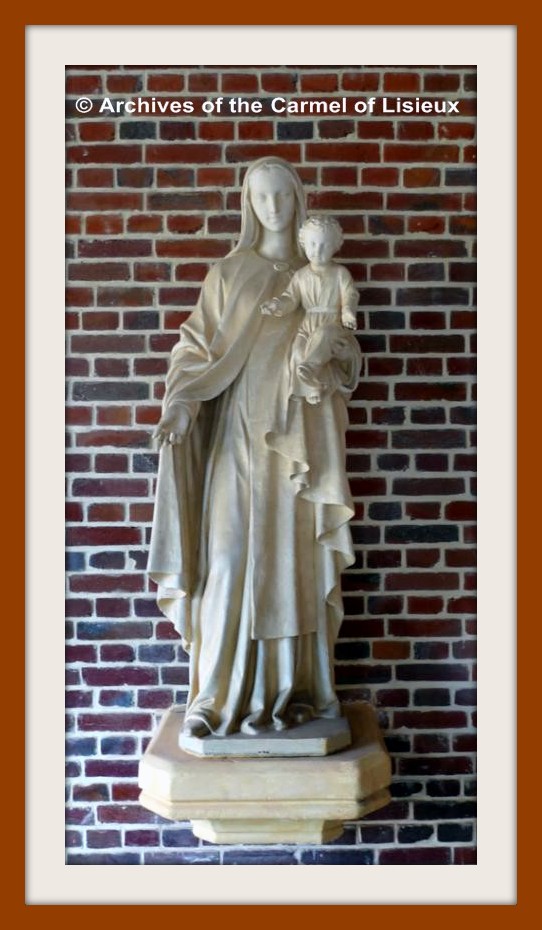
Thanks to the generosity of the Archives of the Lisieux Carmel, we celebrate the feast of Our Lady of Mount Carmel by posting this photograph of the statue of Our Lady of Mount Carmel which, in the time of St. Therese, stood at the entrance to the "heated room" (the room used for recreation).
July 16 was also the birthday of Therese's companion in the novitiate, Sister Martha of Jesus.
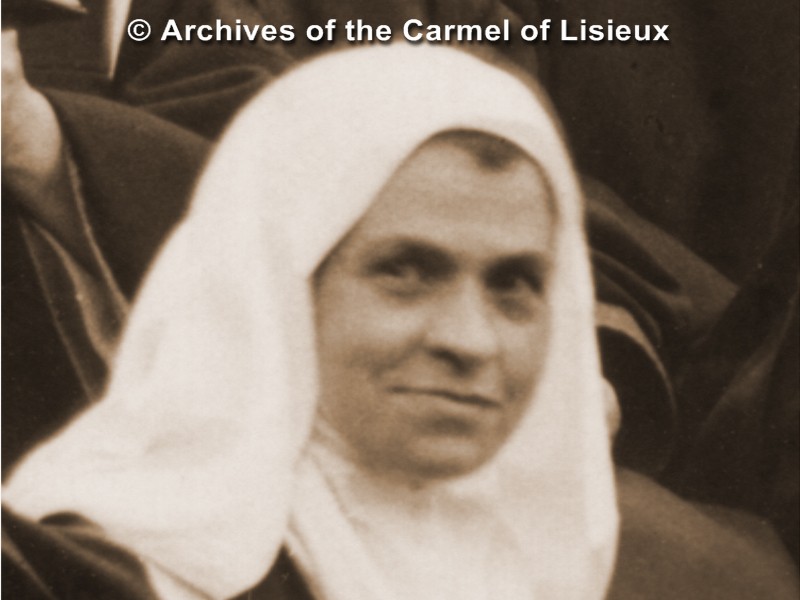 Sister Martha of Jesus
On July 16, 1894, for Sister Martha's twenty-ninth birthday, Therese wrote for her the poem "Song of Gratitude to Our Lady of Mount Carmel." The third stanza:
Close to you, O my loving Mother!
I've found rest for my heart;
I want nothing more on earth.
Jesus alone is all my happiness.
If sometimes I feel sadness
And fear coming to assail me,
Always, supporting me in my weakness,
Mother, you deign to bless me.
(The Poetry of Saint Therese of Lisieux, tr. Donald Kinney, O.C.D. Washington, D.C.: ICS Publications, 1996, p. 57).
 Maureen O'Riordan
in Our Lady of Mount Carmel
|
Maureen O'Riordan
in Our Lady of Mount Carmel
|
 Post a Comment
|
Post a Comment
|  Email
|
Email
|  Print
Print
Eightieth Anniversary of the blessing of the Basilica in Lisieux, by Cardinal Pacelli, July 11, 1937: Seven Things You May Not Know About That Day
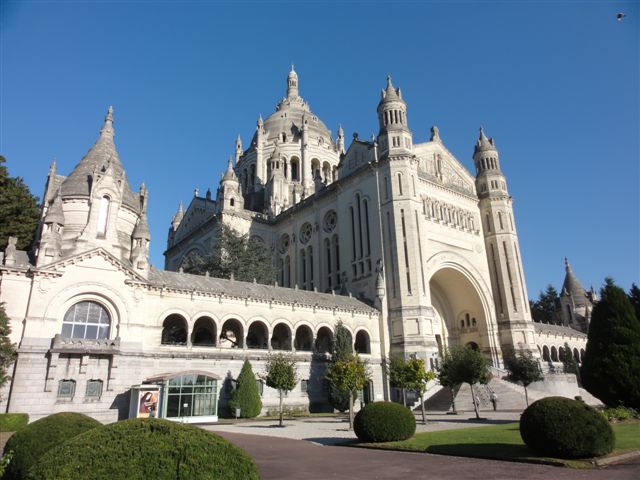
Basilica of St. Therese, Lisieux. Photo credit: Dee Cursi
Tuesday, July 11, 2017 is the 80th anniversary of the blessing of the basilica of St. Therese at Lisieux by Eugenio Cardinal Pacelli, the future Pope Pius XII, on July 11, 1937. At Lisieux today the anniversary is being commemorated with a special program.
1. The personal devotion of Pope Pius XI to St. Therese
In 1937, Pope Pius XI had been gravely ill for some time. For many years he had had an intense personal devotion to St. Therese, whom he called “the star of my pontificate.” When he fell sick, he prayed to St. Therese, and he believed that the improvement in his health which extended his life until 1939 was due to her intercession. He publicly thanked the saint “who has so effectively and so obviously come to the aid of the Supreme Pontiff and still seems willing to help him: Saint Teresa of Lisieux.”1 To show his gratitude to St. Therese, Pope Pius had intended to come to Lisieux himself to address the Eucharistic Congress and to bless the basilica, but, as his health and his workload did not allow it, he missioned his Cardinal Secretary of State, Eugenio Cardinal Pacelli, who, as Pope Pius XII, would succeed him, to travel to Lisieux to speak to the Congress and to bless the basilica. [This was not the basilica’s actual consecration, for in 1937 only the crypt was completed. The cornerstone had been laid in 1929. World War II delayed the construction, and the basilica was not finally consecrated until 1954]. This basilica was close to the heart of Pope Pius XI; he had expresed the desire that it be “big, beautiful, and built as quickly as possible.”
2. Cardinal Pacelli Blesses the Basilica and Speaks to the Eucharistic Congress, Denouncing Nazi Racism
The Eucharistic Congress at Lisieux that summer was of worldwide importance, and Cardinal Pacelli’s visit was very big news spiritually, ecclesiastically, and politically. Please read a contemporary account in the Montreal Gazette. The “Papal Legate” was greeted by a quarter of a million people, including five cardinals, 80 archbishops and bishops, and 1,200 priests. On Sunday morning, July 11, he blessed the basilica, sprinkling the foundations with holy water and blessing the interior walls. See this two-minute video of the blessing and the Eucharistic procession.
After the blessing, the Cardinal Legate stood on the esplanade outside the basilica and addressed the immense crowd for 90 minutes. Read much of the text of Cardinal Pacelli’s address in The Tablet. (This text has since been restricted only to subscribers).
His remarks included a clear condemnation of the actions of the fascist and communist governments which increasingly dominated Europe:
"Rise, basilicas of France, aged ancestors of the Middle Ages, and younger sisters of yesterday ! Rise aloft to greet a new-born sister, the Basilica of St. Teresa of the Child Jesus, the House of God among His own. Here . . . it is the Word that speaks, Truth and Justice, in the threefold law and duty to God, to one's neighbour and to oneself, with a serene, yet clear condemnation of all unjust violence and all criminal cowardice.
At the foot of this pulpit and at the door of this church St. Ambrose stopped Theodore and forced him to his knees in the presence of a crowd, dumbfounded with wonder. From this pulpit, in all the churches of a mighty and noble nation, whom evil pastors would mislead into the idolatry of race, the indignant protest of an eighty-year-old Pontiff suddenly thundered forth, like the voice from Sinai, to recall the inalienable rights of God, the Incarnate Word, and the sacred magisterium of which he is the trustee. . . .
All those who wish to live in Christ must suffer persecutions, but these weigh particularly hardly on the present Pontiff, drawing from him, as they afflict his children in various countries, cries of pain and of protest. Yet neither the revolutionary and sacrilegious violence of masses blinded by false prophets, nor the sophism of doctors of impiety, who would deChristianize public life, could break the resistance or fetter the words of this intrepid old man."2
“The Nazi press interpreted the cardinal’s words as a direct attack on National Socialist ideology . . . . the most direct attack Pacelli ever made on Nazi racism.”3
In a reference to the Pope’s gratitude to St. Therese for obtaining his healing from God, Cardinal Pacelli continued:
It is with a feeling of special gratitude to the wonderworker of Lisieux that His Holiness, unable to come himself as he would have wished, desired to be present by means of an Ambassador extraordinary and a messenger of his grateful heart.4
After his long speech, the Cardinal celebrated Mass. The vast congregation was then informed that the Holy Father himself was about to address the congress by radio.
3. Pope Pius XI Speaks to the Congress at Lisieux by Radio
The Holy Father spoke from an armchair in the private study of his summer residence, Castel Gandolfo, with his eyes fixed on a marble bust of Therese and a relic of her that stood on his table. The press reported at length that his voice was stronger and clearer than it had been for months; it echoed through the big basilica. The Pope spoke for twelve minutes. He spoke on the theme “Pray always and do not grow weary.”
Living Basilicas
“Let us pray, well-beloved sons, so that, as the Divine King of the Tabernacle created our souls and gave for them all his precious blood, he also condescended thus to sanctify and save them, making of them henceforth, in the expectation of celestial glory, a living basilica where he pleases to reside, above all by the Holy Eucharist, today triumphant with its sanctifying grace and with its blessing on the beautiful and magnificent basilicas, to which no beauty in the world can be compared, not even the ravishing splendors of the new basilica of Lisieux.
Let us pray, well-beloved sons, for all those who have charge of and watch those living basilicas which are your souls, . . .
And now falls on you, on all and on each . . .. the benediction of a father, of an old father, whom your prayers have called back on the road of life for a new step, for how long and how far only God knows . . . 5
Read the full text of the speech of Pope Pius XI in the Montreal Gazette.
4. St. Therese's Sisters Hear the Pope's Speech On Radio in Their Monasteries
As you read the Pope's speech above, you will read what the sisters of St. Therese heard. The Pope had expressed the wish that the sisters of St. Therese should hear his address, so radios were set up in the Carmel of Lisieux and in the Visitation monastery at Caen, where Leonie lived. Read Leonie's letter to her sisters sharing the indescribable excitement of the whole community at Caen; she tells her Carmelites that "your poor little sister watered the floor with her tears." Read Celine's reply in which she describes her private conversation with Cardinal Pacelli and the community's exhaustion after the visits of so many ecclesiastical dignitaries.
5. The Eucharistic Procession Closes the Day
More pilgrims were still pouring in, bringing the total to a reported 300,000. The Eucharistic procession in the afternoon began at the Basilica and proceeded to Ouilly-le-Vicomte, where the Martin family used to go on outings.
6. Cardinal Pacelli Visits the Carmel of Lisieux
In the evening Cardinal Pacelli visited the Carmelite monastery and spoke to Mother Agnes. The next morning he returned to the Carmel to offer Mass in the infirmary where Therese died. That morning he met her sisters Marie and Celine; Celine photographed him in the cloisters. See the photograph and a detailed account of his interactions with Marie and Celine in my article "Cardinal Pacelli's Visit With the Sisters of St. Therese at Lisieux Carmel, July 12, 1937." [This article has disappeared from the platform].
7. How You Can Observe the Anniversary Today
In 2017, at Lisieux: Mr. Emmanuel Houis, Secretary General of the Shrine, will speak on the history of the basilica. In the afternoon pilgrims may visit the dome of the basilica and participate in a time of prayer in the lower basilica, near the reliquary of Sts. Louis and Zelie. The day will conclude with Vespers at Carmel and a vigil of prayer for peace in the chapel of the Carmel. Let's unite ourselves with them in prayer so that we may become, as Pope Pius XI said that day in his radio address, "living basilicas [where the Divine King of the Tabernacle] chooses to reside."
At any time, from your own home, make a ‘virtual pilgrimage” to the Basilica at Lisieux, which itself has been a house of grace to so many for so long, by viewing this film with excellent narration in English:
To view "The Basilica of St. Therese at Lisieux" in the "Catholic Destinations" series at Catholic TV, click on the video above.
On the anniversary of the blessing of the Basilica of St. Therese, let’s unite our prayers with the prayers of those celebrating at Lisieux today that we may continue to be drawn through St. Therese to the heart of Christ.
_________________________________________________________________________
Footnotes:
1. "The Popes and Little Teresa of the Child Jesus" in 30 Days in the Church and in the World.
2. "Radio Talk Shows Pope is Improved" in The Montreal Gazette, July 12, 1937.
3. A Cross Too Heavy: Pope Pius XII and the Jews of Europe, by Paul O'Shea. Palgrave MacMillan: New York, New York, 2011.
4. "Cardinal Pacelli at Lisieux" in The Tablet, July 17, 1937. (Subscribers only)
5. "Radio Talk Shows Pope is Improved" in The Montreal Gazette, July 12, 1937.
Maureen O'Riordan
in Basilica of St. Therese, Basilica of St. Therese, Cardinal Pacelli, blessing of the basilica
|
Post a Comment
| Email
| Print
Remembering with joy "Therese's bishop," Guy Gaucher, O.C.D., on the anniversary of his death - July 3, 2017

Today is the anniversary of the death (on July 3, 2014) of “Therese’s bishop,” Guy Gaucher, O.C.D Therese led him to Carmel, and he served her not only as her Carmelite brother but also as auxiliary bishop of the diocese of Bayeux and Lisieux, in which capacity he served many pilgrims to Lisieux, and as a great scholar of St. Therese. In thanksgiving for all he gave to Therese and to us, I gather here a look at the announcements of his death and funeral; several tributes; and the homily from his funeral Mass.
- "Guy Gaucher, 'Therese's bishop,' her 'ardent, enlightened witness,'" - a tribute by Father Olivier Ruffray, rector of the Shrine at Lisieux
- "The return to God of Bishop Guy Gaucher." by Jacques Gauthier
- Photos of the funeral of Bishop Gaucher, who rests near the first tomb of Therese - from the Paris Province of the Discalced Carmelite Friars
Maureen O'Riordan
in Guy Gaucher
|
Post a Comment
| Email
| Print
Statue of St. Therese, Doctor of the Church at the Carmelite Monastery in Philadelphia
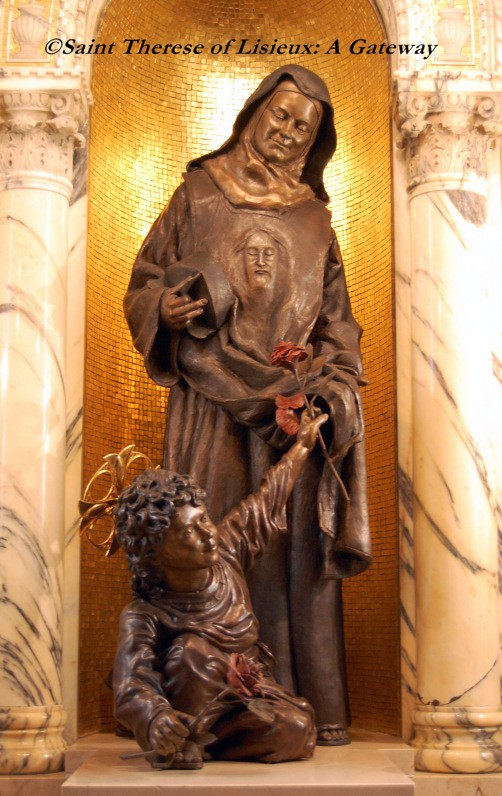
This statue of St. Therese as a Doctor of the Church was given to the Carmelite Monastery in Philadelphia in 1997, the year she became a Doctor. In one hand she holds the biretta, the symbol of the doctorate. A child reaches up to grasp the rose in her other hand. The image of the Holy Face appears on her scapular.
The statue is located in the chapel, in the exact spot where, for nearly a hundred years, the portrait of Therese painted by Celine which was given to the Philadelphia Carmel was displayed on Therese's feast.
St. Therese's Images of Mary - May 31, 2017 - New! Text of the Act of Consecration by which Therese became a Child of Mary on May 31, 1886
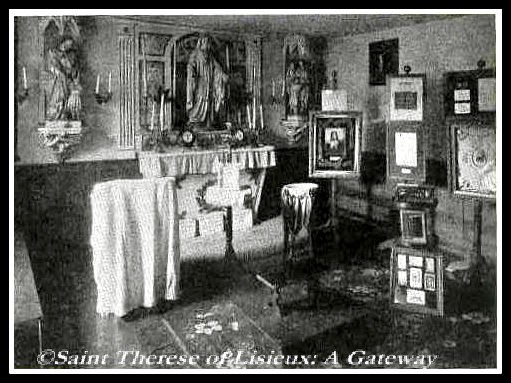 Oratory of the Children of Mary, Benedictine Abbey, Lisieux. Souvenirs of St. Therese's schooldays and of her reception as a Child of Mary. Photo Credit: The Far East.
St. Therese of Lisieux and the Children of Mary
It was on May 31, 1886 that Therese Martin, then thirteen years old, was received as a Child of Mary at the Benedictine Abbey of Notre Dame du Pre where she had until recently been a student. The organization of the “enfants de Marie,” whose members consecrate themselves to the Blessed Virgin for life, is known in some English-speaking countries as the Sodality of Mary. All five of the Martin daughters were members (Marie and Pauline having been received at the Visitation school at Le Mans where they studied), and Celine had been president of the chapter of the Children of Mary at the Benedictine Abbey where the three youngest Martin girls were students.
Therese Martin as an aspirant for the Children of Mary
On February 2, 1885, the feast of the Presentation of Mary, Therese, just turned 12, had been received as an aspirant into the Children of Mary. But, at Easter 1886, when her father decided that she must withdraw from the school due to her frequent illnesses, she had not yet become a full member. Solemn reception into the Children of Mary at the Abbey happened only twice a year on two great Marian feasts: December 8, the feast of the Immaculate Conception, and on May 31, the feast of the Visitation.
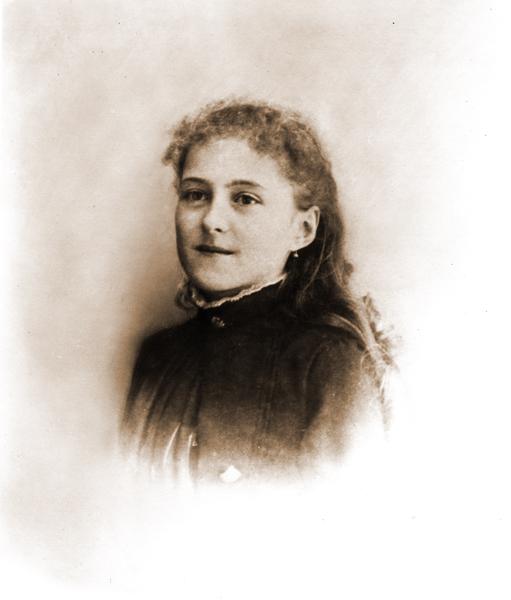 Therese in February 1886, a few months before she was received as a Child of Mary. Courtesy of the Web site of the Archives of the Carmel of Lisieux
Therese tells in her memoir how, not wishing to be less a child of her heavenly Mother than her Sisters had been, she went to Mother St. Placide and asked the favor of being received even though she was no longer a student. Mother St. Placide had to consult the president and counselors of the Children of Mary. As the request was Irregular, they hesitated at first, but Mother St. Placide said prophetically (no doubt without realizing it): “I don’t believe that you will ever have any reason to regret having admitted Therese Martin into the sodality.” As a condition, Therese was obliged to come to the Abbey twice a week in the afternoon, from one o’clock until five o’clock. (All former students were allowed to attend the afternoon classes in drawing, needlework, and painting). She writes of how, after the lesson, she spent the rest of the afternoonbefore the Eucharist, “Jesus . . . my only Friend.” At this time Therese was still technically an aspirant, for the members received new girls only by voting for their admission. The vote was taken a few days before May 31, and Therese was admitted.
Therese Martin's reception as a Child of Mary on the Feast of the Visitation, May 31, 1886
The solemn ceremony of reception was celebrated in the Abbey chapel where Therese had received her First Communion on May 8, 1884. So Therese was consecrated as a Child of Mary before the same altar where she had recited the Act of Consecration on her First Communion day.
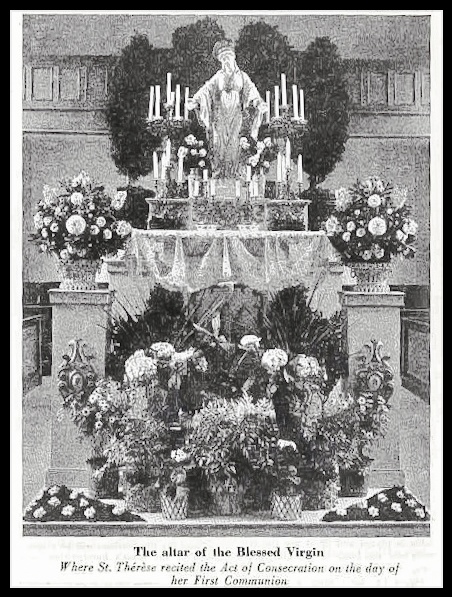 The altar and the statue before which St. Therese was consecrated as a Child of Mary, May 31, 1886
St. Therese's blue ribbon and medal as a Child of Mary
That day, Therese received the blue ribbon and the medal worn by the Children of Mary. Hers, destroyed in the bombing of Lisieux in 1944, was identical to the ribbon and medal pictured, which were displayed at Lisieux in 2009 and which could have belonged to one of her sisters or to another Child of Mary of that time.
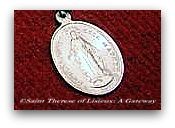 Medal of the Child of Mary. Photo credit: Peter and Liane Klostermann
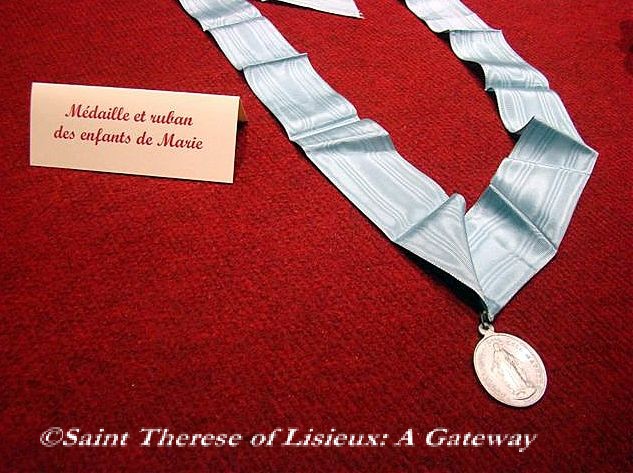 Blue ribbon and medal of a Child of Mary, displayed at Lisieux in 2009. Thanks to Peter and Liane Klostermann for the gift of this photo and to the Pilgrimage Office at Lisieux for permission to display it.
The text of St. Therese's Act of Consecration as a Child of Mary
Thanks to the Southern Cross newspaper, I have the honor of re-presenting the English text of Therese’s Act of Consecration as a Child of Mary. This is not the same text as the consecration used on her First Communion Day.
" O Mary conceived without sin, I, Marie Françoise Thérèse Martin, wishing to be enrolled under your special protection, choose you as my Patron, Advocate, Mistress and Mother. At your feet I make the .firm resolution of working with all my might at spreading devotion to you. . I wish to make henceforth solemn profession of belonging to you .without reserve, of walking in your glorious footsteps and imitating your virtues, especially your angelic purity and incomparable charity. This promise I make at your altar before the whole Heavenly Court. Obtain for me, O tender Mother, the grace of being faithful to it during my whole life, that I may merit the favor of being your child for eternity. Amen."
The Oratory of the Children of Mary became the Oratory of St. Therese
Membership in the Children of Mary was a lifelong commitment. All the Children of Mary came to the Abbey on the first Sunday of every month to listen to a conference from the chaplain, Fr. Domin. The Benedictine nuns took care to influence the spiritual lives of their graduates, and every former student continued to attend these conferences until she married. Therese attended these monthly conferences until she became a Carmelite in April 1888; they were presented in the special oratory of the Children of Mary. Later it became the oratory of St. Therese, where pilgrims came to pray before the souvenirs of Therese’s schooldays. Her blue ribbon and medal and the parchment of her consecration were displayed there until they disappeared when the Abbey was destroyed in the bombing of June 6, 1944.
May Therese unite us more closely to Mary, who, as she wrote, "gives Jesus to us and unites us to Him."
Maureen O'Riordan
in Benedictine Abbey of Notre Dame du Pre, Lisieux, St. Therese of Lisieux as a Child of Mary, Therese Martin as a Child of Mary, oratory of the Children of Mary
|
Post a Comment
|
 1 Reference
| Email
| Print
1 Reference
| Email
| Print