Saint Therese of the Child Jesus
of the Holy Face
Entries by Maureen O'Riordan (558)
Unearthing a long-buried treasure about the First Communion and school days of St. Therese of Lisieux, thanks to the Missionary Society of St. Columban
Once in a great while, in researching St. Thérèse, I find and am permitted to share online a real treasure. Today is such an occasion. In my next blog entry, I will publish the first of a series of four jewels containing eyewitness testimony about St. Therese's First Communion and school life, but first please let me tell you joyfully how I discovered it.
Because I feel that my mission is to communicate St. Thérèse’s spirituality, and because, since I have a “day job,” my time for the mission is limited, I have focused on understanding the events that happened between the birth of the baby Thérèse Martin in 1873 and the death of Sister Thérèse of the Child Jesus of the Holy Face in 1897 and what those events mean for us today. So I've had comparatively little time to study the rise of her cult and influence from 1897 until today. The digitizing and publishing online of newspapers and magazines from the 20th century is making available a wealth of material about the public interest in St. Therese, but for me to discover fresh eyewitness testimony about her in English is extraordinary.
Several weeks ago, for the 70th anniversary of D-day, I was searching for articles about the bombing of Lisieux in 1944 and about how the Carmelites of Lisieux and other townspeople had lived in the crypt of the Basilica of St. Therese from shortly after D-day until Lisieux was liberated at the end of August 1944. On Facebook alone these stories were viewed by more than a thousand people. During that research, I found the article below, which appeared in the Catholic Freeman’s Journal in Sydney in 1934.
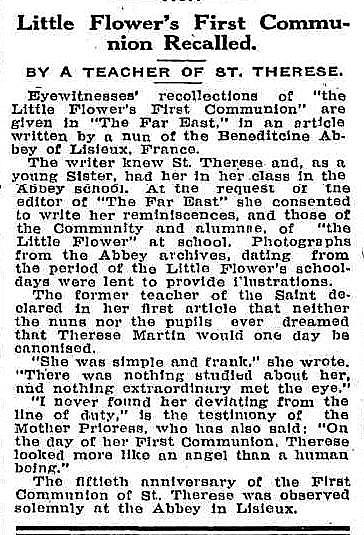
"Little Flower's First Communion Recalled." (1934, July 12).
Catholic Freeman's Journal (Sydney, NSW : 1932 - 1942), p. 31.
Retrieved July 20, 2014, from http://nla.gov.au/nla.news-page17319356
For a moment my heart stopped. Then I began to consider how to find these articles, if, indeed, they still existed 80 years later. I knew that Mother Saint-Lèon Loutrel of the Benedictine Abbey of Notre Dame du Pré in Lisieux had written La petite Thérèse à l’Abbaye, a little book about Thérèse’s five years as a day student at the Abbey. In 1929 it appeared in English as The Little Flower at the Benedictine Convent. Years ago I visited a university library to read this little work, which has been out of print for aeons. Now I was amazed to learn that an unnamed Benedictine, who’d been a senior student when Thérèse had started school, later become a Benedictine nun, and then taught Thérèse in class, had published four articles about Thérèse’s school days. Imagine my joy at discovering through the Internet that The Far East is still being published by the Missionary Society of St. Columban! I wrote them at once to ask whether they still had the articles, and, if so, whether I might republish them online in honor of the 130th annniversary in 2014 of Thérèse ‘s First Communion in 1884. They answered at once, promising to search their archives. After only a few days of suspense, I received on Friday, July 4 the kindest answer saying that their archivists in Ireland had unearthed the very issues I needed, and sending them to me with permission to publish them! All four articles appeared in the United States in 1934. Three appeared in Ireland, but, for some unknown reason, article 3, which gives a moment-by-moment description of the day of St. Thérèse’s First Communion, was never published in Ireland. So I’m especially happy to be able to transmit it to the people of Ireland, many of whom love Thérèse and her parents, Louis and Zélie, deeply. The United States has received much from the many diligent missionaries, Carmelites and others, born in Ireland who have preached St. Thérèse in our country. The late Fr. J. Linus Ryan, director of the National Office for St. Thérèse in Ireland, was one of the most generous supporters of my work. And Mgr Bernard Lagoutte, rector of the Shrine at Lisieux in 2008, when Louis and Zélie Martin were beatified, said “Ireland has led the world in the promotion of the Cause of the Parents of Saint Thérèse of Lisieux.” I remember, at the Mass of Beatification in Lisieux, the Irish contingent in places of honor, each delegate waving a small Irish flag. I am happy to be part of this international collaboration between Ireland, Australia, and the United States to give this testimony about St. Thérèse's childhood back to the world.
The next step was to type the text of the articles so that they’d be easy to read and searchable online. The very day before I received them, Thérèse’s great friend, Bishop Guy Gaucher, O.C.D., had died in France. I had learned of his death the same day and immediately began to pray that he might obtain for us the grace to continue his mission. (Clearly he lost no time in answering!). Arranging the translation into English of the announcement of his death and funeral and the various tributes to him, as well as preparing to celebrate online the feast of Blessed Louis and Zélie Martin on July 12, prevented my typing these articles, but God went before me. Two days after the permission came, I spoke on “The Eucharist as Source and Summit of the Martin Family” at the monthly day of prayer in the presence of the reliquary of the Martin family at the Carmelite Monastery in Philadelphia. Linda Smith, who was present, volunteered to work with me in evangelizing about St. Therese, and offered to type the articles. Her husband, Scott, decided to join her in the apostolate, and he formatted the first article expertly. Patricia Taussig of North Carolina prepared for publication the original images of the pages that appeared in The Far East and the photographs contributed by the Benedictine nuns. Please see the fruits of their work: "The Little Flower at School," Part I. I know you join me in thanking them.
Please join me also in thanking the Missionary Society of St. Columban (often colloquially known as the "Columban Fathers" and "Columban Sisters," together with their lay missioners), who elicited and published these historic articles in 1934, granted me permission to share them with you, and continue to work in solidarity with God's beloved poor in Asia, the Pacific, and Latin America. To learn more about their work, or to send a thank-offering, please visit:
- in the United States, www.columban.org
- in Ireland, www.columban.com; and
- in the United Kingdom, www.columbans.co.uk
 Maureen O'Riordan
in Benedictine Abbey of Lisieux, Columban Fathers, Columban Missionaries, First Communion of St. Therese, St. Therese of Lisieux, The Far East Magazine
|
Maureen O'Riordan
in Benedictine Abbey of Lisieux, Columban Fathers, Columban Missionaries, First Communion of St. Therese, St. Therese of Lisieux, The Far East Magazine
|
 Post a Comment
|
Post a Comment
|  Email
|
Email
|  Print
Print
Sunday, August 3, 2014: "Louis and Zelie Martin As Ministers of Charity and Justice: Loving and Serving Our Neighbor and Christ's Poor"
 Maureen O'Riordan
in Blessed Louis and Zelie Martin, Carmelite Monastery in Philadelphia, programs about St. Therese of Lisieux
|
1 Comment
| Email
| Print
Maureen O'Riordan
in Blessed Louis and Zelie Martin, Carmelite Monastery in Philadelphia, programs about St. Therese of Lisieux
|
1 Comment
| Email
| Print
The homily preached by Francois-Marie Lethel, O.C.D., at the funeral of Guy Gaucher, O.C.D., "Therese's bishop," on July 10, 2014 at the Basilica of St. Therese in Lisieux
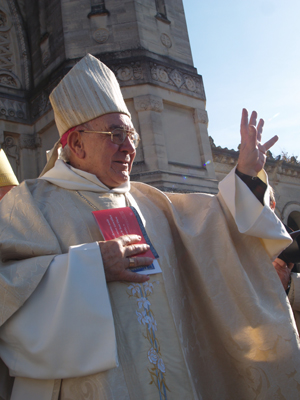

Photo Credit: Paris Province of the Discalced Carmelite Friars
Homily
delivered by François-Marie Lethel, O.C.D.,
a Carmelite friar of the Paris province,
at the funeral of his brother, Guy Gaucher, O.C.D.,
a Carmelite friar of the same province,
the auxiliary bishop emeritus of Bayeux and Lisieux,
and the friend of Thérèse,
on July 10, 2014 in the Basilica of St. Thérèse at Lisieux
Dear Friends,
Our brother Guy Gaucher brings us together to celebrate together the Passover of Jesus in this Basilica of St. Thérèse of Lisieux. He brings us together as his brothers, his friends, and each of us has a personal bond with him.
He asked me to give this homily because I am his brother in the Carmelite Order, in our Province of Paris, and especially because we entered the novitiate on the same day, September 21, 1967, on the feast of St. Matthew. On the following October 2, we both received the Carmelite habit at the hands of Fr Bernard Delalande, Provincial. Then, at the end of the novitiate year, we made our Religious Profession on October 3, 1968, which was then the feast of St. Thérèse of Lisieux. After that, it was always Thérèse who brought us together with so many brothers and sisters, so many friends, believers and non-believers, present in one way or another at this moment..
Our brother Guy himself chose the readings of Holy Scripture that we have just heard, and it is these texts that illuminate our Celebration. The words of St. Paul in the Letter to the Romans tell us the true meaning of his whole life and of his death: to live for Jesus, to die for Jesus, to belong to Jesus Dead and Risen, Unique Lord of the dead and of the living. With the words of the Gospel of Luke, Guy invites us to relive, as he did, this journey of the two disciples of Emmaus on which the Risen Jesus came to meet them in the depth of their sadness, their inner turmoil, to revive in their hearts the flame of Hope, of Faith and of Love, so that their sorrow will turn into joy. But above all, through his own testimony, Guy comes to repeat to us these words of Jesus: “Was it not necessary that the Christ should suffer his Passion in order to enter into his Glory?”
Dear Friends, let’s listen to Guy himself, speaking to all of us at the end of his Spiritual Testament:
I thank all those who have loved me, formed me, helped me throughout my life: my parents, already gone; my family, and a great number of faithful friends in all ecclesial vocations and in the world.
I thank above all her who entered into life saying “All is grace.”
I have tried to be in the service of her mission: to give her evangelical little way to the people of all five continents. How she welcomes me!
I give thanks for her Doctorate, one of the high points of my life, that October 19, 1997 in Rome, Mission Sunday, the eleventh anniversary of my episcopal ordination, thanks to John Paul II.
Amen! Alleluia!
In these few lines, our Brother Guy tells us again in a magnificent way what was the most beautiful and most characteristic facet of his life, which is his extraordinary spiritual communion with little Thérèse.
He reiterates this in a more developed fashion in his Simple personal notes:
On that October 19, 1997, Mission Sunday (the eleventh anniversary of my ordination as a bishop), I felt that my life had reached its goal, a goal which had been decided for me, almost without my knowledge.
Thérèse, patron of missions, of France, and of the world: the mission was at the heart of my life as a layman (Cœur vaillant, JEC, patro, Centre Richelieu), as a priest in Paris, as a Carmelite friar in HLM Orleans-La Source (such a beautiful time in my life, 16 years), as bishop (short-lived) of Meaux, then of Lisieux.
I owe first to Thérèse this flawless realism in the face of human weakness, the sin, the wounds, the walls, and the nights that sweeps away any naïveté, any narcissistic generosity and seriously confronts the unprecedented abasement of the Incarnate Word to “his poor little creature.”
I can say that Thérèse taught me much about the truth of the Gospel, making it livable, possible, because everything comes from God, in short, because “Everything is grace,” from which, consequently, flows constant thanksgiving.
Of course, she is not the only one who has enlightened me, but she has brought me from the most banal daily life into the world of holiness, which is at once loneliness and love, suffering and joy.
For Guy, this same date of October 19 symbolized the deep bond between his Episcopal Ordination and the proclamation of Thérèse as a Doctor of the Church by Pope John Paul II. Recall that, exactly 11 years later, on October 19, 2008, Guy had the joy of participating in the beatification of the Parents of Thérèse, Louis and Zelie Martin, here in Lisieux. And it is from the Church of Heaven that he will participate in the beatification of Paul VI, to be held in Rome on October 19 precisely. Another lovely sign, because Paul VI was deeply Theresian. He was baptized on September 30, 1897, the very day of the death of Thérèse. In declaring, for the first time, two women, Teresa of Avila and Catherine of Siena, as Doctors of the Church, he definitively surpassed an obstacle that his Predecessors had believed insurmountable, and he reopened the way to the doctorate for little Thérèse. But above all, in his very depths, Paul VI had lived, like Thérèse, a very painful interior night, which was for him the night of Hope.
Dear Friends, our brother Guy thus opens his inner world, the “world of holiness” where "Thérèse is not the only one.” He invites us all to enter with him into this very great Mystery of the Communion of Saints, into this wonderful “circle of Saints” painted by the Blessed Fra Angelico, where the saints of heaven join hands and extend their hands to us, to guide us together, as sisters and brothers, along the path of holiness that we are called to travel. This is one of the most beautiful teachings of Vatican II! For Guy, there were also the other saints of Carmel, especially the other two doctors, Teresa of Avila and John of the Cross, who are the “spiritual parents“ of little Thérèse, and also the Venerable Father Marie-Eugène of Child Jesus, founder of the Institute of Notre-Dame de Vie (Our Lady of Life). Father Guy worked hard for the cause of his beatification, and he wrote Father Marie-Eugène’s biography.
But in this “circle of saints,” our Thérèse always came in first; it is always she who held him by the hand (like Joan of Arc for Charles Péguy). Guy never stopped working for her, but even more living with her, loving with her, and suffering with her.
Thérèse led Guy to Carmel. Immediately after his novitiate, in 1968, he was called to work for the Critical Edition of her Works with a whole team, which was to culminate in the great Edition du Centenaire in 1992.
But above all, our Brother Guy has fully lived the spirituality of Thérèse in its most interior dimension, which is also the most dramatic, in all the depth of the Passion and the Agony of Jesus. With Thérèse, he repeats to us Jesus' words heard in the Gospel: “Was it not necessary that the Christ should suffer his Passion in order to enter into his Glory?”
In 1972, he published his fine book, The Passion of Thérèse of Lisieux (a book that really touched me personally in those difficult years after 1968). For Guy, this book was to have a mysterious meaning, prophetic, as the announcement of this period in which he personally relived the Passion of Thérèse in her sickness and in her interior trial.
The period of the luminous and peaceful years of community life and of service in our Province of Paris would end in1986 with his nomination as a bishop, this “martyrdom of the Episcopate,” as he tells us in his personal notes :
I knew, in 1986, that accepting the episcopate could lead to martyrdom, and (without playing the martyr) I started to experience at Meaux a path of unexpected solitude, in complete powerlessness and in the darkest night.
I regret nothing of these three years. They were a great grace and a decisive stage in my life. Having experienced this, what worse could happen to me?
To go through this tunnel which seems interminable changes life. One who has not lived it, what does he know? (I mention the inestimable value of faithful friends, those in the medical profession and others).
Now I say: “Every vocation is a mission,” adding: “every mission is a passion.”
After these three years of his passion, supported by many brothers and friends, especially by members of the Institute of Our Lady of Life that had welcomed him, Guy would know years of resurrection, of a great ecclesial fruitfulness here in Lisieux, as “Thérèse’s bishop,” which were to culminate with the Doctorate of Thérèse in 1997. Becoming bishop emeritus in 2005, he retired to the residence of Quinsan, in Vénasque, near the community of Our Lady of Life, and it was there that he wrote his last book, his great biography of Thérèse, published in 2010.
After that, he found Thérèse near the Cross, in the last four years which were so painful, but always supported and accompanied by many friends. This was the last step of his way of holiness, lived with Thérèse, who said on the very day of her death: “I do not regret having surrendered myself to love . . . Never would I have believed it was possible to suffer so much! never! never! I cannot explain it except by the ardent desires I have had to save souls.” Just before she died, Thérèse had fixed her gaze on Mary, the Virgin of the Smile, and, according to the beautiful expression of Father Marie-Eugène, “the light of the Virgin never shines more sweetly than in the darkness.” She was present near our brother Guy; she is close to us right now as we prepare to celebrate her as Our Lady of Mount Carmel on July 16.
Now, our brother Guy has entered into life, and he invites us to raise our eyes to the happiness of Heaven. Let us listen to his last words to us about this mysterious passage from death to eternal life:
It will be a passage through a narrow door, a passover, a birth.
Because I see what I believe today (very badly), and it will be ineffable. Of faith in the vision. Ultimately, the unveiling of what was hidden, not the ephemeral light of the Transfiguration, but the opportunity to pitch one’s tent forever at the top of the mountain with Moses, Elijah, Peter, James, John, and a huge crowd that one cannot count ( . . . )
Jesus . . . it had to happen to him. Everything converges towards him: the earth and all its riches that I am leaving (unlike Bernanos, I can say that I really liked them), the great History of humanity.
Risen Jesus, Alpha and Omega, you are the “Door.” You left this life to prepare the one which is to come, your own, that of the Father and of the Holy Spirit, the eternal Life you have promised us.How many times have I quoted Thérèse’s words, “I am not dying, I am entering into life!” (LT 244). Soon I will repeat this luminous phrase “for real,” in another and more difficult way.
A friend often repeated to me, when we were talking of the inexpressible joys to come: “The best is ahead of us.”
May this departure be a blessing to all those I leave (temporarily). This will be the best way to ask their forgiveness for my sins, voluntary or not, and to thank them for having been what they are. (I mention no names; he has many names here).
A Dieu! Pray for me. We are all going to the eternal reunion, prepared by the merciful Love of the Trinity . . . .
English translation by Maureen O'Riordan, in thanksgiving.
I thank the homilist, Fr. François-Marie Lethel, O.C.D., and Fr. Guillaume Dehorter, O.C.D., the provincial superior of the Paris Province of Discalced Carmelite Friars, for permission to translate this homily. Their generosity reflects that of their brother.
Maureen O'Riordan
in Francois-Marie Lethel O.C.D., Guy Gaucher O.C.D., Therese of Lisieux
|
2 Comments
| Email
| Print
Photos of the funeral of Bishop Guy Gaucher, who rests near the first tomb of Therese
Photos des obsèques de Guy Gaucher qui repose à côté de la 1ère tombe de Thérèse ... !http://t.co/2kj1h4tdKT pic.twitter.com/eo25V99G7Q
— Carmes de Paris (@carmesparis) July 11, 2014
I thank the Carmelites of the Paris province for these beautiful photos of the funeral of their brother, Carmelite friar and Bishop Guy Gaucher, "Therese's bishop." His funeral Mass took place on Thursday, July 10 at 3:00 p.m. in the Basilica of St. Therese at Lisieux, and he was laid to rest in the town cemetery, near the tomb where the body of St. Therese rested from the day of her own funeral in 1897 until it returned to Carmel in 1923. In communion of thanksgiving and in prayer that we might continue the mission he shared with her, "to love Jesus and to make Him loved." "All is grace."
Maureen O'Riordan
in GGuy Gaucher O.C.D., funeral photos
|
Post a Comment
| Email
| Print
For the feast of Blessed Louis and Zelie Martin in 2014 . . .

Jacques Habert, Bishop of Seez
please see "What if Louis and Zelie had known about Vatican II?" , a conference written and presented by Mgr Jacques Habert, bishop of Seez, for their feast. This is on my Web site for them, "Blessed Louis and Zelie Martin, The Parents of St. Therese of Lisieux." I thank Bishop Habert for his permission and Gordon Henry for the translation. The conference appeared first on the Web site of the Shrine at Alencon. A blessed feast day!
Maureen O'Riordan
in Alencon, Bishop Jacques Habert, Louis and Zelie Martin, Vatican II, feast of Blessed Louis and Zelie Martin
|
Post a Comment
| Email
| Print