Saint Therese of the Child Jesus
of the Holy Face
Entries by Maureen O'Riordan (558)
The Carmelites of Lisieux in the Summer of 1944: 80 Days and 80 Nights in the Basilica of St. Therese. Written for the 70th anniversary of the liberation of Lisieux on August 23, 1944
by Joseph Ritson, of Great Britain, and Maureen O'Riordan
At the beginning of June, 1944, the French city of Lisieux, in the heart of the Normandy countryside. had been living under the Nazi Occupation for almost four years. During this time Lisieux and its population had been spared much of the devastation other French towns and cities had experienced. But Lisieux was a vital center of communication with Paris, and, when the Alllies launched their campaign to drive the Germans from France, they pounded Lisieux mercilessly with bombs. It would not be long until the people of Lisieux would see the German occupiers gone forever, but not before much suffering, death, and destruction came upon Lisieux.
D-Day, Tuesday, 6 June 1944 (in the evening)
The Allies bomb Lisieux at 8:30 p.m., aiming at the railroad yards. The raid lasted 30 seconds. The Carmelites were at evening prayer, and they continued their normal life as well as they could.
D + 1, Wednesday, 7 June 1944
A second, much bigger raid came at 2:00 a.m. during the night of June 6-7. Thousands of bombs destroyed many of the buildings in Lisieux. The Benedictine Abbey of Notre Dame due Pre, where Therese had been a student for five years and where she made her First Communion, had a direct hit. The souvenirs of Therese’s schooldays and of her First Communion disappeared. Sixty-three or more religious sisters in Lisieux died in the bombing. The number of deaths reported varied only slightly: contemporaneous accounts said that 21 Benedictines of the Abbey of Notre Dame du Pre, where Therese studied for five years; 20 Sisters of Providence, a nursing order; 10 Little Sisters of the Poor, who maintained a home for elderly men; 10 Sisters of Charity of the Refuge (a home for girls in trouble); and four Sisters of Notre Dame were killed.
Most buildings near the Carmel were destroyed. During the 2:00 a.m. raid, “while everything seemed crumbling and burning around them,” the Carmelite nuns gathered in little groups in the cells and prayed. Fire destroys the chaplain’s house at Carmel and the bookstore, Office Central, threatening the Carmel and the chapel.
At 2:00 p.m. a third aerial bombardment destroyed the esplanade of the Basilica and all the shops near the Basilica. Incendiary bombs fell in the courtyard of the Carmel, which “disappeared in a flash of flame and smoke."
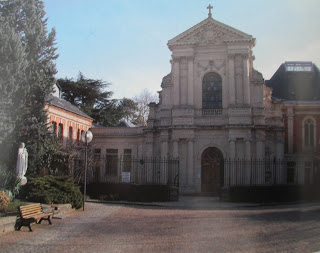
Carmelite Monastery, Lisieux. Photo credit: Joseph Ritson
The Carmelite nuns decide to remain in their cloister no matter what. But in the evening, the superior of the Mission de France urges Mother Agnes (the prioress, St. Therese’s sister Pauline) to lead the community to the Basilica, where the Carmel’s chaplains had already taken refuge. Mother Agnes at first feels that the nuns cannot leave the Carmel, but the whole city around the Carmel is burning, and the superior urges her not to stay there alone with the nuns, whose lives were in extreme danger; he says “You have only a few moments to decide.” Mother Agnes says “If it is our duty, we will do it.” The nuns took the Blessed Sacrament from their tabernacle and took it with them to the Basilica. Passing through the door, Mother Agnes blesses her Carmel with the sign of the Cross, and then leaves it for the first time since she had entered it 62 years before (October 2, 1882).
The nuns make their way through the devastation of Lisieux and up the hill to the Basilica of St. Therese. With the few other townspeople who had not evacuated, they shelter in the crypt. They take their place at the front of the crypt, on the right, before the statue of Our Lady of the Smile. They are surrounded by refugees and even by the wounded, whom the brave seminarians of the Mission of France had just dug out of the rubble. The number of refugees is about 80-100, of whom at least 40 were priests and nuns. At certain times in the summer, when refugees came form the countryside, there are more.
Later in the night, the roof of the house of the extern sisters at the Carmel is burned. There is a risk that the chapel containing the reliquary of St Thérèse might be destroyed by the fire. Then the direction of the wind suddenly changes. The chapel is spared. Some people attribute the saving of the chapel to the intercession of St Thérèse.
D + 2, Thursday, 8 June 1944
At daybreak, the fires of the night before are still burning. Most of the town has been evacuated, and few people are left to fight the fires. Priests and seminarians from the 'Mission de France' manage to extinguish the fires that threatened the Carmel. They rescue both the documents in the Carmel’s archive and the reliquary of St Thérèse, and transport them to the Basilica.
Many civilians from Lisieux and its surroundings seek shelter in the Basilica.
The weekend of Saturday 10 June and Sunday 11 June 1944
During the nights of June 10 and June 11, the Allies bomb Lisieux again. The Carmelite monastery and garden are slightly damaged. Three or four Masses are offered in the Basilica every morning all summer, with rosary and Benediction in the evening. In their corner of the crypt, the Carmelites continue to recite the Divine Office.
D + 7, Tuesday, 13 June 1944
A message reaches Mother Agnes from Emmanuel Cardinal Suhard, archbishop of Paris, stating that on May 3, 1944, Pope Pius XII had declared St. Therese secondary patron of France. (St. Joan of Arc is the other secondary patron. The principal patron of France is the Blessed Virgin). To their evening prayer the nuns add the invocation (in Latin): “St. Therese, patron of France, pray for us.”
June and July 1944
The Allies continue to bomb Lisieux and its environs. More civilians seek shelter in the Basilica.
Tuesday, 11 July 1944
By July 11, about three-quarters of the buildings in Lisieux had been destroyed. The priests and nuns in the crypt of the Basilica organize a novena to ask for the intercession of St Thérèse.
Wednesday, 12 July 1944
The first day of the novena to St Thérèse.
Sunday, July 16, 1944
In the crypt, Mother Agnes receives the vows of a young Carmelite nun.
On various days when the military situation permitted it, Mother Agnes visits the Carmel several times to inspect it. She and Sister Genevieve also visit the town cemetery to pray before the tombs of their parents, other members of the family, and other Carmelites. They pray near the spot where Therese’s body had been buried before its return to Carmel in 1923.
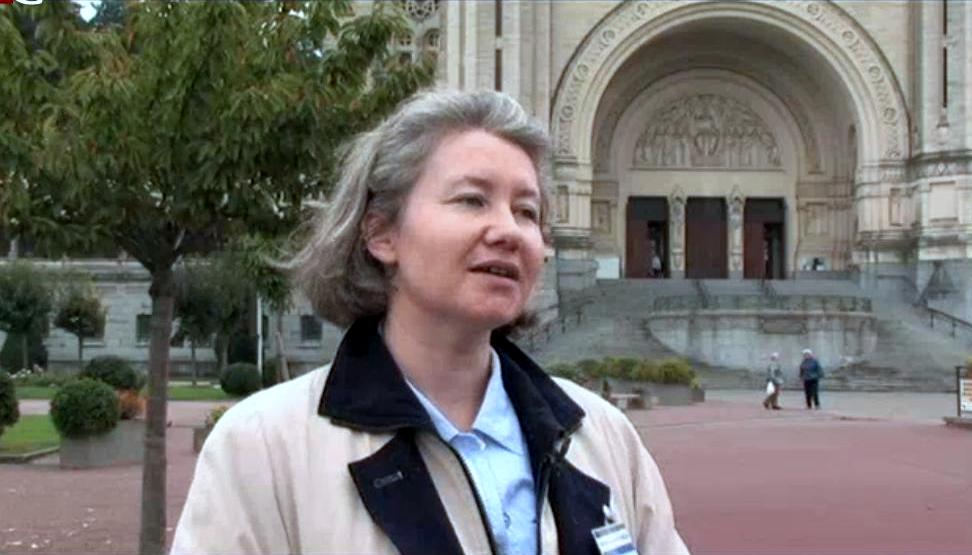
Mgr Germain, Director of Pilgrimages, invites the saint’s sisters to climb up to the cupola of the Basilica to see what remains of the town. Mother Agnes, at 82, surprises everyone by climbing fastest of all.
Thursday, 20 July 1944
The Basilica is crowded with refugees, including those from nearby villages. Many had already seen their homes and churches destroyed. The clergy make a vow that, if they are delivered, each year they will bring the relics of St. Therese in procession from St. Pierre’s Cathedral to the Basilica. Since the end of the war, this procession has taken place every year on the feast of St. Therese.
Sunday, 6 August 1944
A “perpetual rosary” begins in the crypt of the Basilica. It continues until August 27. At every moment at least three persons were praying this rosary,.
Monday, 7 August - Tuesday, 15 August 1944
In early August 1944 the 'Secours National' (National Relief) offers to transport the Carmelite nuns by truck to Paris. There was talk of a forced evacuation of Lisieux. Reluctant to leave the townspeople, the Carmelites organize a novena of adoration to help them decide. Mother Agnes invites them to pray fervently for light. She gives permission to any Sisters who might want to leave, but they all decide to stay and wait for the outcome of the battle for Lisieux. To prepare for the Feast of the Assumption on August 15, a second general novena is organized in the crypt to pray for the deliverance of Lisieux, the end of the war, and the coming of peace.
Wednesday, 16 August 1944
In Rome, the Pope requests that the religious buildings of Lisieux be respected. The German 'Kommandatur' asks the civil authorities for precise details about the buildings. For some unknown reason, the 'Kommandatur' suddenly leaves, never to return!
Saturday, 19th August 1944
The battle for Lisieux begins in earnest. Artillery fire is aimed at Lisieux. One artillery shell hits the wall of the Carmelite cloister. The doors and windows of the monastery are blown in, and the roof is blown off the wash house.
Monday, 21 August 1944 - Wednesday, 23 August 1944
The battle for Lisieux.
On the night of August 21-22, about 200 German soldiers arrive at the Basilica asking for a place of peace for a few hours so they can sleep. The crypt is crowded with civilian refugees, and the Germans are directed to the upper part of the Basilica.
Tuesday, 22 August 1944 (evening)
The first Allied tanks arrive. They meet strong and determined resistance from German machine guns positioned in the town square. The two sides exchange fire. Some German artillery shells fall in the yard which gives access to the crypt. The religious community and the civilans fear that the Basilica may be destroyed in the fighting. Nevertheless, they continue to pray for deliverance and for the intercession of St Thérèse. One of the Carmelites, Sister Anne of Jesus, writes, on September 8, 1944, this description: “The final battle lasted for 48 hours, and we were between the two fires. I cannot tell you what an uproar it was. It was sinister. Finally on August 25 the last Germans left, and we were able to breathe a little easier . . . .”
Wednesday, 23 August 1944 (evening)
One way or another, the end is in sight with the arrival of British troops. They ask to set up an observation post from the lantern inside the dome of the cathedral and also to install a machine gun. However, this position is abandoned within a few hours as the Germans have departed.
After 48 hours of fierce fighting Lisieux had finally been delivered! Liberation at last and the Basilica has remained largely unharmed.
According to the Basilica archives, the saving of the Basilica from further damage is attributed to Major George Warren of the 1/6 Battalion, Queen's Royal Regiment:
"The Basilica, it was to be knocked down! We were given the order to destroy it because we were told it was protecting Germans. It was already aimed at when we were guaranteed that there were no soldiers. Not wanting to foolishly destroy such a monument we asked on numerous occasions to check if there were no troops hiding here. There was a counter-order but you were very lucky!”
Sunday, 27th August 1944
At the Basilica there is a religious ceremony of thanksgiving. Afterwards, Mother Agnes and the Carmelite nuns, carrying the coral trunk with the relics of St. Therese, return in procession across the ruins of the liberated city to their monastery. They are accmpanied by a crowd of the lay persons with whom they had lived for eighty days and eighty nights. The relics of St. Therese are restored to the chapel.
All the Carmelites of Lisieux survive the battle. Their monastery is slightly damaged, but not destroyed. Les Buissonnets, St. Therese’s family home, remains intact.
The Carmelite nuns return to their usual monastic way of prayer and silence. With the ending of the Battle of Normandy and the liberation of France, many more people from the surrounding countryside come to Lisieux to give thanks for their deliverance.
[Note: Part of this article is drawn from information in Joseph Ritson's "The Deliverance of Lisieux in August 1944." Sources included the Tourist Information Office at Lisieux; the Pilgrimage Office at Lisieux; and the Carmelite Monastery at Lisieux. Information for this 70th anniversary article was also drawn from documentation furnished by the Carmelite Monastery of Philadelphia; from Celine: Sister and Witness of St. Therese of the Child Jesus by Stephane-Joseph Piat, O.F.M. (San Francisco: Ignatius Press, 1997); and from the sites listed as references to this blog entry. Our sincere thanks to all those who furnished information].
 Maureen O'Riordan
in 1944. Carmelites of Lisieux, Basilica of St. Therese, Sister Anne of Jesus, invasion of Lisieux, liberation of Lisieux
|
Maureen O'Riordan
in 1944. Carmelites of Lisieux, Basilica of St. Therese, Sister Anne of Jesus, invasion of Lisieux, liberation of Lisieux
|
 Post a Comment
|
Post a Comment
|
 3 References
|
3 References
|  Email
|
Email
|  Print
Print
163 photographs of Lisieux after the bombing of June 1944
Thanks to the Mediatheque de Lisieux and Photos Normandie, we can mark the 70th anniversary of the liberation of Lisieux (August 23, 1944) with this show of 163 photographs of Lisieux taken after the bombing of June 1944. See several photos of the ruins of the Benedictine Abbey where Therese made her First Communion; photos of the rue du Livarot, on which the Carmel is located; and the destruction of three-quarters of the city. These photos give you an idea of the horrific destruction and of the ruins seen by Therese's sisters and the other Carmelites when, on the evening of June 7, 1944, they were obliged to leave their monastery and climb up to the Basilica to seek refuge, with other civilians,in the crypt. May these images of destruction inspire us to pray for peace today.
Maureen O'Riordan
in June 1944, Lisieux, bombing of Lisieux, photographs of bombing of Lisieux
|
Post a Comment
| Email
| Print
St. Therese of Lisieux and Sister Stanislaus of the Blessed Sacrament, "Philadelphia's Little Flower"- Part 1 - August 21, 2014
Leading up to the first presentation of the new conference "The Martin Family and the Lisieux Carmel, and St. Therese and the Carmel of Philadelphia" on September 7, 2014, we are featuring a series of "teaser" articles about the remarkable personalities who participated in the extraordinary outpouring of devotion to St. Therese that was born at the Philadelphia Carmel from its foundation in 1902, five years after the death of Therese. We introduce the series with part one, "St. Therese of Lisieux and Sister Stanislaus of the Blessed Sacrament (1879-1911)," who came to be known as "Philadelphia's Little Flower."
 Sister Stanislaus of the Blessed Sacrament, O.C.D.
The young nun who established the first contact between the Philadelphia Carmel and the Lisieux Carmel, and who maintained it for many years, was Sister Stanislaus of the Blessed Sacrament, one of the remarkable group of young women who came to be known as the “four foundresses” of the Philadelphia Carmel.
The future Sister Stanislaus was born in Philadelphia on June 6, 1879 to Francis and Mary Therese Kelly and baptized Helen Genevieve. (At that time little Therese Martin, almost six and a half years old, had been living in Lisieux, where her family moved after the death of her mother, for less than two years). The resemblance between Helen's life and that of St. Therese is striking. Like St. Therese, she was the youngest of a large family (thirteen children!) Like Therese, she had two sisters who also became nuns (Sisters of Charity). She was also granted what Therese and her parents, Louis and Zelie Martin, had long desired: a priest brother, Father Joseph Kelly.
Lively and playful as a child, Helen was educated by the Sisters of Notre Dame de Namur and had ties to the Church of the Gesu, a now-closed parish in North Philadelphia which was then staffed by Jesuits. Like Therese, Helen experienced the call to Carmel early. Years before Helen was born, the future St. John Neumann, bishop of Philadelphia, had wanted to establish a monastery of Discalced Carmelite nuns in this diocese. With the echo of the Know-Nothing riots of the 1840s still in their ears, his council had persuaded him against it. In Helen’s youth, then, no Carmelite monastery existed in Philadelphia. But in 1895, while Sister Therese of the Child Jesus was writing her first memoir at the Carmel of Lisieux, another young Catholic woman of Philadelphia, Mary Otillia McGeogh, had entered the Carmel in Boston. It was to this Carmel of Boston that Helen applied at age sixteen. She so impressed the community that they waived the rule (as the Lisieux Carmel had done for Therese) and allowed her to enter at seventeen. She was received in April, 1896, the very month in which, “during those very beautiful days of the Easter season,” Therese first began to experience her trial against faith.
Lisieux Carmel also had a Sister Stanislaus
Another synergy between Stanislaus and Therese: the Lisieux Carmel also had a Sister Stanislaus, this time Sister Stanislaus of the Sacred Hearts, a goodhearted elderly nun who, for several years, supervised the young Sister Therese when she worked in the sacristy. It was for Sister Stanislaus’s jubilee that Sister Therese wrote her last religious play, “St. Stanislaus Kostka,” about the young Polish Jesuit who died, while still a novice, at age seventeen—the age at which Sister Stanislaus of the Blessed Sacrament of Philadelphia entered the Carmel in Boston. Perhaps the name “Stanislaus” was chosen for her because she was the same age as the young Jesuit saint.
Sister Stanislaus of the Blessed Sacrament Meets St. Therese in Boston
Sister Stanislaus was still in her early religious formation at the Boston Carmel when Sister Therese died in Lisieux on September 30, 1897. A little more than a year later, the memoir of the young French nun who had died at age 24 was published as Histoire d’une Ame, in an edition of 2,000 copies. One of them found its way to the Boston Carmel, where Sister Stanislaus read it eagerly. She began at once to translate it into English. Her life would never be the same.
Her childlike simplicity and purity of heart were wings with which she flew in the wake of the Little Flower. In Therese she found her soul’s companion and guide for the fulfillment of her own holy desires and longings.
When she became a foundress of the Philadelphia Carmel in 1902, she already had become a central figure in the American campaign to beatify the future saint, and she remained devoted to this effort as long as she lived.
(Carmel in Philadelphia: The First Hundred Years (published by the Discalced Carmelite Nuns of Philadelphia, 2002), p. 54.
Sister Stanislaus Was a Pioneer in Making Sister Therese Known
That Sister Stanislaus, as early as 1902, was central to the "American effort to beatify Therese" is the more significant when one realizes that the word "beatify" is not known to have been mentioned in France until 1903, when Fr. Thomas Taylor of Scotland first visited the Lisieux Carmel and urged Therese's sisters and Mother Marie de Gonzague, who received him in the speakroom, to open her cause. At the diocesan process in 1910 Fr. Taylor testified that Therese's reputation developed slowly at first (at least until 1908). When he visited the Blackrock Carmel of Dublin in 1904, "before the great movement of devotion that has developed since then," the prioress laughed at the idea of canonizing Therese and said "We may as well canonize all the Carmelite nuns." (She changed her mind later). He said that after a favor received at the Good Shepherd Convent in London in 1908, Sister Therese's reputation "has greatly developed, especially in Scotland." (Testimony of Fr. Thomas Nimmo Taylor at the 1910 Process for St. Therese on the Web site of the Archives of Lisieux).
After the arrival of the four foundresses, Philadelphia would never be the same.
[Continue to part two of this series, "Letters from St. Therese's sister Pauline, Mother Agnes of Jesus, to Sister Stanislaus of the Blessed Sacrament, "Philadelphia's Little Flower"]
[Continue to part three of this series, "St. Therese of Lisieux and Sister Mary of St. Joseph," which recounts the efforts of Sister Stanislaus’s childhood friend and fellow apostle, Sister Mary of St. Joseph, to make the spirituality of St. Therese known and loved].
To learn more, visit the Web site of "The Discalced Carmelite Nuns of Philadelphia." I thank the nuns for generously allowing me to use the publication listed above and the documents in their archives (digitized on their Web site!)].
Maureen O'Riordan
in Carmelite Monastery in Philadelphia, Philadelphia's Little Flower, Sister Stanislaus of the Blessed Sacrament
|
Post a Comment
| Email
| Print
"September 7, 2014: The Martin Family and the Carmel of Lisieux, and St. Therese and the Carmel of Philadelphia"
An Encounter with St. Thérèse of Lisieux
and her parents, Blessed Louis and Zélie Martin
Pray in the presence of their relics on Sunday, September 7, 2014
from 10:00 a.m. to 4:00 p.m.
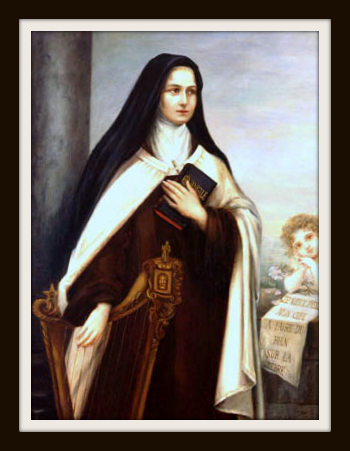 Portrait by St. Therese's sister Celine (Sister Genevieve),
commissioned by Pauline Wilcox for the Philadelphia Carmel
“The Martin Family and the Carmel of Lisieux,
and St. Therese and the Carmel of Philadelphia"
- a conference by Maureen O’Riordan at 1:00 p.m.:
the Philadelphia Carmel, the birthplace of devotion to St. Therese in the U.S.
Benediction of the Most Blessed Sacrament at 3:30 p.m.
Carmelite Monastery Bookstore Open
1400 66th Avenue 10:00 a.m. to 3:30 p.m.
(66th Avenue and Broad Street) Spiritual books,
Philadelphia, Pa. children's books, DVDs,
Free parking in monastery lot and religious articles.
on 66th Avenue Cash and checks only
Chapel is handicapped-accessible.
Download the flyer

Learn more about the role of the Philadelphia Carmel in establishing devotion to St. Therese in the United States at their Web site, "Discalced Carmelites of Philadelphia."
Maureen O'Riordan
in Carmelite Monastery in Philadelphia, Lisieux Carmel, Therese of Lisieux, programs about St. Therese of Lisieux
|
Post a Comment
| Email
| Print
Pope Francis's top 10 secrets for happiness: July 2014

Read Pope Francis's top 10 secrets for happiness, thanks to uCatholic. Do any of them remind you of his favorite saint, Therese of Lisieux?
Maureen O'Riordan
in Pope Francis, Therese of Lisieux, happiness, secrets for happiness
|
Post a Comment
| Email
| Print