Saint Therese of the Child Jesus
of the Holy Face
Entries by Maureen O'Riordan (558)
"Guy Gaucher, 'Therese's bishop,' her 'ardent, enlightened witness:'" a tribute by Fr. Olivier Ruffray, rector of the Shrine at Lisieux

Bishop Guy Gaucher after leaving the Mass of beatification
for Louis and Zelie Martin at Lisieux, October 19, 2008.
Photo credit: Sanctuaire de Lisieux
Bishop Guy Gaucher, affectionately known as “Thérèse’s bishop,” has “entered into life,” in the words of his beloved sister Saint Thérèse, on the morning of July 3, 2014, in Carpentras, on the feast of the apostle Thomas. What a great grace for a bishop, a successor of the apostles, to go to the Father on the feast-day of an apostle!
Guy Gaucher was born March 5, 1930, in Tournan-en-Brie. He was ordained a priest March 17, 1963, and made his religious profession in the Order of Discalced Carmelites on October 3, 1968. At the insistent request of Pope John Paul II, he was consecrated Bishop of Meaux on October 19, 1986. This date was to be important not only for the bishop he became but also for the whole Church, since it was on this date, October 19, that St. Thérèse was proclaimed a Doctor of the Church in 1997 and that Louis and Zelie Martin, the parents of St. Thérèse, were beatified in Lisieux in 2008.
On May 7, 1987, Pope John Paul II appointed Bishop Guy Gaucher auxiliary bishop of the diocese of Bayeux-Lisieux. Bishop Jean Badré, the bishop of the diocese at that time, welcomed him fraternally by entrusting to him “the mission of taking care of St. Thérèse.”
A very cultured man and an authority on the novelist Bernanos, in his literary studies Bishop Guy Gaucher discovered St. Thérèse and became an expert on her life and spirituality. All acknowledged his expertise, and his word was an authority on that subject.
Bishop Guy Gaucher leaves us a considerable body of literary work: books, articles, conferences, and symposia. He was the ardent, enlightened witness of his older sister in the Order of Carmel. He deciphers for us the spiritual experience of Thérèse, through the writings (no less considerable) “the greatest saint of modern times” has left us to introduce us to the merciful love of God and to love for the Church. Monseigneur Guy Gaucher had the gift of explaining, in simple words most of us could understand, the spirituality of Thérèse, which had become his own, so that it might also become ours, faithful to the desire of the spiritual mistress of us all: “to love Jesus and to make Him loved.”
An outstanding pianist, Bishop Gaucher could not resist the sight of a piano. The keyboard attracted him and reminded him of how, when quite young, from time to time, he had been a pianist in a piano bar. Listening to him play in the evening, one might revisit all the musical repertoire in our collective memory, with a little bit of off-beat flavor, from the talented fingers of the bishop--which he always remained. Along with his sharp mind, these spontaneous moments in a relaxed atmosphere reflected as well the solid sense of humor he possessed.
As a man in poor health, he lived the spiritual practice of abandonment into the arms of the Father, supported by his loyal friends and caregivers and the community of the Institute of Notre-Dame de Vie [Our Lady of Life] in Venasque (Vaucluse).
Our brother Guy let himself be guided along his Paschal journey. Grafted onto the cross of Jesus, he has passed from death to life and to the light of the Resurrection into which he has already entered.
Monseigneur Guy Gaucher leaves the legacy of a rich, full, challenging, and inspiring life. Committed to Thérèse as perhaps no one else was, at the time of his departure from Lisieux, in June 2005 he wrote a letter entitled “Why I love you, O Thérèse,” paraphrasing the title of one of Thérèse’s poems, “Why I Love You, O Mary.” Bishop Gaucher wrote:
“Thérèse said, ‘Who could have invented the Blessed Virgin?’ In the same way, one could ask: ‘Who could have invented Sister Thérèse of the Child Jesus of the Holy Face?’ At once so near and so far away, so ordinary and so extraordinary, this little Norman woman, loved throughout the whole universe, whom we think we know and who always escapes us, because the last word of her being expresses something of the unfathomable mystery of the Love of God.”
Being a man of great simplicity and of the freshness of the Gospel, Bishop Guy Gaucher wanted to be buried in Lisieux, near Saint Thérèse, whom he loved so well and to whose work he consecrated his life, and also close to Blessed Louis and Zelie Martin, who brought him equal joy as a pastor.
We will celebrate the funeral Mass for Bishop Guy Gaucher in the Basilica of Lisieux on Thursday, July 10, at 3:00 p.m. “Thérèse’s bishop” then will be laid to rest in the cemetery of Lisieux among his Carmelite brothers, not far from the first tomb of St. Thérèse or from the tombs of other members of the Martin and Guérin families.
From our hearts we invite you all to be present with us or to unite yourself to us in prayer in this celebration, at which Bishop Jean-Claude Boulanger, bishop of Bayeux and Lisieux, will preside.
We share with the family of Monsigneur Gaucher, with all our Carmelite brothers and sisters, and with all his friends, their pain and their hope.
--Father Olivier Ruffray, Rector of the Shrine at Lisieux
Father Olivier Ruffray was appointed Rector of the Shrine of St. Thérèse, Lisieux, on October 6, 2013. A priest since 1989, Father Ruffray has served in various parishes and spent 14 years as pastor of Notre-Dame de l’Estuaire in Honfleur.
Father Ruffray grew up in Lisieux, and he says that St. Thérèse was like a big sister for him, always with him to show him the path to Jesus and teaching him to love the Church. He also admires the generosity and deep spirituality of Blessed Louis and Zelie Martin, the holy parents of St. Thérèse, and prays for their timely canonization.
We thank Father Olivier Ruffray for his generous permission to translate this tribute, which appeared in French on the Facebook page of the Shrine at Lisieux, and Mary Davidson for her translation.
 Maureen O'Riordan
in Fr. Olivier Ruffray, Guy Gaucher O.C.D., Therese's bishop
|
Maureen O'Riordan
in Fr. Olivier Ruffray, Guy Gaucher O.C.D., Therese's bishop
|
 Post a Comment
|
Post a Comment
|  Email
|
Email
|  Print
Print
"The return to God of Bishop Guy Gaucher," by Jacques Gauthier


Bishop Guy Gaucher, who died on Thursday, July 3, was an authority on St. Therese of Lisieux and is best known to English speakers as the author of The Story of a Life: Saint Therese of Lisieux (Harper and Row, 1993), a truly invaluable companion to St. Therese's own Story of a Soul. See other books in English by Guy Gaucher.
“I am not dying; I am entering into life,” wrote Thérèse of Lisieux a few weeks before her death in Carmel on September 30, 1897, at the age of 24. Her dear friend, Bishop Guy Gaucher, went to join her on July 3, 2014, at the age of 84 years. The phrase “All is grace” perhaps expresses best the desire of these two souls as they greet each other in the love of Christ.
“All is grace!” It was reading these words at the end of Diary of a Country Priest, by novelist Georges Bernanos, that guided the young Guy Gaucher, aged 18, toward Thérèse. He would become an authority on both subjects, even preaching a retreat in a Carmel in 2004 on the affinities between the great Georges and Thérèse (“All is grace,” Cerf, 2009). Bernanos might have quoted these words of Thérèse, his spiritual master, but Guy Gaucher found in them the beautiful flower of his life. When he sought the source of the text, he discovered the true face of Thérèse and her spirituality based on trust, mercy, and hope. From that day he never left Thérèse.
Ordained at age 33 in 1963, Bishop Gaucher was professed in the Order of Discalced Carmelites on October 3, 1968. When he was appointed Bishop of Meaux in 1986, the change from the life of a contemplative religious to that of an active bishop was a trial. A few months later, he rediscovered his beloved Thérèse when he became auxiliary bishop of Bayeux and Lisieux until 2005, when he reached the age limit. He was a member of the team that published the New Centenary Edition of Thérèse’s writings. Bishop Gaucher devoted all his energy to making known the life and writings of St. Thérèse, who was declared a Doctor of the Church by Pope John Paul II in 1997. In 2010, Bishop Gaucher published a definitive biography of Thérèse (Sainte Thérèse de Lisieux: Biographie, 1873-1897. Cerf, 2010), containing more than 700 pages.
The friends of our friends often become our friends. So it was through Thérèse that I met Bishop Gaucher. I visited with him several times in Lisieux, together with my wife and his faithful secretary, Sister Monique-Marie, who accompanied him until the end of his life. I remember his good nature, his simplicity, his sense of history. Quiet and with a subtle sense of humor, he loved playing the piano, inviting friends out for crepes, making notes in a small notebook, and sharing his experiences as he traveled around France with the reliquary of Thérèse.
Bishop Gaucher also visited Quebec several times. He was there in 2001, during the pilgrimage of the relics of Thérèse in Canada. He writes in the journal Thérèse of Lisieux in January 2002: “Once again, I saw with my own eyes, always astonished that I was seeing the same sight again in a completely different context-- Moscow, New York, Manila, Rome, Belgium: the crowds that come from who knows where, who wait in silence, in prayer before the reliquary, confessing their sins, listening to the Thérèsian teaching. All these families, the disabled, children, the elderly, all these friends of Thérèse who have a secret relationship with her, some of whom had not set foot in a church for decades …”
Guy Gaucher had the look of a child who would “sing God’s mercies” with Thérèse. He wrote the foreword to my book Thérèse of Lisieux, A Hope for Families, revealing my love for the saint which, in fact, reflected his own: “I have seen in this book that love for the young Carmelite of Lisieux comes alive.”
Dear Guy, I hope you are now with Christ, St. Thérèse, her Blessed parents Louis and Zelie Martin, and all the others, so many brothers and sisters of the same Father. You have not left; you have arrived. You have not died; you have entered into life. On this day, July 3, Thérèse confided in her last conversations that with her death “I will do all that I please.” I hope that, like Thérèse, you will spend your Heaven doing good on earth.
I remember presenting a program with you on Thérèse for Radio Ville-Marie in Montreal. Toward the end, the facilitator asked for a sentence that summarized the Patroness of the Missions. I read this excerpt from one of her letters: “It is confidence, nothing but confidence and trust, that will lead us to love.” You chose this amazing sentence said by Thérèse on July 13, 1897, and it reveals something of your life also: “The Good Lord will do all my will in heaven, because I've never done my own will while on earth.”
The funeral of Bishop Gaucher will be celebrated in the Basilica of St. Thérèse in Lisieux on Thursday, July 10, at 3:00 p.m. The Mass will be celebrated by Bishop Boulanger, bishop of Bayeux-Lisieux. The homily will be given by Carmelite Father François-Marie Léthel.
|
This article was translated by Mary Davidson, OCDS. I thank her for translating it and Jacques Gauthier for his generous permission to translate and republish his tribute to Bishop Gaucher. Please see this article in French (Retour à Dieu de Mgr Guy Gaucher) at his blog, Le blogue du Jacques Gauthier. About Jacques Gauthier: Jacques Gauthier, longtime professor at the University of St. Paul at Ottawa, now dedicates himself to writing and to giving conferences in France and in Quebec. He has written many books, including eight books about St. Therese. His two books about her that have been translated into English appear below.
|


Maureen O'Riordan
in Conversatsions wtih Therese of Lisieux, Guy Gaucher O.C.D., I Thirst, Jacques Gauthier, Story of a Life, books about St. Therese
|
1 Comment
| Email
| Print
"Why I Love You, O Therese" by Bishop Guy Gaucher, O.C.D.
"Why I Love You, O Therese" by Bishop Guy Gaucher, O.C.D.
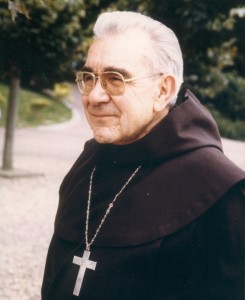 Guy Gaucher, O.C.D. Photo courtesy of the Discalced Carmelite Friars of Paris
At the beginning of the month of July 2005, Bishop Guy Gaucher became emeritus bishop of the Diocese of Bayeux and Lisieux; that is to say, having reached the age of seventy-five, the age at which bishops submit their resignation to the Pope, he retired from the position he held in the diocese and also the position he held at the Lisieux Pilgrimage Centre, both of which he had served for eighteen years.
Several gatherings marked his departure, one with the diocesan priests at Caen, on Thursday 16th June, and another on Sunday, June 19th in the basilica of Lisieux, in the presence of Pierre Pican, Bishop of Bayeux and Lisieux.
During that thanksgiving service, Bishop Guy Gaucher gave the homily which is reproduced here.
Guy Gaucher’s life was influenced by Thérèse of Lisieux, whom he made known through many lectures, articles, and works, the most important of which is Story of a Life (Cerf) [English translation published by Harper and Row].
The enormous engagement that Guy had as a Carmelite, before he became bishop, continued throughout his Episcopate. This, plus the support and energy he gives the Lisieux Pilgrimage Centre, the talent with which he presents the Theresian message, and the friendship that he shares with everyone, can all be seen in a concise form in his letter to Thérèse. The Rector of the Lisieux Pilgrimage Centre is pleased to share this fiery testimony of love with all those who love Thérèse, and for whom Bishop Guy Gaucher has been, and continues to be, a guide to make her known.
Thank you, Guy.
Bernard Lagoutte
Rector
St. Thérèse Shrine, Lisieux.
Brothers and Sisters in Christ
For this thanksgiving service, allow me, for once, not to ponder exclusively upon the Word of God.
In this Basilica where I celebrate my farewell Eucharist to the Diocese of Bayeux and Lisieux, and to the Lisieux Pilgrimage Centre, I would like to share with you one more time what I owe to Sister Thérèse of the Child Jesus of the Holy Face.
Of course, every thanksgiving goes first and foremost to the Triune God. It is the Father, Son, and Holy Spirit, the beginning and the end of everything, who lead the Church, who lead the world, who lead each one of us. But God’s grace goes through intermediaries, mediators. Thérèse Martin is one of these favoured ones.
Now that I am going to practice my Episcopal ministry in a different way--for the mission continues--I would like to give thanks for this young woman, this “beacon of our century” as Father Congar said, by way of a meditation, a testimony, which one could entitle “Why I love you, O Thérèse."
Like so many others, at first I experienced only indifference, if not scorn, toward you, Thérèse. Your statue in my parish, the ‘Orphelins d’Auteuil,' held hardly any attraction for me. At the age of twenty-two, I passed through Lisieux without bothering to visit your Carmel. Everything seemed to distance me from you: these countless merchants who offered your honeyed image, which was ugly because too “pretty”; the little--very little--I knew about you: your Catholic environment, which had turned in on itself; your collectively canonizable family; your ‘Belle Epoque,’ which exasperated me with its narrow moralism, its conformist art, its naïve confidence in Progress; your pious language; your “angelic” life at the Carmel, with its strange rules, its black veils and grilles; your romantic death as the “young girl of the rose” («de jeune fille á la rose»).
As for those who sang your praises, they irritated me even more. Truly, you had everything against you.
These difficult situations quite suit you: you love a fight. How are you going to go about moving us deeply, “catching” us, penetrating our lives like a burglar, yet without imposing your presence. Sometimes you strike like lightning; sometimes you take your time. Often you need only reveal your true face. Who can resist your secret charm? Those who do not receive this Theresian grace. Because, of course, there has to be grace there. Grace which annihilates, as if playing a game, the wall of obstacles that has been built up at a whim. So that, if you ask me why I love you, I can only reply—because it’s you. Which, obviously, doesn’t explain anything. But I have been asked to give reasons. So, let us look for them.
I love you because you remain constantly surprising, an elusive, puzzling personality. You are nothing like the wooden image that I pictured before. You surprised even yourself by the contrasts in your character. It is true, I believed you to be vapid, even though your intuitive mind never rests. You are always searching, never satisfied with your discoveries. You always want to go farther, especially where God is concerned. But you also know how to weigh up those around you; You are not taken in by those who try to impress.
Sometimes you are gentle, shy; sometimes you are a virgin warrior hungry for glory, fascinated by your sister, Joan of Arc. Persistent, bold, daring, you pursue your goal: to die for love.
At first I took you for a pious little girl, a young lady from a good family, an exemplary nun yet passionately in love with Jesus, your Beloved, using the informal ‘tu’ form to address him in private. For him, you risk everything: you run down the street after your bishop so that he might move forward the date of your First Communion; you go to see him at Bayeux (hair tied back to make you look older) so that he would agree to let you enter the Carmelite Order at fifteen; you appeal to the Pope for the same permission. You were so sure of yourself. For love alone, you became “delirious” in September 1896, suffering infinite desires that burdened your heart: you want to be a Priest, a Doctor of the Church, a missionary, a martyr . . . is this reasonable? No. You know that, but you don’t give up. You have to find a solution and you will find it.
Unassuming, quiet, and yet brave (much more so than your sister Céline), you proceed alone along unfamiliar paths. “And my own folly is this, to trust . . . ”. Your youth and your littleness is your strength.
I love you because your “little way," your brilliant Eureka, rediscovers the heart of the Gospel at a time when Christians were torn apart by a multitude of obligations, duties, and practices often done out of fear, obsessed with the Justice of God. You go right to the fundamental issue with clear simplicity, inflexible as steel. “As for me, I no longer find anything in books, with the exception of the Gospel. The Gospel is enough.”
I love you because you remained a child, or, rather, you rediscovered all the graces of a child at maturity, a privilege so rare. At twelve or thirteen you must have been unbearable with your endless tears; your looks of a Magdalene who “would cry because she had cried." What a contrast with the maturity you had in later years (when you were a little moire than twenty), something that older Carmelites came to you seeking.
I love you for your sense of humour: you have no illusions about yourself or those around you. You love the saints who joke, who are always cheerful, who are very fond of their families. That is also why we love you. When you reach maturity, about 1895, it seems to me that you are finally completely yourself: you breathe life, you freely love nature, flowers, animals, the sky, the stars . . . but first and foremost you love humankind, especially the poor in your community. In your vocation of solitude--O paradox!--your feminine nature blossoms. Your emotions, at first so disrupted (you had a rough start in life: the loss of successive mothers, your serious illness, your scruples, the “sorrows of your soul," your excessive sensitivity) stabilised, and you loved all your sisters, and your two spiritual brothers even though they were young. You moved with astonishing ease through the pettinesses and misunderstandings of the cloistered life, without despising anyone: taking care of each one and loving them just as they were.
I love you because you are true, love truth, and fight for it, mercilessly tracking down the prevarications, the small “pious” hypocrisies. You preferred to be sent away from the Carmel rather than to let Sister Marthe, your companion during the novitiate, become attached to Mother Marie Gonzague “like a dog to its master." You like clarity. How you must have suffered when you found yourself at the center of the influences of all your Mothers, who wanted to model you according to their ideal. You knew how to escape them, to be steadfast on your road of freedom, and to surrender yourself to God alone; to follow your path, inspired by the Holy Spirit. You do not want to seem but to be. Too bad if that displeased them.
I love you because at the end of your life you entered darkness and took your place at “the table of sinners." You left the Catholic ghetto, which looked down on those “great sinners” from atop its clear conscience. You go to seek your “first child” in prison, where he awaits the guillotine. Henri Pranzini will die forgiven without knowing what he owes you, but you, you will never forget him. Among your companions, we note also Hyacinthe Loyson, the former provincial of the Carmelites, married, who rebelled against papal infallibility: you consider him your “brother." Confined to your sickbed, you offer your last communion for him and offer your suffering for René Tostain, that morally irreproachable atheist who married your cousin, Marguerite Maudelonde. You experienced the trials of faith confronted by God’s silence, by giddy calls to “nothingness," by temptations to suicide, by moral and physical sufferings in many forms. Through all that, you kept the hope of a bold young woman gambling her whole life on love, without ever playing the stoic: staying little and vulnerable.
I love you because you revealed to me the spirit of Carmel and because, through you, God has inspired many people to surrender themselves to Love in the heart of the Church, by way of freely given, silent prayer. Patron of the missions of the whole world, you are the proof of the mysterious efficacy of this concealed prayer. All your posthumous life shows this, proclaims it. Little unknown Carmelite, you inspired Vatican I; you are a teacher of life for all generations, in all walks of life. You democratised holiness by living faith, hope, and love in everyday life, the life of many people.
I love you because, cheerful and daring little girl, you overturned the heavy ecclesiastical apparatus. Grave investigators wanted to make you fit the model of a definable sanctity. You foiled all their plans, and, for you, it was necessary to shorten the time regulations [for examining a candidate for sainthood]. That was easy: all the Popes were your friends. You showered the world with countless miracles, sometimes novel ones in which your sense of humour could be seen.
I love you, finally--I should stop the litany--as a sign, a reflection, a proof (what world shall I use?) of the Merciful Love of the Father manifested to the world through Jesus and the Holy Spirit which blows where it wants to. If the Trinity made you a “masterpiece of nature and grace,” we must give thanks in adoring silence. “For you, God, even silence is praise” (Ps. 64)
I love you because you are a brave and intrepid missionary of Jesus in our secularised world. During my seventeen years here at Lisieux I was able to see, through contact with crowds from all over the world, the power of your action on their hearts, on people from all classes of society, all countries, all languages.
I was also blessed to observe the incredible impact of your travels across the world. Since 1994, your Relics have reached the five continents, I have seen it with my own eyes: in Italy, Belgium, New York, the Philippines, Hong Kong, Canada, Russia, Ireland, Lebanon, Benin, Poland . . . You are truly a sister to the world.
I love you because everything you wrote is true, and you always keep your promises, this one among others: “I will spend my heaven doing good on Earth until the end of the world”.
I love you, finally--I really have to stop--because one of your promises was fulfilled on October 19th, 1997, one hundred years after your death: “Ah! In spite of my littleness, I would like to enlighten souls as did the Prophets and the Doctors . . .” (Ms B, 3 r°)
Here I would like to include in my thanksgiving Pope John Paul II. All of my episcopate took place during his pontificate.
Now, if Thérèse was declared a Doctor of the Church at the age of 24, the youngest in two thousand years; it’s really thanks to him who wanted it, overcoming every obstacle, realising that her “feminine genius” made a major contribution to the “Science of Divine Love” (the title of his Apostolic Letter of October 19, 1997).
This is also a good opportunity to give thanks to John Paul II, another mediator of divine grace for our world. How can we doubt that, since the proceedings for his Beatification open, exceptionally, next June 28th, he will soon join his friend Thérèse as a canonised saint?
***
“Our Church is the Church of Saints,” wrote Bernanos. Let us praise God for his Saints, give thanks for their existence: they are signs for the world that the Gospel is alive everywhere, in all walks of life. They are our guides, our teachers, our friends; they help us along our way. They are God’s family. Thérèse said “Who could have invented the Blessed Virgin?”. One could say “Who could have invented Sister Thérèse of the Child Jesus of the Holy Face?,” at the same time so near and so far away, so ordinary and so extraordinary: this little Norman woman, loved in all the world, whom we think we know and who always escapes us, because the last word of her being expresses something of the unfathomable mystery of the Love of God. Yes, thank you Lord for having given us Saint Therese of Lisieux. Praise be to you for this young woman who fully answered the call of your Merciful Love.
These are some reasons why I love you, O Thérèse.
Bishop Guy Gaucher, O.C.D.
Basilica of Lisieux
June 19, 2005
We thank Fr. J. Linus Ryan, O. Carm. for permission to share this text with you. It was first published at www.sttherese.com.
Maureen O'Riordan
in Guy Gaucher O.C.D., Why I Love You O Therese
|
1 Comment
| Email
| Print
The death on July 3, 2014 of Monseigneur Guy Gaucher, O.C.D., a great scholar of St. Therese of Lisieux, is announced by the Carmelite friars of the Paris province
The death of Mgr Guy Gaucher
(1930-2014)
is announced on July 3, 2014 by the Paris province of the Carmelite Friars
 Brother Guillaume Dehorter, provincial superior of the Paris province of the Discalced Carmelite friars, informs you of the
Return to God of Monseigneur Guy Gaucher
(1930-2014)
Our brother Guy left us on July 3 at 9:30 a.m. His funeral will be celebrated at Lisieux during the week of July 7, at a date which is not yet fixed. (It will be decided as soon as possible).
“No, I am not dying, I am entering into life.” This saying of Thérèse, we can say with our brother Guy, who dedicated his life to making his little sister known. How she must have welcomed him, with the Lord, into the glory of Heaven!
Guy Gaucher was born March 5, 1930 in Seine-et-Marne. Ordained a priest on March 17, 1963, he entered Carmel in our province of Paris. He pronounced his vows on October 3, 1968. He was ordained bishop of Meaux on October 19, 1986 and then auxiliary bishop of Bayeux and Lisieux on May 7, 1987, in residence at Lisieux. In 2005, having reached the age of 75 years, he retired to our convent at Lisieux and then to Vénasque (Notre Dame de Vie; that is, Our Lady of Life).
At first a great connoisseur of Georges Bernanos, Bishop Guy Gaucher was one of the greatest experts on St. Thérèse of the Child Jesus. Here is his principal bibliography:
- La biographie référence : Sainte Thérèse de Lisieux (1873-1897), août 2010, Éditions du Cerf
- « Tout est grâce ». Retraite avec Georges Bernanos dans la lumière de sainte Thérèse de Lisieux, mai 2009, Éditions du Cerf
- La Vie du Père Marie-Eugène de l’Enfant-Jésus Henri Grialou (1894-1967) « Je veux voir Dieu », mars 2007, Éditions du Cerf
- « Je voudrais parcourir la terre… » Thérèse de Lisieux thaumaturge, docteur et missionnaire, octobre 2003, Éditions du Cerf
- « Histoire d’une vie » : Thérèse Martin (1873-1897) Sœur Thérèse de l’Enfant-Jésus de la Sainte-Face » février 2002, Éditions du Cerf
- « Histoire d’une âme » de Thérèse de Lisieux, juin 2000, Éditions du Cerf
- Jean et Thérèse. L’influence de saint Jean de la Croix dans la vie et les écrits de sainte Thérèse de Lisieux » septembre 1996, Éditions du Cerf
- Georges Bernanos ou l’invincible espérance, mars 1994 Éditions du Cerf
- La Passion de Thérèse de Lisieux. 1972, réédition en 1993, Éditions du Cerf – Desclée De Brouwer.
- Sainte Thérèse de Lisieux» septembre 1992, Éditions du Cerf
- Histoire d’une vie : Thérèse Martin. 1982, Paris, Éditions du Cerf, rééd. revue et corrigée en 1993.
- Collectif, Édition du Centenaire, édition critique des œuvres de Thérèse de Lisieux, Ed. du Cerf/Desclée de Brouwer, 1971-1992
For information, please contact Father Provincial Guilaume Dehorter : provincial@carmes-paris.org
Translated from the Web site of the Paris Province of the Discalced Carmelite Friars
Maureen O'Riordan
The Shrine at Lisieux has announced that the funeral of Bishop Gaucher will take place at the Basilica of St. Therese in Lisieux on Thursday, July 10, 2014, at three o'clock. He, who was called "Therese's bishop," will repose among his Carmelite brothers, not far from the first tomb of St. Therese and the tomb of the Martin and Guérin families. The bishop of Bayeux and Lisieux, Monseigneur Jean-Claude Boulanger, will preside. Please unite yourself in prayer to this celebration, which will take place on Thursday at 9:00 a.m. Eastern Standard Time in the United States.
Maureen O'Riordan
in Carmelite friars of Paris, Guillaume Dehorter, Guy Gaucher O.C.D., July 3 2014, books about St. Therese, death
|
Post a Comment
| Email
| Print
October19, 1916 - "The Story of the 'Little Flower' - French Soldiers and Sister Therese - Relics on Regimental Flag"
On the annniversary of the assassination of Archduke Franz Ferdinand, which opened the hostilities that became World War I, and with the kind permission of the National Library of Australia's Trove Site, I'm happy to present this 1916 article about devotion to Therese among the soldiers of World War I. [Citation: 1916 'THE STORY OF 'THE LITTLE FLOWER," Freeman's Journal (Sydney, NSW : 1850 - 1932), 19 October, p. 8, viewed 29 June, 2014, http://nla.gov.au/nla.news-article115590570]. Therese was the granddaughter of two soldiers of Napoleon. She saw herself during her lifetime as engaged in a spiritual combat for souls, and it is evident that she did not forget the soldiers after her death.
I present a thumbnail image of the newspaper article. The text appears underneath them, here on my own site, for easier reading.
;)
THE STORY OF 'THE LITTLE FLOWER’
FRENCH SOLDIERS AND SISTER THERESE,
RELICS ON REGIMENTAL FLAG
Paris.
I had occasion the other day to meet Monsignor de Teil 'postulateur'— to use a technical term; — of the process of beatification of Soeur Therese de Lisieux, the young Carmelite nun who, although, she died only nineteen years ago, is now so well known throughout the Catholic world. Her brief life passed almost entirely in the silence of a Carmelite convent seemed to ordinary observers, identical with, the lives of any regular and fervent religious: there were no ecstasies, no apparently marvelous manifestations about it.
Therese was a young girl of fifteen, when she became a nun, and she was but twenty-four when, after a lingering illness, she died as happy as a tired child going home. Her chief characteristics were her ardent love for and confidence in God and her extreme simplicity. Although her exterior life was marked by no extraordinary manifestations, its interior perfection deeply impressed her Prioress, who, in consequence, commanded her to write the story of her vocation; a happy thought, as it proved, for it is the book thus written, from obedience, that made the little Sister's name known throughout the Christian world, for the greater happiness of many souls.
A Promise Fulfilled
Soeur Therese died at Lisieux, in September, 1897, aged twenty-four. One of her last utterances seemed to prophesy the countless favours that have been obtained through her intercession. 'I wish,' she said, 'to spend my time in Heaven in doing good on earth. After my death I will scatter a shower of roses.' It was this 'shower' of graces, and also the important testimonies received in Rome as to Soeur Therese's holiness, that induced Pope Pius X. to 'introduce her cause' in June, 1914, and as we write these lines the process of beatification is being pursued before the Congregation of Rites [today the Congregation for the Causes of Saints], with every prospect of success.
The 'shower' of favours that the little Sister predicted has never fallen so abundantly as since the beginning of the terrific conflict that weighs so heavily on thousands of hearts. Before me lies a tiny pamphlet published by the Carmelite nuns of Lisieux. There is no attempt to sound the little nun's praises, no high-flown or sensational stories, in this modest booklet; it merely quotes some extracts of the hundreds of letters that pour into the convent from the line of fire; they come not only from ignorant soldiers, but also from officers of every rank, to whom, strange as it may appear, the sweet memory of Soeur Therese brings comfort and strength in their strenuous struggle.
Letters from Soldiers
An English diplomat writes that the Catholic British 'Tommies' possess and treasure relics of the 'Little Flower,' as she is generally called by her English clients; a British chaplain that 'hundreds of soldiers' beg him for her pictures or relics; another that the influence she exercises upon the men in life and death is truly wonderful.
A French soldier, says a Red Cross nurse, died after kissing her picture, and his last words were: 'Little Sceur Therese, come and fetch me!' A Capuchin soldier, who has won the Croix de Guerre, writes: ''She continues to protect me; when I go to the trenches, the shells seem to avoid me.' Another : 'I am no longer a lonely soldier: whoever prays God and the dear little Sister is never alone on earth.' A colonel writes: 'The little saint has visibly protected my regiment; it has done more hard work and suffered fewer losses than any.' Captain A., after fifteen months campaigning, is the only officer of his regiment who is unhurt. His wife writes to Lisieux that 'when the danger is greatest he never fails to whisper, 'Sister Therese, protect us!' Some of his men remarked, 'Our captain is always standing up under a hail of fire, and we cannot understand how it is that he is unwounded.'
Relics on Regimental Flag
On certain flags is sewn a picture of the young Carmelite. 'We are going to fasten her relics to our flag and to take her into battle with us,' writes Colonel de L; and a private, who at first refused to believe in her power, now says in a letter dated March 16th, 1916 : 'I have now been obliged to yield to evidence, and have become a devotee of the little saint.'
The French prisoners in the German camps read the life of the little Sister. 'It is never to be found on the shelves of our camp library,' says a soldier-priest; and another adds that 'Sister Therese is the consolation of our prisoners, whom she visibly protects.' A non-commissioned officer in the same camp says: 'You cannot imagine the good done here by Sister Therese. I cannot take a step without hearing of the favours obtained through her intercession.'
A Place of Pilgrimage
The humble grave at Lisieux is frequented by many soldiers and officers on leave.
A young airman, who married lately, went there on his wedding day with his bride, to thank the 'Little Flower' for past favours. Another pilgrim writes that he found the grave surrounded by soldiers, one of whom, taking off his Croix de Guerre, fixed it to the wooden cross at the head of the grave, shedding tears of gratitude.
Decorations of all kinds: Military Medals, the Legion of Honour, the Croix de Guerre, arrive daily at Lisieux as thank-offerings, and are carefully put aside by the Carmelites until the hoped-for beatification of Soeur Therese allows them to pay her public honour. In the meantime, over the bloody fields of battle at the front and in anxious or bereaved circles at home, the young Carmelite scatters her 'shower of roses,' graces of preservation from death, or spiritual favours that make death acceptable. To the letters that I have quoted I might add others that tell how Sister Therese has made her presence known in a supernatural manner to those who invoke her; but in these matters the greatest prudence is necessary, and we give the contents of the letters as they were given to us, without in any way forestalling the judgment of the Church. They serve, at any rate, to prove the confidence with which the little Carmelite's clients bring her their anxieties at this crucial moment.
A Supernatural Message
A nun, known in the world as the Comtesse de X, had two brothers ; both were officers, and both were killed by a shell in August, 1914. The eldest was a practical Catholic, the second had given his sister much anxiety, and when he came to bid her good-bye he refused to go to Holy Communion like his elder brother, but he allowed his sister to pin a relic, of Soeur Therese to his tunic, and he promised never to cease to wear it. Some months elapsed, the two brothers having fallen in Alsace, on German soil. It was only in March, 1915, that Sister X was informed of their deaths, and with the news came a pencil note from the younger, saying that he had just received the Last Sacraments. 'In your prayers,' said the note, 'pray for me; I could not die without telling you that I am converted. My two legs and one arm have been carried off.' This letter reached Sister X through the Prioress of Lisieux, to whom it was sent by a comrade of. the dead officer. When she wrote to acknowledge it, Sister X informed the Prioress that she already knew of its contents. She had been officially informed, without any details, of the death of her two brothers, and with her sorrow for both mingled keen anxiety as to the spiritual condition of the younger. She became ill from grief, and, having daily recommended the younger to Sister Therese, was almost inclined to resent what she considered a betrayal of trust on the part of her heavenly friend.
On March 6th, 1915, in the evening, Sister X had a strange experience. She saw a field of battle and the prostrate figure of a soldier, whose two legs and one arm were hidden by bloody bandages. Near him knelt a Carmelite nun. She turned to Sister X, who recognised Soeur Therese's sweet face, and said these words: 'He went to Confession and to Communion.' Then the vision or dream — call it as you will — passed away.
That same evening Sister X related her strange experience to her Superioress, whose letter confirms the circumstance. The next morning, a Sunday, the same Superioress, much agitated, put the dead officer's pencil note into the hands of Sister X. It was written in Germany on August 26th, 1914, had been sent to Lisieux at the end of six months, and forwarded in a letter written by the Carmelite Prioress to Sister X's own Superioress.
A Final Anecdote
A last anecdote was told me by Monsignor de Teil. A party of French soldiers, separated from their comrades, seemed hopelessly encircled by the enemy, when one of them called out: 'I propose that if we reach the French lines safely, we should after the war erect a statue of Sister Therese of Lisieux. Will you make the promise?' The promise was duly made, and the little band of soldiers reached the French lines in a manner that seemed almost miraculous. They agreed that, after the war they would all subscribe to the statue and they drew lots to know in whose village it should be erected. Mon- signor de Teil has corresponded with the particular soldier near whose home the little Sister's statue will one day stand. He is a peasant from the north of France, the father of a family, and an excellent Catholic; he gives, as to his escape and that of his comrades, minute details that point to a special protection of Heaven.
Maureen O'Riordan
in French soldiers, Mgr de Teil, Therese of Lisieux, World War I
|
1 Comment
| Email
| Print