Saint Therese of the Child Jesus
of the Holy Face
Entries by Maureen O'Riordan (558)
"Witness, Proclamation, Communion, and Service" - excerpt from Therese of Lisieux, Doctor for the Third Millennium - September 19, 2017
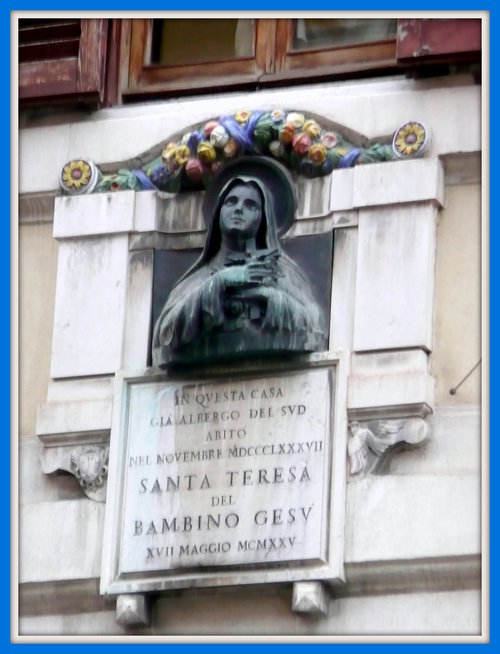 Sculpture of St. Therese on the facade of the Hotel du Sud in Rome, where she stayed as a pilgrim in November 1887 Photo credit: Juan Marrero
Section II A), "Demands of the New Evangelization," of Therese, A Doctor for the Third Millennium, siggests what is necessary to proclaim the gospel. This section continues to create the context for Therese's doctorate. Excerpted from the joint pastoral letter written by the Carmelite superiors geneeral, Fr. Camilo Maccise, O.C.D. and Fr. Joseph Chalmers, O. Carm., when Therese was named a doctor in 1997. For the footnotes, please follow the link above to the complete document.
A) Demands of the New Evangelization
10. To make the proclamation of the Gospel ring out requires following in the direction pointed out by the encyclical Redemptoris Missio: witness, proclamation, communion, and service.3 It is useful to keep these in mind in order to understand the heart and relevance of the message of Thérèse of Lisieux, Doctor of the Church.
Witness
11. To evangelize is not to transmit a doctrine but an experience transformed into life. This experience is precisely what is shared: "Something which we have heard, which we have seen with our own eyes, which we have watched and touched with our own hands…we are declaring to you…so that you too may share our life" (1 Jn 1:1-3). At the threshold of the third millennium the world to which we must give witness is largely one of unbelief and injustice. Christians are called to "always have your answer ready for people who ask you the reason for the hope that you have" (1 Pt 3:15). The question is how to make this hope and witness clearly intelligible. It must lead the faithful to revise their personal lives and the way they participate in the Church because: "People today put more trust in witnesses than in teachers, in experience than in teaching, and in life and action than in theories."4 "The evangelical witness which the world finds most appealing is that of concern for people, and of charity toward the poor, the weak and those who suffer,"5 along with a commitment to peace, justice, and human rights.6
Proclamation
12. As well as witnessing by their lives, Christians fulfill their evangelical missions by proclaiming the good news of salvation: Christ has died and is risen, and he has transformed us into sons and daughters of God; he has set us free from the slavery of evil, sin, and death. We must proclaim the love of God, our Father, who calls us to union with Him. The good news is addressed to all. There are some areas that need our particular attention in our day: big cities tend to foster individualism, anonymity, cultural disintegration, pluralism, and indifference. Young people in particular need to be evangelized. They are the future of the world. There is also urgent need to proclaim the Gospel among the masses of non-practicing Christians. Of perennial importance is the need for a first proclamation to those who have never heard the Gospel or who do not know Christ.
Communion
13. "God, however, does not make men and women holy and save them merely as individuals, without bond or link between one another. Rather has it pleased him to bring mankind together as one people, a people which acknowledges him in truth and serves him in holiness."7 with these words the Second Vatican Council stressed that faith is lived in community, that the fruit of evangelization and the action of the Spirit is the creation of fraternal communities forming the new family of God. The coming of Christ manifests itself in this communion. "By this we know that we have passed from death to life (cf. 1 Jn 3:14)…and from communion there emanates a source of great apostolic energy."8 Communion comes about as a result of faith and the sacraments of faith which lead us to a koinonía, open to all, especially to those who believe in Christ through an ecumenism that is active and in solidarity. Communion demands a sincere and fraternal dialogue.
Service
14. Faith needs to be expressed in deeds because in Christ Jesus "only faith working through love" (Gal 5:6) has value. To serve God and people is the best proof of love. Christian diakonía is nothing else than following Jesus who "came not to be served but to serve" (Mt 20:28), and who lived among us "as one who serves" (LK 22:27). From the beginning, Christian service has been notable toward the poor, the outcasts, and the suffering. For this reason, at the threshold of the Great Jubilee of the Year 2000, John Paul II, in his Apostolic Letter "Tertio Millenio Adveniente," did not hesitate to state: "Indeed, it has to be said that a commitment to justice and peace in a world like ours, marked by so many conflicts and intolerable social and economic inequalities, is a necessary condition for the preparation and celebration of the Jubilee."9
Stay tuned for the next section, "Therese: Doctor of the Experience of a God both Merciful and Near to Us," which speaks more precisely of Therese herself.
 Maureen O'Riordan
|
Maureen O'Riordan
|
 Post a Comment
|
Post a Comment
|  Email
|
Email
|  Print
Print
Section II, "Therese of Lisieux, Doctor for the Third Millennium," of the joint pastoral letter written by the superiors of the Carmelite Orders when St. Therese was named a Doctor of the Church in 1997
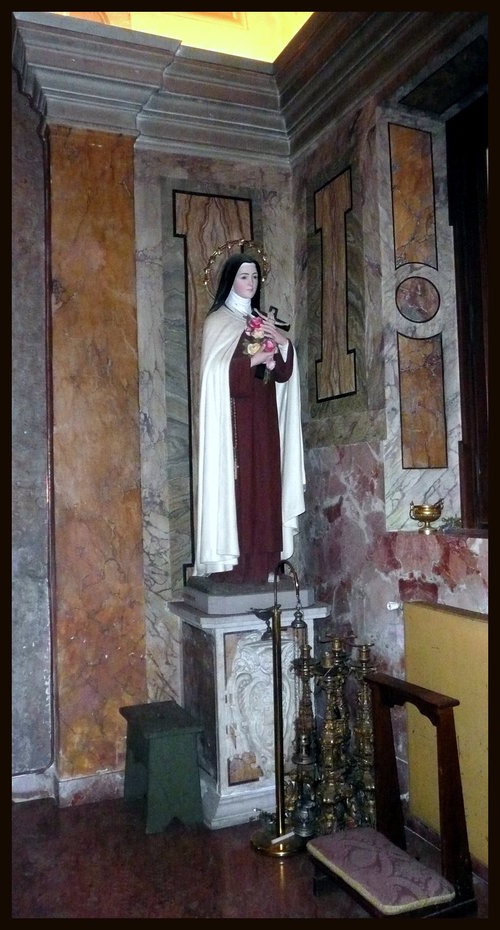
A statue of Therese, donated by Celine, at Santa Maria
della Vittoria in Rome, near the place where Therese,
as a pilgrim, wandered into the inner cloisters.
Photo credit: Juan Marrero
The beginning of Section II of Therese, A Doctor for the Third Millennium, the joint pastoral letter written by the Superior Generals of the two branches of the Carmelite Order, Fr. Camilo Maccise, O.C.D. and Fr. Joseph Chalmers, O. Carm., creates the context for Therese's doctorate: the new millennium as a time of grace and the need for a new evangelization to respond to this time of grace.
II. Thérèse of Lisieux, Doctor for the Third Millennium
8. To speak of the third millennium is to speak, in the first place, of time and the action of God. He manifests himself and works within human events. Teresa of Jesus told us, "It is always a suitable time for God to grant great favors" (Foundations 4, 5). Two thousand years of Christian history are about to conclude. In celebrating this historical event, "It is certainly not a matter of indulging in a new millenarianism, as occurred in some quarters at the end of the first millennium; rather, it is aimed at increasing sensitivity to all that the Spirit is saying to the Church and to the churches (cf. Rv 2:7 ff.), as well as to individuals through charisms meant to serve the whole community. …Despite appearances, humanity continues to await the revelation of the children of God, and lives by this hope."1 God calls us today, as he did yesterday and will always, to construct our personal and community existence through a reply that is free and responsible.
9. With regard to the celebration of the Great Jubilee of the Year 2000, God has awakened in the Church the awareness of a need for a new evangelization in order to respond to this special time of grace, and to renew faith, hope, and love by centering them on Jesus, who is the only Savior and center of history. He reveals to us the true face of God and helps us discover the presence and action of the Spirit in people and in the world.
History, our world, is the place where the saving presence of God is at work and the place where the responsibility of persons lies. "The church emphasizes the importance of history as the place in which God manifests himself. …But it is precise to say as well that the Church understands that time, liberty, and history are the place in which mankind constructs human existence. Both need to be present, not in an incommunicable parallel, rather in a dialogue, which, on God's part, is gratuitous and initiates and, on the part of mankind, is open to transcendental meaning."2
The time of new evangelization is also a time of great trials and challenges for the world. We cannot separate these two things. The Gospel of Jesus, confided to the Church to be proclaimed and realized in the world around us, challenges us by its content and all that is in contrast with it. The Gospel throws its light on these challenges and claims our total attention. Leaving aside the constancy of it, let us direct our words solely to the demands presented to us directly in the field of evangelization itself.
(my emphasis).
Coming soon:
the next section:
"Demands of the new evangelization:
witness, proclamation, communion, and service."
Maureen O'Riordan
|
Post a Comment
| Email
| Print
"A Long Road Towards the Doctorate," Section 1 of the joint pastoral letter written by the Carmelite Superiors General when St. Therese was named a Doctor of the Church in 1997 - September 9, 2017

St, Teresa of Avila, St. Therese of Lisieux, and St. Catherine of Siena, the first three women doctors of the Church, Stained glass window in St. Therese of Lisieux Parish, Montauk, New York
Section I of Therese, A Doctor for the Third Millennium, the joint pastoral letter written by the Superior Generals of the two branches of the Carmelite Order, Fr. Camilo Maccise, O.C.D. and Fr. Joseph Chalmers, O. Carm., details the enthusiasm for Therese's doctorate that culminated with a formal request to the Vatican in 1932. It was turned down because Therese was a woman. Further movement occurred only after 1970, when Pope Paul VI named St. Teresa of Avila and St. Catherine of Siena Doctors of the Church.
I. A LONG ROAD TOWARDS THE DOCTORATE
First Steps
4. Already from the time of her canonization, there was no lack of bishops, preachers, theologians, and faithful from different countries who sought to have our sister Thérèse of Lisieux declared a Doctor of the Church. This flow of petitions in favor of the doctorate became official in 1932 on the occasion of the inauguration of the crypt of the Basilica at Lisieux, which was accompanied by a congress at which five cardinals, fifty bishops, and a great number of faithful participated. On June 30, Fr. Gustave Desbuquois, SJ, with clear and precise theological argument, spoke of Thérèse of Lisieux as Doctor of the Church. Surprisingly, his proposal had the support of many of the participants, bishops, and theologians. This positive reaction to the suggestion of Fr. Desbuquois spread universally. Mons. Clouthier, Bishop of Trois Rivières, Canada, wrote to all the bishops of the world in order to prepare a petition to the Holy See. By 1933 he had already received 342 positive replies from bishops who supported the proposal to have Thérèse of Lisieux declared a Doctor of the Church.
The Obstacle of Being a Woman
5 The petition of Fr. Desbuquois was presented to Pope Pius XI, along with a letter of Mother Agnes of Jesus, sister of Therese and prioress of the Lisieux Carmel. She informed the Pope about the great success of the Theresian Congress. On 31 August 1932, Cardinal Pacelli, Secretary of State, replied to Mother Agnes' letter on behalf of the Pope. He was very pleased about the positive results of the congress, but added that it would be better not to speak of Thérèse's doctorate yet, even though, "Her doctrine never ceased to be for him a sure light for souls searching to know the spirit of the Gospel."
However, the time was not yet ripe for a woman to be declared a Doctor of the Church. In fact, Pope Pius XI had already replied negatively to the Carmelites' petition to have St. Teresa of Jesus, "Mother of Spiritual People" declared doctor. The petition was turned down because she was a woman. "Obstat sexus" ("Her sex stands in the way"), the Pope replied, adding that he would leave the decision to his successor. After the Vatican's negative response, and by its order, the gathering of signatures in favor of Thérèse of Lisieux's doctorate was interrupted.
Circumstances Change
6. Teresa of Jesus and Catherine of Siena's declaration as Doctors of the Church in 1970 eliminated completely any obstacle to naming a woman doctor. As a result, the proposal for the doctorate of Thérèse of Lisieux was taken up again.
In 1973, the centenary of her birth, Mgr. Garrone stated the question anew: "Could St. Thérèse of Lisieux become some day a Doctor of the Church? I respond affirmatively, without hesitation, encouraged by what has happened to the great St. Teresa and St. Catherine of Siena." On subsequent occasions, the Carmelites proposed the possibility of the doctorate. In 1981, Cardinal Roger Etchegaray, following up a petition from the Teresian Carmel and after consulting the permanent council of the French Episcopate, sent an official letter to Pope John Paul II asking him to declare Thérèse of Lisieux Doctor of the Church. On different occasions the Discalced postulator general and the bishop of Lisieux, Mgr. Pierre Pican, wrote official letters to this effect. The general chapters of the Teresian Carmel in 1991 and the Carmelites of the Ancient Observance in 1995 also sent petitions. In addition, more than thirty episcopal conferences and thousands of Christians, priests, religious, and lay people of 107 countries pronounced themselves in favor of the doctorate.
Examination and Approval of the Positio
7. In the first months of this year 1997, the Teresian Carmel was asked to prepare the "Positio," i.e. the presentation of proof required by the church to demonstrate a person's suitability to be declared Doctor of the Church. Because the time allowed was limited, collaboration was necessary. At the beginning of May, a 965-page volume was printed. It was divided into 4 parts and 13 chapters that presented the facts of the life and doctrine of St. Therese and the prominence, influence, and present-day impact of her message. It contains a brief history of the causes for her beatification and canonization (ch. 1) and the process for the doctorate (ch. 2), followed by a small but compact biography of Thérèse of Lisieux (ch. 3), an analysis of her personality (ch. 4), a chronology (ch. 5), and a presentation of her writings (ch. 6). From the doctrinal point of view, it offers a general view of Thérèse's doctrine (ch. 7), a synthesis of her theology (ch. 8), and a study of the sources of her teachings (ch. 9). The impact of Thérèse of Lisieux is examined from three different perspectives: the acceptance and presentation of her doctrine by the magisterium of the church (ch. 10), its spread and influence (ch. 11), and finally the importance of her doctrine for the Church and world of today (ch. 12). The final chapter of the Positio highlilghts the "eminence"of the doctrine of St. Thérèse of the Child Jesus and the Holy Face (ch. 13). It concludes with the transcripts of the letters proposing the doctorate from episcopal conferences and ecclesiastical and lay personages. A selected bibliography (130 pages) is also included, as well as the opinions of the five theologians chosen by the Congregation for the Doctrine of the Faith, and the two by the Congregation for the Causes of Saints. There is also an iconographic appendix that shows Thérèse as teacher and doctor.
After studying the Positio, the Congregations for the Doctrine of the Faith and for the Causes of Saints, along with the Consistory of Cardinals, gave their approval that our sister could be declared Doctor of the Church. Pope John Paul II, as we said, agreed to the proposal, announcing it to the Universal Church at the end of the International Gathering of Youth in Paris.
Maureen O'Riordan
|
Post a Comment
| Email
| Print
Meditation on "Therese, a Doctor for the Third Millennium," the 1997 circular letter to the Carmelite Family about the proclamation of St. Therese as a Doctor of the Church

 Statue of St. Therese near the entrance of the Lisieux Carmel
As we draw near to the 20th anniversary of the day (October 19, 1997) when Pope John Paul II proclaimed St. Therese a Doctor of the Church, I invite you to reflect on the joint pastoral letter written by the general superiors of the two branches of the Carmelite family, Fr. Camilo Maccise, O.C.D. and Fr. Joseph Chalmers, O. Carm. Because the letter is extremely rich, we will look at it in sections. If you want to read the whole letter at once, you may do so, thanks to the Carmelites of Eldridge, Iowa, at "Therese: A Doctor for the Third Millennium." I am most grateful to the nuns of the Eldridge Carmel for making this meditation feasible.
The authors introduce their letter by evoking the Pope's announcement at World Youth Day, August 24, 1997, that he would name St. Therese a Doctor of the Church in October. They then give a brief history of the movement and process of Therese's doctorate, and spend most of the letter reflecting on the significance for the women and men of our times of her being named a doctor. Today, please meditate on their introduction:
Dear brothers and sisters in Carmel:
1. Little over a year ago, we wrote to you to reflect upon the message of our sister, Thérèse of the Child Jesus and the Holy Face, on the occasion of the centenary of her death. We had no idea then that we would be writing another circular letter about her so soon. This time it is to consider the meaning and significance of the title Doctor of the Church, which, as Pope John Paul II announced recently in Paris at the International Gathering of Youth, he will officially bestow on her in Rome on October 19, 1997, International Mission Sunday.
2. On the morning of August 24, at the closure in Paris of the International Gathering of Youth, the Pope described the character and doctrine of our sister and the motives for declaring her a Doctor after a "careful study" and many petitions received from the Universal Church. He called Thérèse of Lisieux a young Carmelite who was filled with the love of God, who offered herself completely to this love, and who knew how to practice love of neighbor in the ordinary things of daily life. She imitated Jesus as she sat at the table of sinners, his brothers and sisters, so that they would be purified by love, since her ardent desire was to see everyone enlightened by faith. She discovered, the Pope continued, that her vocation was to be love in the heart of the Church, and she walked the "little way" of children who take refuge in God with bold confidence. The core of her message is her child-like attitude, which can be proposed to all the faithful. "Her teachings, a veritable science of love," are the radiant expression of her knowledge of the mystery of Christ and her personal experience of grace. She will continue to assist the people of today and the future to understand better the gifts of God and to spread the good news of infinite love.
3. The Pope called her: "a Carmelite and an apostle, a teacher of spiritual wisdom for numerous consecrated and lay persons, patroness of the missions." He mentioned that she "occupies a place of primary importance in the Church, and that her doctrine merits finding a place among the most effective." He concluded by stating that he wished to announce the Doctorate of Thérèse of Lisieux during the gathering of the youth since she, a young saint, so close to our times, has a message particularly suitable for them. In the school of the Gospel, she leads the way towards Christian maturity for young people, "calling them to unlimited generosity and inviting them in the heart of the Church to be apostles and ardent witnesses of Christ's love." He prayed, along with the young people, to Thérèse of Lisieux that she may lead the people of this age along the way of truth and life. He ended his discourse with these words: "With Thérèse of the Child Jesus, let us turn to the Virgin Mary, whom she honored and prayed to with child-like confidence during her life."
Maureen O'Riordan
in 1997, Doctor of the Church, Doctor of the Church, St Therese of Lisieux, World Youth Day, pastoral letter to the Carmelite family
|
Post a Comment
| Email
| Print
St. Zelie Martin died 140 years ago today. Read "Death of a mama: August 28, 1877" - translated article about the death of Saint Zelie Martin, mother of St. Therese
 The first tombstone of St. Zelie Martin, from her first tomb in the cemetery of the basilica of Notre Dame in Alencon. Photo credit: Susan Ehlert
Saint Zelie Martin died 140 years ago, on August 28, 1877, at 12:30 a.m. This article "Death of a mama: August 28, 1877," translated for us from Therese de Lisieux, the magazine of the Pilgrimage Office at Lisieux, .gives details of her last hours, her death, and her funeral. It includes the testimony of Louise Marais, the maid who looked after Zelie in her last illness.
May Saint Zelie, who accepted her illness, its pain, and her early death with extraordinary courage, and who confided her husband and the five minor children she was obliged to leave to God's care, intercede for all mothers who die young and all children who lose their mothers early.