Saint Therese of the Child Jesus
of the Holy Face
Entries by Maureen O'Riordan (558)
For Dorothy Day's birthday, November 8: her reprinted book "Therese: The Story of Saint Therese of Lisieux"
Dorothy Day's classic book Therese: The Story of Saint Therese of Lisieux, in which Dorothy shares how Therese entered and re-entered her life, how she finally became devoted to Therese, and how Therese and the Martin family inspired her in the Catholic Worker movement, has been reprinted. Dorothy was born on November 8, 1897, about five weeks after Therese's death on September 30, 1897.
About eight years after Dorothy died, I had the honor of speaking at the Catholic Worker in New York about St. Therese. Many friends and former co-worker's of Dorothy's came back to the house for the occasion, and the evening truly brought Dorothy's devotion to Therese to life for me. To celebrate Dorothy's birthday by learning more about the book or purchasing it, click on the image below:


To learn more about Dorothy Day, please see, thanks to Fr. James Martin, S.J., text, photos, and a video about her. May she, with Therese, continue to draw "little souls" to the Heart of Christ.
 Maureen O'Riordan
in Dorothy Day, Therese of Lisieux, books about St. Therese
|
Maureen O'Riordan
in Dorothy Day, Therese of Lisieux, books about St. Therese
|
 Post a Comment
|
Post a Comment
|  Email
|
Email
|  Print
Print
An important step toward the canonization of St. Therese's parents: November 4, 2014
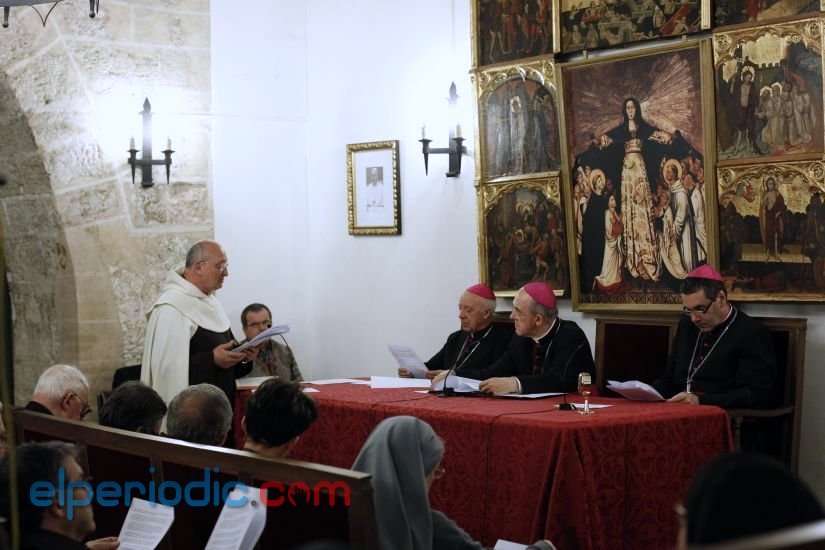 Fr. Antonio Sangalli, the vice-postulator, speaks at the diocesan inquiry. Credit: elperiodico.com
The doctors of the Congregation for the Causes of Saints have declared that the healing of little Carmen, whose unexplained recovery from a brain hemorrhage soon after she was born is the "presumed miracle" submitted for the canonization of Blessed Louis and Zelie Martin, cannot be explained by the intervention of medicine. Read more at our companion site, Blessed Zelie and Louis Martin, The Parents of St. Therese of Lisieux.
Maureen O'Riordan
in Beatos Celia Guerin y Luis Martin, Blessed Louis and Zelie Martin; miracle; Father Antonio Sangalli
|
Post a Comment
| Email
| Print
The Carmel of Lisieux presents a video of the recreation room known by St. Therese
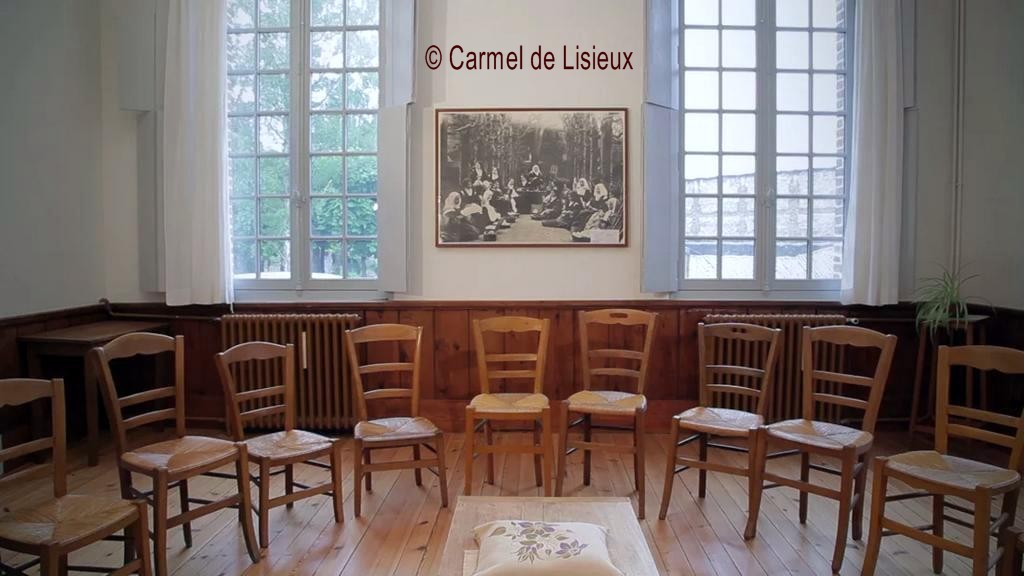 A four-minute film of the recreation room in the Lisieux Carmel, where "Story of a Soul" was born.
The Carmelites of Lisieux present a four-minute film in English of the recreation room St. Therese knew.
The daily schedule of the Lisieux Carmel allowed an hour of communal recreation after lunch and again after supper. This was one of the few times the nuns were free to speak. In the summer, recreation was often spent in the "chestnut walk" (see the photo on the wall above, where Therese, with the statue of the Child Jesus, was photographed with her sisters), but in the winter and cooler seasons it was in this room on the ground floor, called the "warming room" (le chauffoir) because, unlike the other rooms in the monastery, it had a fireplace.
Many incidents reported by Therese or her Carmelite sisters took place in this room, and all her religious plays were produced here. Perhaps the most historic moment was a conversation among Therese and her sisters Marie and Pauline that led to Therese's writing her memoir, "Story of a Soul," which has transformed so many lives. Pauline, who was prioress at the time, testified in 1910:
One winter's evening early in 1895 (two and a half years before Sister Therese's death), I was chatting with my two sisters, Marie and Therese, and the latter was telling us a lot of stories about her childhood. "Mother," said Sister Marie of the Sacred Heart [Marie Martin], "what a pity we haven't got all that in writing! If you asked Sister Therese of the Child Jesus to write down her childhood memories for us, I'm sure we'd find them very entertaining." "I couldn't ask for anything better," I replied. Then I turned to Sister Therese, who was laughing at what she took to be a bit of leg-pulling, and said "I order you to write down all your childhood memories."
St. Therese of Lisieux by those who knew her, testimonies from the process of beatification, edited and translated by Christopher O'Mahony. Dublin: Veritas Publications, 1975, p. 33.
This conversation, at which the fourth sister, Celine, was not present, took place during the holidays after Christmas 1894; it could have been on Therese's twenty-second birthday, January 2, 1895.
See two early photos of this room at the Web site of the Archives of the Carmel of Lisieux.
We congratulate and thank the Carmel of Lisieux and the Association of the friends of St. Therese and of her Carmel, which produced this film. Thanks to their generosity and accomplishment, we can see without leaving home what the pilgrims who have flocked to Lisieux since Therese's death could not see: the rooms where, in her adventure of faith, she allowed God, "content with my weak efforts, to raise me to Himself and make me a saint, clothing me with His infinite merits."
Maureen O'Riordan
in Lisieux Carmel, St. Therese of Lisieux, recreation room, video of Lisieux Carmel
|
Post a Comment
| Email
| Print
17th anniversary of St. Therese of Lisieux being named a Doctor of the Church on October 19, 1997
 Statue of St. Therese as a Doctor of the Church, Carmelite Monastery, Philadelphia. In her right hand she holds the biretta, the symbol of the doctorate.
To celebrate this anniversary, please visit St. Therese of Lisieux, Doctor of the Universal Church There you can see "The Science of Divine Love," the Apostolic Letter of St. John Paul II naming St. Therese a Doctor of the Church; his homily at the Doctoral Mass; an interview about Therese's doctorate with "Therese's bishop," Guy Gaucher, O.C.D., who died July 3, 2014; and other fascinating speeches, documents, and articles on this subject.
If you're especially interested in Therese's doctorate, please see Therese of Lisieux: Doctor of the Church - A Study of the Cause, Process, and Proclamation of October 19, 199 , a master's thesis by Mary Ellen Malolepszy that is available online.
Today, considering that St. Therese is a Doctor of the Church, I am struck by the lines she wrote to her priest-brother, Adolphe Roulland, on May 9, 1897:
.At times, when I am reading certain spiritual treatises in which perfection is shown through a thousand obstacles, surrounded by a crowd of illusions, my poor little mind quickly tires; I close the learned book that is breaking my head and drying up my heart, and I take up Holy Scripture. Then all seems luminous to me; a single word uncovers for my soul infinite horizons, perfection seems simple to me, I see it is sufficient to recognize one's nothingness and to abandon oneself as a child into God's arms.
She is truly the doctor of the poor and the simple, showing that God can make Scripture "luminous" for the soul and can inspire us without the need for learned books.
Maureen O'Riordan
in Doctor of the Church, St. Therese of Lisieux
|
Post a Comment
| Email
| Print
Video (1:22) of the ceremony at which St. John Paul II named St. Therese of Lisieux a Doctor of the Church, October 19, 1997
See St. John Paul II naming St. Therese a doctor of the Church before the vast crowd in St. Peter's Square; hear him say, in French, her famous words "My vocation, at last I have found it! My vocation is love," and see women from different countries casting rose petals on her reliquary. Thanks to ina.fr.
Maureen O'Riordan
in Doctor of the Church, Mission Sunday, October 19 1997, Pope John Paul II, Therese of Lisieux
|
Post a Comment
| Email
| Print