Saint Therese of the Child Jesus
of the Holy Face
Entries by Maureen O'Riordan (558)
December 14: the anniversary of the day St. Therese was proclaimed patron of missions by Pope Pius XI on December 14, 1927
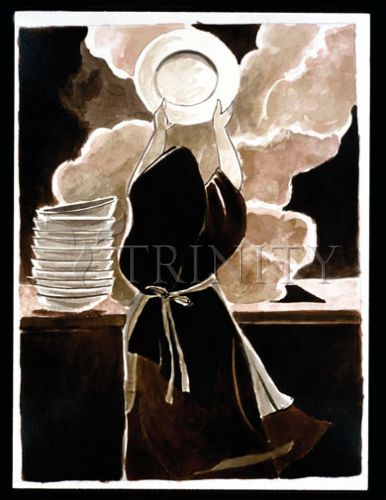 St Therese doing dishes, an icon by Brother Mickey McGrath, OSFS. To purchase from Trinity Icon Stores, please click on the image.
On December 14, 1927, the Congregation of Rites proclaimed a decree by Pope Pius XI that declared St. Therese of Lisieux, canonized less than three years before, patron of all missionaries, both men and women, the equal of St. Francis Xavier, who had held the title of Patron of Missions alone. The Congregation of Rites and the Propagation of the Faith opposed making St. Therese patron of missions, but Pope Pius XI insisted on it.
The letter written in 2007 for the 80th anniversary of the proclamation of St. Therese as patron of missions by Dámaso Zuazua, O.C.D., then General Secretary of the Missions of the Discalced Carmelite Order, (thanks to the Internet Archive), has many valuable insights into the history and significance of Pius XI's conferring this title on Therese, who had already, in 1921, been named patron of the Carmelite missions. I recommend reading it.
Therese really believed that her fidelity to the smallest demands of her everyday life made a difference to the eternal salvation of souls. In 1910 her young novice, Sister Marie of the Trinity, testified about this attitude:
Her love for God gave her a burning zeal for the salvation of souls, especially those of priests; she offered all her sacrifices for their sanctification, and urged me to do likewise. She called sinners "her children" and took her role as their "mother" very seriously. She was passionately fond of them, and worked for them with untiring fervor.
One washing-day, I was sauntering along to the laundry, looking at the flowers in the garden as I went, when along came Sister Therese at a brisk pace, and overtook me. "Is that how one hurries with children to feed and work to do so they can live?" she said, and then, dragging me with her, "Come on, let's hurry; if we amuse ourselves here, our children will die of hunger."
St. Therese of Lisieux by those who knew her, tr. Christopher O'Mahony, O.C.D. Dublin: Veritas Press, 1975, p. 237. (If you want to see what Therese's lived holiness looked like from the outside, this book, consisting of the testimony of witnesses at the first diocesan inquiry 13 years after she died, is invaluable).
In this encounter Therese showed her solidarity with the poor and with the working mothers of the world (a solidarity prefigured by her parents, Blessed Louis and Zelie Martin, who went daily to the 5:30 a.m. Mass because it was the Mass of the poor and the only one the workers could attend). She truly believed that if she were not generous in carrying out her duties, her "children" would go without. The other nuns remarked that when she arrived at the laundry (one of the hardest physical tasks the nuns had to do), she chose the least comfortable place: near the hot water in summer, near the cold rinsing tub in winter, and she worked energetically at every moment. In a small contemplative community, she avoided the temptation to become closed in on herself. She modeled what Pope Francis asked for many years later when speaking to women religious from 75 countries:
Chastity for the Kingdom of Heaven shows how affection has its place in mature freedom and becomes a sign of the future world, to make God’s primacy shine forever. But, please, [make it] a ‘fertile’ chastity, which generates spiritual children in the Church.
The consecrated are mothers: they must be mothers and not ‘spinsters’!
Forgive me if I talk like this but this maternity of consecrated life, this fruitfulness is important! May this joy of spiritual fruitfulness animate your existence. Be mothers, like the images of the Mother Mary and the Mother Church. You cannot understand Mary without her motherhood; you cannot understand the Church without her motherhood, and you are icons of Mary and of the Church.”
"Pope Francis to nuns: Don't be old maids," by Melnda Henneberger, May 8, 2013.
Celine tells us that Therese had observed in Carmel some nuns who had yielded to the temptation to be spinsters:
. . . . in a letter dated 15 September 1972, Fr. Louis Augros, the first superior of the famous “Mission of France," recalls that Celine, the sister of Therese, confided in him that when she entered the Carmel and realized all the faults of the community, she reproved Therese for not telling her about them before, and that, smiling, Therese answered her like this:
“I hadn’t wanted to tell you anything ahead of time, but now you see for yourself that you’ve landed in the middle of quite a crew of old maids, and you can see what you shouldn’t become!”
What would our lives be like if we lived them every day in full solidarity with the poor and with the gospel mission of Jesus? This is why I chose the icon of "Therese doing dishes" to illustrate this article. I believe that those who say Therese's way of confidence and love, often called the "little way," is nothing more than offering every little thing to God have not yet seen the whole picture. That is, in her poem, "Why I Love You, O Mary," Therese wrote "To love is to give everything," but followed that line immediately with this explanation: "It's to give oneself." Therese's God is not an insatiable idol greedy for more sacrifices; instead, her Creator thirsts to be loved by the creature. Offering what I'm doing at the moment is only the expression of the prior gift of myself. To give the whole person to God, as Therese did, transcends offering all one's tasks. Yet the energy and eagerness Therese put into all her occupations illuminates for us how she consecrated her whole self to the mission of the Church. It is also interesting that, even with her "passionate fondness for souls," she was considered of little practical use by some of her community; she wasn't good at manual work and was an assistant in all her jobs. Her failures in this regard did not disturb her or prevent her mission from being fulfilled.
Two more points:
- A close reading of Therese's writings will show that, as she grew in solidarity with "sinners," she moved from the role of their mother to that of their sister. See Jones, M. (2006). From mother to sister: The development in the understanding of mission in the life and writings of St Thérèse of Lisieux and its contemporary relevance (Master's thesis). University of Notre Dame Australia.
- For a unique contemporary interpretation of Therese's mission, please see "The Mission of Therese of Lisieux: Saigon and Beyond," by Constance FitzGerald, O.C.D. This article appeared in the Summer 1997 Article of The Way Supplement, pp. 28-37, and is copyright The Way, Heythrop College, Kensington Square, London, W85HQ England.
More on the Web about Therese's mission:
- The "Therese's mission today" page of "Saint Therese of Lisieux: A Gateway"
- "Therese of Lisieux: Woman of Culture, Education, and Peace" honored by UNESCO on the 150th anniversary of her birth, January 2, 2023

 Maureen O'Riordan
in Damaso Zuaza, From Mother to Sister, Michelle Jones, Pope Francis, Pope Pius XI, St. Francis Xavier, St. Therese of Lisieux by those who knew her, Therese of Lisieux, Therese patron of missions, Therese's mission, Why I Love You O Mary, little way, mission of St. Therese of Lisieux
|
Maureen O'Riordan
in Damaso Zuaza, From Mother to Sister, Michelle Jones, Pope Francis, Pope Pius XI, St. Francis Xavier, St. Therese of Lisieux by those who knew her, Therese of Lisieux, Therese patron of missions, Therese's mission, Why I Love You O Mary, little way, mission of St. Therese of Lisieux
|
 Post a Comment
|
Post a Comment
|  Email
|
Email
|  Print
Print
Thomas Merton (died December 10, 1968) and St. Therese of Lisieux
 An icon of Thomas Merton by Brother Robert Lentz, OFM
Forty-four years ago, on December 10, 1968, Thomas Merton, the Trappist monk, poet, author, peacemaker, died in Bangkok. Thinking gratefully of him tonight, I remember his great love for St. Therese of Lisieux. He often acknowledged her profound influence on his life. For the anniversary of his death, I share these lines from Merton:
In reading the story of this saint it is not possible to doubt from the very first word about her parents that she was a totally extraordinary saint, more extraordinary than even Saint John of the Cross or Saint Theresa of Avila, who rejoice in heaven in her, their little sister's immense simplicity and love which includes also their love and their wisdom, because all their love and wisdom came from God and was all His.
From "Run to the Mountain, The Journal of Thomas Merton, Vol. I, 1939-1941," ed. Patrick Hart, O.C.S.O. San Francisco: HarperCollins, 1996.
The icon of Thomas Merton is available at
Maureen O'Riordan
in Robert Lentz, Run to the Mountain, Therese of Lisieux, Thomas Merton, icon of Thomas Merton
|
Post a Comment
| Email
| Print
Pope Francis uses the symbol of St. Therese of Lisieux for Christian refugees in Iraq, calling them "the reeds of God." December 6, 2014
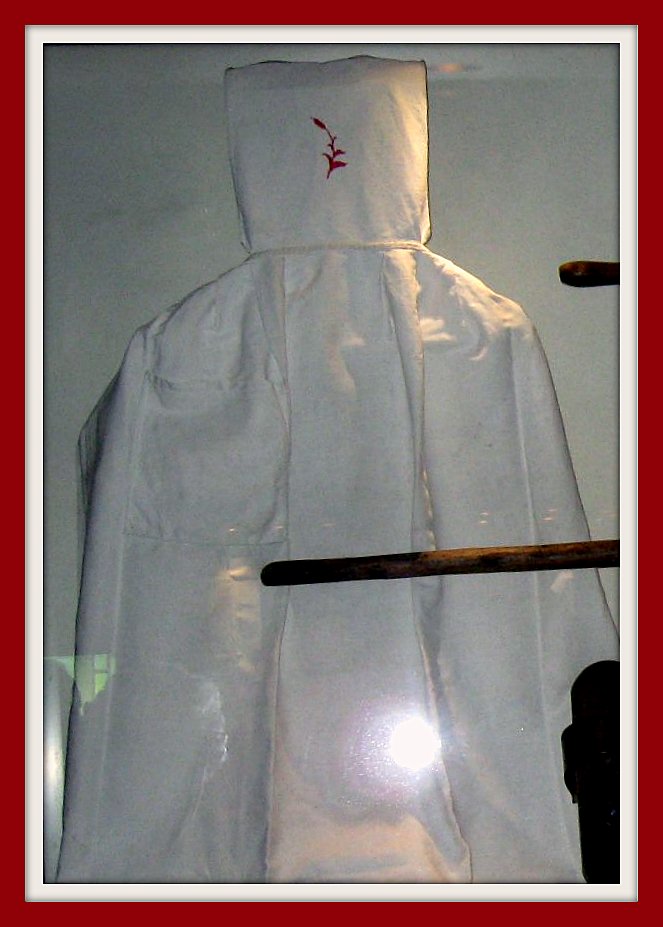 St. Therese's laundry mark, the reed, on her Carmelite work apron
On Saturday, December 6, 2014, Pope Francis sent a special video message to the Christian refugees of Mosul, in Erbil. Tens of thousands of Christians driven from their homes in Mosul have taken refuge in Erbil. They are among almost two million people displaced by the offensive of the Islamic State in northern Iraq. The Pope compared these suffering refugees to the image St. Therese used of herself, the reed that is not broken by the storm.
Today I would like to draw near to you who are enduring this suffering, to be close to you …. And I think of St. Thérèse of the Child Jesus, who said that she and the Church felt like a reed: when the wind and the storm comes, the reed bends, but it does not break! You are now this reed, you bend in suffering, but you have the strength to carry on your faith, which for us is a witness. You are the reeds of God today. The reeds that are bowed down by this fierce wind, but that will then arise!
See the text of the Pope's message, sent through Cardinal Barbarin.
The context of St. Therese's use of the symbol of the reed
Therese had many nicknames and symbols for herself. She used "the little reed" in her early religious life, usually to describe her extreme fragility. In May 1888, about a month after she entered Carmel, she wrote to her sister Marie, who was preparing to make her vows:
You, who are an eagle called to soar in the heights and to fix your gaze on the sun, pray for the very feeble little reed that is at the bottom of the valley, the least breeze makes it bend. Oh, pray for it on the day of your Profession.
See this letter (LT 49) at the Web site of the Archives of the Carmel of Lisieux.
On July 4, 1888, she wrote her sister Pauline, Sister Agnes of Jesus:
Jesus alone! Nothing but Him. The grain of sand is so little that, if it wanted to place someone other than Him in its heart, there would be no room for Jesus....
and signed the letter
"The little Reed of Jesus"
See this letter (LT 51) at the Web site of the Archives of the Carmel of Lisieux.
That same week (July 5-9, 1888), the 15-year-old postulant wrote to Sister Agnes of Jesus, and it is this letter to which Pope Francis refers:
Thanks to the dear lamb for having made the little lamb hear once again the music from heaven. The gentle breeze made the little reed sway softly....
It was after nine o'clock when the reed noticed the dear little paper; there was no earthly light, but its heart more than its eyes knew how to decipher St. Cecilia's music. It did not miss one single word!. . .
Yes, I desire them, these agonies of the heart, these pinpricks about which the lamb speaks. What does it matter to the little reed if it bends? It is not afraid of breaking, for it has been planted at the edge of the waters, and, instead of touching the ground when it bends, it encounters only a beneficent wave which strengthens it and makes it want another storm to come and pass over its frail head. Its weakness gives rise to all its confidence. It cannot break since, no matter what happens to it, it wants only to see the gentle hand of its Jesus.... Sometimes the little gusts of wind are more unbearable for the reed than the great tempests, for in these latter it will be refreshed in its dear brook, but the little gusts of wind don't make it bend low enough; these are the pinpricks....
But nothing is too much to suffer to gain the palm. . . ."
By "the great tempests" Therese could be referring to the suffering the Martin sisters experienced because of the illness of their father, who disappeared for several days at the end of June. The "pinpricks" and 'the little gusts of wind" probably refer to the little trials of community life. See this letter (LT 55) at the Web site of the Archives of the Carmel of Lisieux.
In January 1889, when Therese received the habit, the symbol of the reed found a concrete expression in her everyday life. The Carmel used symbols, not numbers, to mark each nun's laundry and shoes so that the nuns could recognize them, and Therese's laundry mark was the reed. You can see it on the photo of her work apron above. Click and scroll down to view also Therese's wooden sandals and clogs with the mark of the reed.
Therese's use of this symbol could have been suggested by her novice mistress, Sister Marie of the Angels, who loved to call herself "the little reed of Jesus." On November 21, 1889, as Therese reached the end of her prolonged novitiate and after her father had been interned in a psychiatric hospital, Sister Marie of the Angels wrote to Therese:
Little reed, infinitely loved by Jesus and profoundly dear to my heart!. . . . Tomorrow, the feast of St. Cecilia, 1 will offer my Holy Communion for my beloved little reed, and I will ask Jesus that she may love Him just as the virgin martyr did! Time seems long for me without my Benjamin; if she were not suffering, I would feel it less, but courage, little reed of Jesus! The storm will not break the reed; it will make it bend, but afterward it will quickly stand up straight and its head will again look up to heaven. Remember that Jesus carried it in His hand on the day of His Passion! Be, then, the privileged reed of your heavenly Fiancé.
Pray, too, for your little mistress, who loves and cherishes her Benjamin.
Sister Marie of the Angels
Read this letter at the Web site of the Archives of the Carmel of Lisieux.
In January 1895, when Therese finished the first manuscript of what would become Story of a Soul, she illustrated it with a "coat of arms of Jesus and Therese." In Therese's explanation of the symbolism of her coat of arms, she writes of her desire for martyrdom and adds:
In order to respond to all the love of Jesus she would desire to do for Him what He did for her ... but Thérèse is aware that she is only a weak reed, thus she has put one on her blazon
Later in her religious life Therese seems to have moved on to other symbols for herself. But in her play The Flight into Egypt (performed on January 21, 1896), when Joseph has just told Mary that he received word in a dream that they must flee to Egypt, she puts into the mouth of the Blessed Virgin about the Child Jesus and reed, words about the refugee Savior which are curiously appropriate for the refugees to whom the Pope was speaking;
I know that if He willed it, a word from His infant lips would suffice to wipe out all enemies; however, He chooses to flee from a weak mortal, He is the Prince of peace.... The Word made Child will not crush the half-broken reed, He will not extinguish a wick that is still burning. If He is rejected by those of His own heritage, that will not stop Him from giving His life for poor sinners who fail to recognize the time of His visit. Let us leave without fear, let us go sanctify an infidel shore with the presence of the Savior.
Maureen O'Riordan
in Iraq, Pope Francis, St. Therese of Lisieux, reed, reed of Jesus, refugees
|
Post a Comment
| Email
| Print
18 old postcards from Lisieux, showing the houses of St. Therese's father and uncle
The Web site of the Archives of the Carmel of Lisieux has posted a collection of 18 old postcards of Lisieux, showing, among other things, the house of Isidore Guerin, Therese's uncle, in rue Paul-Banaston in Lisieux, and, just across the back alley from it, the house at 7 rue Labbey where Louis Martin lived from shortly after he was released from the Bon Sauveur mental ohspital until he died in1894.
Maureen O'Riordan
|
Post a Comment
| Email
| Print
St. Therese of Lisieux and the Four American Churchwomen Martyred in El Salvdaor, December 2, 1980
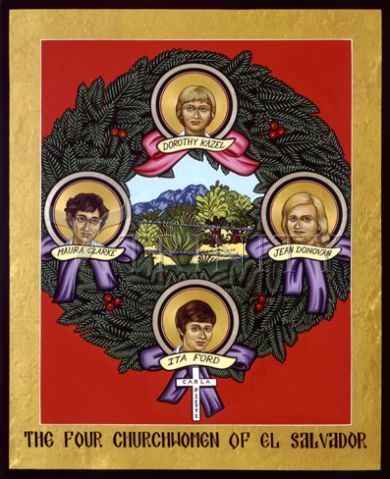 An icon by Lewis Williams, SFO
This icon, "The Four Churchwomen of El Salvador," available at Trinity Stores, represents Maryknoll missioners Ita Ford and Maura Clarke, lay missioner Jean Donovan, and Ursuline Sister Dorothy Kazel, who were martyred in El Salvador thirty-four years ago today. How they lived in the spirit of St. Therese, who loved the "little ones" of the world and who longed to be both a missionary and a martyr!
In reflecting on their lives and witness in the light of the life of St. Therese, patron of missions, I was reminded of Therese's letter of May 9, 1897 to Fr. Adolphe Roulland, the newly ordained French priest who had just gone out on mission to China, where the French were so much hated that their lives were at risk. Therese had just learned of the death of Fr. Mazel, a 26-year-old French priest in China who had been killed by looters because he was a European.
On this earth, where all changes, one single thing remains, and this is the conduct of the King of heaven regarding His friends. Ever since He has lifted up the standard of the Cross, it is under its shadow that all must fight and carry off the victory. Théophane Vénard said: "The whole of a missionary's life is fruitful in the Cross"; and again: "To be truly happy we must suffer, and to live we must die."
Brother, the beginnings of your apostolate are marked with the seal of the Cross; the Lord is treating you as a privileged one. It is more by persecution and suffering than by brilliant preaching that He wills to make His kingdom firm in souls. You say: "I am still a child who cannot speak." Père Mazel, who was ordained the same day as you, did not know how to speak either; however, he has already taken up the palm. ... Oh! how the divine thoughts are above ours! ... When learning about the death of this young missionary whom I heard named for the first time, I felt drawn to invoke him; I seemed to see him in heaven in the glorious choir of Martyrs. I know that in the eyes of men his martyrdom does not bear this name, but in the eyes of God this sacrifice without any glory is not less fruitful than the sacrifices of the first Christians, who confessed their faith before tribunals. Persecution has changed in form, the apostles of Christ have not changed in sentiment, so the divine Master would not be able to change His rewards unless it were to increase them in proportion to the glory which was refused them here below.
. . . . how can we doubt that God will open the doors of His kingdom to His children who loved Him even to sacrificing all for Him, who have not only left their family and their country to make Him known and loved, but even desire to give their life for Him whom they love....
(Letters of Saint Therese of Lisieux, Volume II, tr. John Clarke, O.C.D. Washington, D.C.: ICS Publications, 1988, pp. 1092-1093).
These words remind me so much of the women, especially of Ita, who arrived in El Salvador in April 1980, and Maura, who came to El Salvador in the autumn of 1980. In a few short months, they suffered much with the eople they loved so well. Therese's words "This sacrifice without any glory" reminded me vividly of the heart-rending film of the shallow grave by which the other nuns were kneeling--film which was all over our television screens. At that time it was only a year since I had completed my year with the Jesuit Volunteer Corps. We felt very close to these women, who were our contemporaries. To many young people today, they are historical figures, but, if you get to know them, they will inspire you no less. To learn more about them, view the 2:32 film below.


May Therese, Ita, Maura, Dorothy, and Jean draw us to witness in the shadow of the Cross to the special love of Christ for the poor, and may we share in the Resurrection they enjoy now.
Maureen O'Riordan
in Dorothy Kazel, El Salvador, Ita Ford, Jean Donovan, Maura Clarke, St. Therese of Lisieux, four American churchwomen
|
Post a Comment
| Email
| Print