Saint Therese of the Child Jesus
of the Holy Face
Entries by Maureen O'Riordan (558)
The Sacrament of Mercy - Day Five of Nine Days of Prayer and Reflection before the feast of St. Therese during the Jubilee of Mercy - September 26, 2015
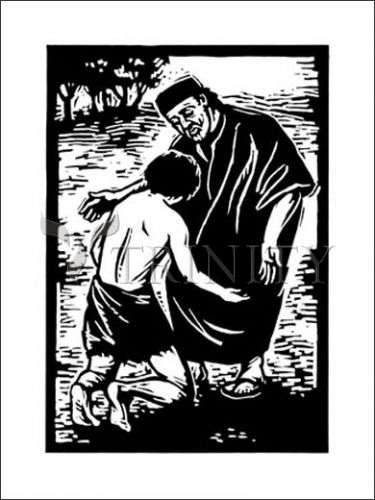 The Return of the Prodigal - an icon by Julie Lonneman
The Sacrament of Reconciliation and the Year of Mercy
During his first years in office, Pope Francis called for the renewed celebration of the Sacrament of Reconciliation: the sacrament of joy, mercy, and healing. Now he finds this sacrament important to the celebration of the Jubilee of Mercy. “Let us place the Sacrament of Reconciliation at the centre once more in such a way that it will enable people to touch the grandeur of God’s mercy with their own hands.”
In Misericordiae Vultus Pope Francis sets forth his teaching about this sacrament of mercy by speaking of the mission of confessors:
Confessors must be “ authentic signs of the Father’s mercy. . . . We become good confessors when, above all, we allow ourselves to be penitents in search of his mercy. . . . to be confessors means to participate in the very mission of Jesus to be a concrete sign of the constancy of divine love that pardons and saves . . . . None of us wields power over this Sacrament; rather, we are faithful servants of God’s mercy through it. Every confessor must accept the faithful as the father in the parable of the prodigal son: a father who runs out to meet his son despite the fact that he has squandered away his inheritance. Confessors are called to embrace the repentant son who comes back home and to express the joy of having him back again. . . . In short, confessors are called to be a sign of the primacy of mercy always, everywhere, and in every situation, no matter what.
How beautiful are Luke's words about the response of the father: "While he was still a long way off, his father saw him, and was moved with compassion, and ran to meet him."
Missionaries of Mercy
During Lent in this Jubilee Year, Pope Francis sent out Missionaries of Mercy as “a sign of the Church’s maternal solicitude for the People of God,” priests authorized to grant absolution even for sins usually reserved to the Holy See, “living signs of the Father’s readiness to welcome those in search of his pardon . . . facilitators of a truly human encounter, a source of liberation, rich with responsibility for overcoming obstacles and taking up the new life of Baptism again.”
Question:
- Where and how have I experienced God’s mercy?
- Have I experienced liberation through and healing in the Sacrament of Reconciliation?
- Who are the people who have been sacraments of mercy in my life?
St. Therese and the Sacrament of Reconciliation
St. Therese made her first confession in the Cathedral of St. Pierre in Lisieux near the date of her seventh birthday. Her radiant words show how joyful and liberating she found the sacrament:
"What a sweet memory for me! . . . Father encouraged me to be devout to the Blessed Virgin and I promised myself to redouble my tenderness for her. Coming out of the confessional I was so happy and light-hearted that I had never felt so much joy in my soul. Since then I've gone to confession on all the great feasts, and it was truly a feast for me each time."
The priest who heard her first confession, Fr. Ducellier, testified later that the little girl impressed him as a pure and pious soul and “very fearful of offending God in the smallest of things.”
Various guarded statements suggest that, as a Carmelite, Therese did not find much consolation from the monastery’s confessor or from many of the extraordinary confessors who visited from time to time. But in October 1891, less than three months before her 19th birthday, Therese met a priest who understood her. Fr. Alexis Prou, a Franciscan who “was supposed to do good to great sinners but not to religious souls,” was assigned at the last moment as a substitute to preach the community’s annual retreat. Therese said he was “appreciated only by me in the community.” Fr. Prou preached in factories (as was customary in France at that time), and it is significant that this priest who spoke to the heart of working-women also spoke to the heart of the young cloistered Carmelite who would become patron of missions. Therese writes that she had not planned to say much in the confessional about her interior trials, but “ "Hardly had I entered the confessional than I felt my soul expand. After speaking only a few words, I was understood in a marvelous way. My soul was like a book in which this priest read better than I did myself. He launched me full sail upon the waves of confidence and love which so attracted me, but upon which I had not yet dared to set out." She goes on to say that she had been worried that her faults caused God pain, but Fr. Prou did her much good by assuring her that her faults caused God no sorrow. Throughout her life she was grateful to him. See a photo of Fr. Alexis Prou and a few lines about his life.
Question:
Have you ever been ‘understood in a marvelous way?’ How was your life different after that?
What would it be like to be “launched full sail upon the waves of confidence and love?”
Time of Personal Prayer
Pray as the Holy Spirit leads you. Perhaps pray over the story of the prodigal son (Luke 15:11-32), and pause wherever you feel your heart moved.
The Prayer of Pope Francis for the Jubilee
 Maureen O'Riordan
|
Maureen O'Riordan
|
 Post a Comment
|
Post a Comment
|  Email
|
Email
|  Print
Print
"To Free the Oppressed: Day Four of the Nine Days of Reflection and Prayer before the feast of St. Therese of Lisieux during the Jubilee of Mercy - Sunday, September 25, 2016"
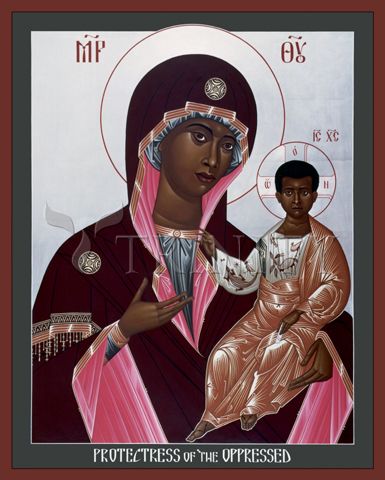
icon by Robert Lentz
A Year of the Lord's Favor
In Misericordiae Vultus, Pope Francis writes:
Luke writes that Jesus, on the Sabbath, went back to Nazareth and, as was his custom, entered the synagogue. They called upon him to read the Scripture and to comment on it. The passage was from the Book of Isaiah where it is written: “The Spirit of the Lord God is upon me, because the Lord has anointed me to bring good tidings to the afflicted; he has sent me to bind up the brokenhearted, to proclaim liberty to the captives, and freedom to those in captivity; to proclaim the year of the Lord’s favour” (Is 61:1-2). A “year of the Lord’s favour” or “mercy”: this is what the Lord proclaimed and this is what we wish to live now. This Holy Year will bring to the fore the richness of Jesus’ mission echoed in the words of the prophet: to bring a word and gesture of consolation to the poor, to proclaim liberty to those bound by new forms of slavery in modern society, to restore sight to those who can see no more because they are caught up in themselves, to restore dignity to all those from whom it has been robbed. The preaching of Jesus is made visible once more in the response of faith which Christians are called to offer by their witness.
Question: How is God callling me, my family, my faith community to console the poor, to free those bound by new forms of slavery, to bring new insight to those caught up in themselves, to restore dignity to those stripped of it?
The Biblical Jubilee
The Jubilee Year of Mercy is rooted in the ancient Hebrew tradition: every fiftieth year, debts were to be forgiven and those sold into slavery because of debt to be freed. Please read a little more about the biblical jubilee in America Magazine.
Mercy: To Liberate the Incarcerated
Although Pope Francis is not in a position to empty the jails, he shows the depth of his commitment to the imprisoned and the importance of the jubilee year to them in these lines from his letter of September 1, 2015 proclaiming the indulgence available in the Jubilee Year:
My thoughts also turn to those incarcerated, whose freedom is limited. The Jubilee Year has always constituted an opportunity for great amnesty, which is intended to include the many people who, despite deserving punishment, have become conscious of the injustice they worked and sincerely wish to re-enter society and make their honest contribution to it. May they all be touched in a tangible way by the mercy of the Father who wants to be close to those who have the greatest need of his forgiveness. They may obtain the Indulgence in the chapels of the prisons. May the gesture of directing their thought and prayer to the Father each time they cross the threshold of their cell signify for them their passage through the Holy Door, because the mercy of God is able to transform hearts, and is also able to transform bars into an experience of freedom.
Question: Am I being called to reach out to the imprisoned? How can I make a merciful difference inthe lives of those who are incarcerated and those who are re-entering?
Mercy: To Free the Oppressed
Pope Francis also asks us, during the Jubilee, to meditate on this passage from Isaiah:
“Is not this the fast that I choose: to loosen the bonds of wickedness, to undo the thongs of the yoke, to let the oppressed go free, and to break every yoke? Is it not to share your bread with the hungry, and bring the homeless poor into your house; when you see the naked, to cover him, and not to hide yourself from your own flesh? Then shall your light break forth like the dawn, and your healing shall spring up speedily; your righteousness shall go before you, the glory of the Lord shall be your rear guard. Then you shall call, and the Lord will answer; you shall cry, and he will say, here I am. If you take away from the midst of you the yoke, the pointing of the finger, and speaking wickedness, if you pour yourself out for the hungry and satisfy the desire of the afflicted, then shall your light rise in the darkness and your gloom be as the noonday. And the Lord will guide you continually, and satisfy your desire with good things, and make your bones strong; and you shall be like a watered garden, like a spring of water, whose waters fail not” (58:6-11).
One day between 1894 and 1897 St. Therese received much light from this passage. She told her sister Celine that it applied not only to the physical but also to the spiritual needs of their neighbors. She said “We are surrounded continually by multitudes of souls in need, by weak souls and souls that are sick and oppressed. Oh! to relieve them of their burdens and send them away free!” She suggested that whenever someone talks to us about the faults of a third party, instead of agreeing with the speaker, we can gently point out a virtue of the absent one.
For Therese, to ‘share one’s bread with the hungry’ is to share yourself with those who do not know where to go, to make them at home in your life by giving up your own rest and ease. By loving words and a compassionate manner, we can free oppressed souls. “How tenderly we should not only love them but also show our love for them."
[My Sister Saint Therese, by Sister Genevieve of the Holy Face, O.C.D. Rockford, Illinois: reprinted by Tan Publishers, 1997].
Question: How is God freeing me of my burdens? How can I free others of theirs?
Time of Personal Prayer
Pray as the Holy Spirit leads you. Perhaps choose one of the three passages above; pray over it, and pause wherever your heart feels moved.
The Prayer of Pope Francis for the Jubilee
Click here to read the Prayer of Pope Francis.
Maureen O'Riordan
|
Post a Comment
|
 1 Reference
| Email
| Print
1 Reference
| Email
| Print
"The Corporal and Spiritual Works of Mercy: Day Three of the Nine Days of Prayer and Reflection before the feast of St. Therese of Lisieux during the Jubilee of Mercy - September 24, 2016
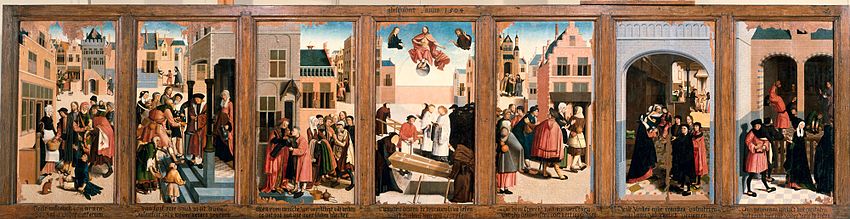 "The Works of Mercy," by the Master of Akmaar, Netherlands
In Misericordiae Vultus, Pope Francis writes:
“It is my burning desire that, during this Jubilee, the Christian people may reflect on the corporal and spiritual works of mercy. It will be a way to reawaken our conscience, too often grown dull in the face of poverty. And let us enter more deeply into the heart of the Gospel where the poor have a special experience of God’s mercy. Jesus introduces us to these works of mercy in his preaching so that we can know whether or not we are living as his disciples. Let us rediscover these corporal works of mercy: to feed the hungry, give drink to the thirsty, clothe the naked, welcome the stranger, heal the sick, visit the imprisoned, and bury the dead. And let us not forget the spiritual works of mercy: to counsel the doubtful, instruct the ignorant, admonish sinners, comfort the afflicted, forgive offences, bear patiently those who do us ill, and pray for the living and the dead.”
Most of the corporal works of mercy are based in Matthew 25:34-46, the gospel in which Jesus says “I was hungry and you fed me.” Sts. Louis and Zelie Martin practiced the works of mercy every day, and they taught this practice to their daughter Therese. Their vice-postulator, Fr. Antonio Sangalli, remarked:
Works of mercy were the very base on which Louis and Zélie Martin built their life. They showed love for neighbor, for family, for life, through corporal and spiritual works of mercy; and by carrying out these works, they grew in love for God and neighbor.
As we know, Pope Francis recently called for a Jubilee of Mercy, which, like the Martin parents, we must live out through works of mercy. We must carry out these works in all areas of life: at home, work, school and within all of our relationships. This, to me, was the Martins’ special charisma that they impart to us.
["Louis and Zelie Martin Model 'a Simple Spirituality Achieved in Daily Life." National Catholic Register, July 7, 2015]
Louis and Zelie were hardly married when they welcomed into their home a foster child whose mother had just died. When Louis went out, he always carried small change to give alms to the poor who begged of him. When he found an intoxicated man on the street, he helped him get home. At the train station, finding a poor epileptic man who had no money for his fare, he took up a collection and settled the man in his seat. Noticing a homeless family shivering near the police station, he took pains to help the father get a new job. Finding a poor old man freezing in a barn, he battled the bureaucracy for a long time to get the man into a home for the elderly. As a member of the St. Vincent de Paul Conference, he visited and cared for poor families. He arranged for the burial of a neighbor when there was no one else to attend to it.
Zelie often took care of children who needed temporary help; sent her maid to poor families with a bottle of wine, a hot meal, and coins; sent the children to give alms to the poor they met when out walking; nursed her servants and visited her employees when they were ill; went to great lengths, badgering the police and appearing in court, to rescue Armandine, a child who, taken in by two local women who pretended to be nuns, was being horribly abused. Zelie welcomed those in need to her own house and gave them food and clothes, often crying when she heard their tales of distress.
The Martins extended themselves to the spiritual works of mercy, too: teaching catechism; accompanying the dying and arranging for the priest to visit them; offering Masses for living persons in need as well as for the dead; enrolling their whole family in making novenas for the cure of a sick neighbor or the conversion of a dying one; forgiving a neighbor who sued them in a boundary dispute.
Today we may not find the poor living in our own neighborhood as Louis and Zelie did. We might imitate them by participating in service projects as a family, or volunteering with groups or institutions which allow us to serve those in need. We can support organizations which serve the increasing number of refugees.
In Carmel, Therese gave herself to the spiritual works of mercy. She devoted her life to prayer, often praying for special intentions recommended by the other nuns or by those outside the monastery; taught, counseled and admonished the novices; and forgave with her whole heart those who hurt her. Most of all, she offered herself to Merciful Love and allowed that love to flow through her. The Pope emphasizes how crucial these works of mercy are:
We cannot escape the Lord’s words to us, and they will serve as the criteria upon which we will be judged: whether we have fed the hungry and given drink to the thirsty, welcomed the stranger and clothed the naked, or spent time with the sick and those in prison (cf. Mt 25:31-45). Moreover, we will be asked if we have helped others to escape the doubt that causes them to fall into despair and which is often a source of loneliness; if we have helped to overcome the ignorance in which millions of people live, especially children deprived of the necessary means to free them from the bonds of poverty; if we have been close to the lonely and afflicted; if we have forgiven those who have offended us and have rejected all forms of anger and hate that lead to violence; if we have had the kind of patience God shows, who is so patient with us; and if we have commended our brothers and sisters to the Lord in prayer. In each of these “little ones,” Christ himself is present. His flesh becomes visible in the flesh of the tortured, the crushed, the scourged, the malnourished, and the exiled… to be acknowledged, touched, and cared for by us. Let us not forget the words of Saint John of the Cross: “as we prepare to leave this life, we will be judged on the basis of love”
Let us not use the words of Christ to make ourselves wrong, but remember that the Jubilee of Mercy is above all a time of grace. Let's ask St. Therese to celebrate her feast by obtaining from God for us the grace of recognizing his face in every human being we meet and of ministering to him in those in whom he still suffers poverty, illness, and loneliness today, so that one day He will say to us “I was hungry and you fed me . . . come, enter into eternal joy!”
Time of Personal Prayer
Pray as the Holy Spirit leads you. Consider reading over paragraph 15 of "Misericordiae Vultus” and pausing wherever your heart feels moved.
The Prayer of Pope Francis for the Jubilee
Click here to read the Prayer of Pope Francis.
Maureen O'Riordan
|
Post a Comment
| Email
| Print
"Saint Therese of the Child Jesus: An Echo of the Heart of God." September 21, 2016
Saint Therese of the Child Jesus: An Echo of the Heart of God


Definitive documentary about St. Therese, made in 1997 to honor the centenary of her death. Filmed on location in France, it gives Therese's whole story in interviews, dramatizations, and long visits to her birthplace, her home in Lisieux, and the Carmelite monastery. The distinguished Theresian scholar, the Carmelite friar Bishop Guy Gaucher, supplies commentary. 90 minutes. If you have ever longed to see the places where Therese lived and to visit the interior of her monastery, this is your chance.
To purchase the DVD "Saint Therese of the Child Jesus: An Echo of the Heart of God. click on the image above or click here.
Maureen O'Riordan
in DVD about Saint Therese, Guy Gaucher, Saint Therese of the Child Jesus
|
Post a Comment
| Email
| Print
"'The Thirst of Jesus' in the Vocations of Mother Teresa and Therese of Lisieux," by Mary Frohlich, RSCJ.
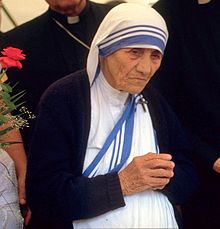 Teresa of Calcutta
To enter into the “thirst of Jesus,” then, is to touch the most radical and absolute level of desire. It is to experience, not just conceptually but in the most intimate ground of one's created being, what Emmanuel Levinas called "the idea of Infinity" that awakens the most imperious desire--in his words, "not a Desire that the possession of the Desirable slakes, but the Desire for the Infinite which the desirable arouses rather than satisfies."
On the occasion of the canonization of Mother Teresa, I recommend this article by Mary Frohlich, editor of Saint Therese of Lisieux: Essential Writings. With the distinction that characterizes all her work, she explores the theme that linked Mother Teresa to her patron saint, herese of Lisieux. This article, first published in New Theology Review in November 2008, may now be read online.
Read "'The Thirst of Jesus' in the Vocations of Mother Teresa and Therese of Lisieux."
United in the bond of sainthood, may St. Therese and her newest canonized disciple continue to quench the thirst of Jesus.
See in one volume some of the texts of the saint who inspired Teresa of Calcutta:


Saint Therese of Lisieux: Essential Writings, edited by Mary Frohlich
Ordering the book here supports this Web site.
Maureen O'Riordan
|
Post a Comment
| Email
| Print