Saint Therese of the Child Jesus
of the Holy Face
Entries by Maureen O'Riordan (558)
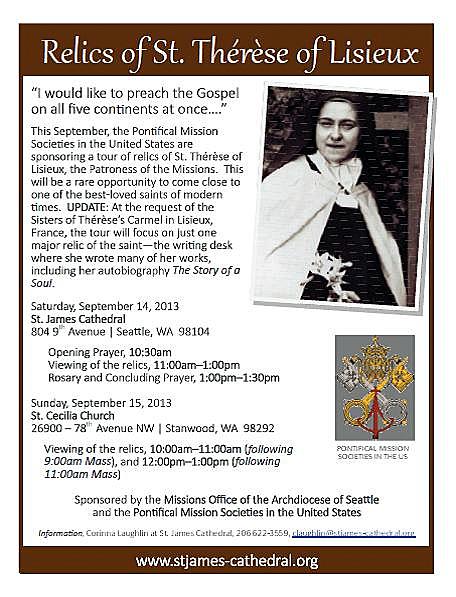
The writing-desk on which St. Therese of Lisieux wrote "Story of a Soul" will visit St. James Cathedral in Seattle on September 14, 2013 and St. Cecilia's Church in Stanwood, Washington on September 15

 Maureen O'Riordan
in Seattle, St. James Cathedral, witing-desk of St. Therese
|
Maureen O'Riordan
in Seattle, St. James Cathedral, witing-desk of St. Therese
|
 Post a Comment
|
Post a Comment
|  Email
|
Email
|  Print
Print
The religious profession of St. Therese of Lisieux, September 8, 1890
Seotember 8, 1890, the feast of the Nativity of Mary, was the date set for St. Therese's religious profession. At that time nuns did not make temporary vows, so one's novitiate ended with the one set of permanent vows. According to the custom of Carmel, professions were usually made on a feast day of Mary, the patron of the Carmelite Order. Therese wrote "Mary's nativity! What a beautiful feast on which to become the spouse of Jesus!"1
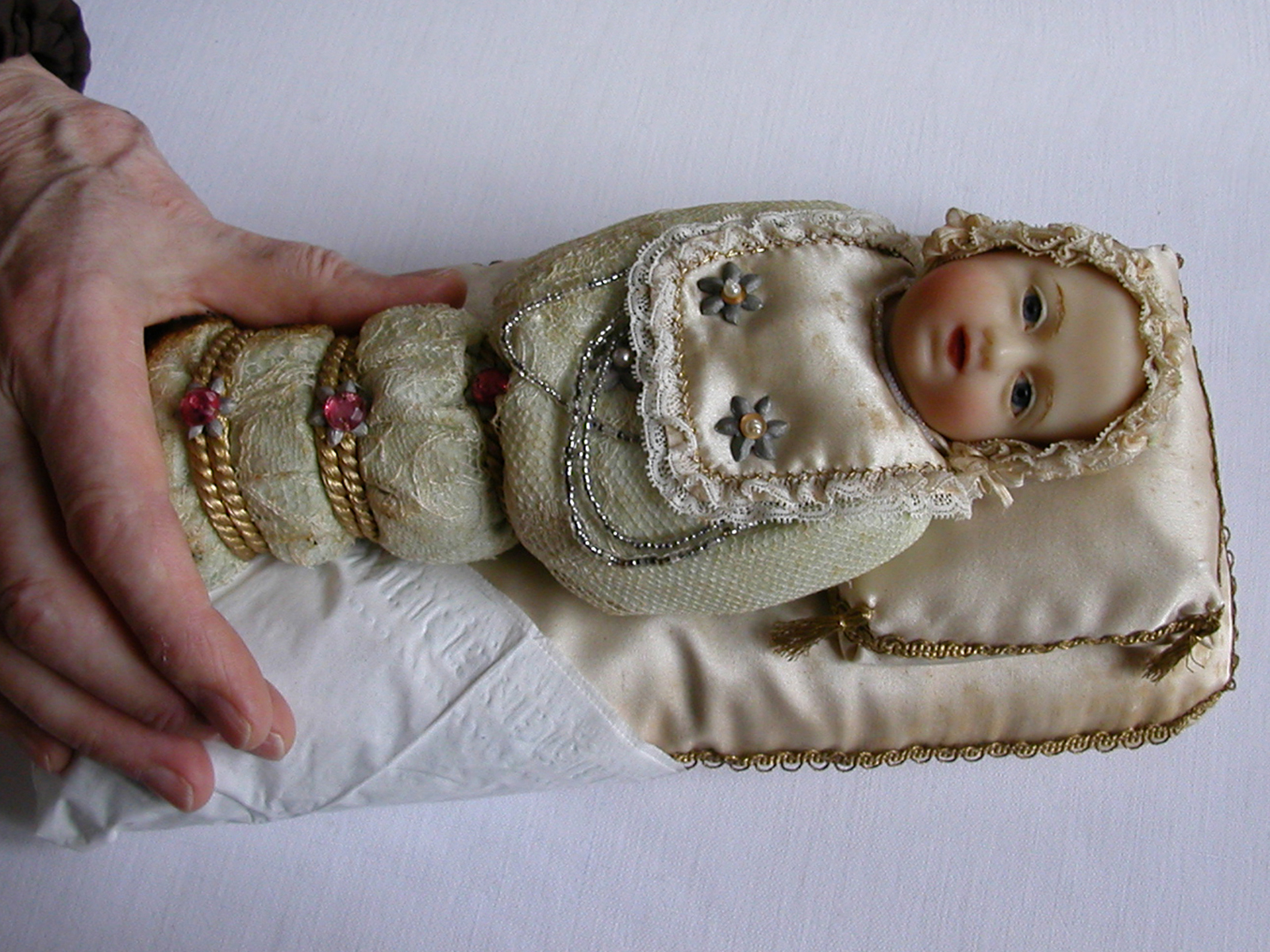
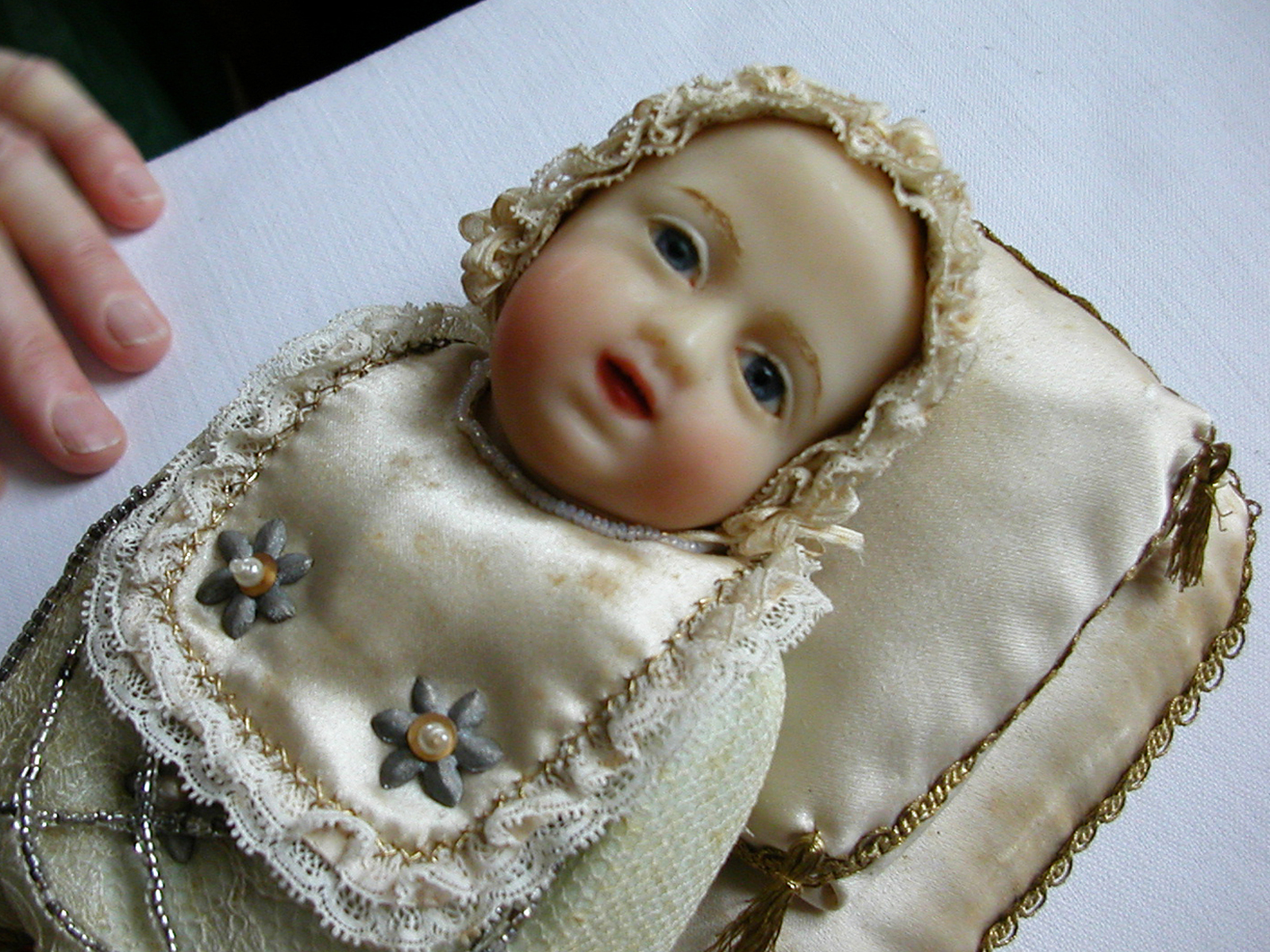
On every September 8, the Carmelites of Lisieux exposed on the altar of the choir a small wax statuette representing the newborn Mary so that the nuns could venerate it there. The statue was called "La Bambina." Please click here to see the statue and here to see a close-up of the face of the statue. Have you ever seen another statue representing the infant Mary?
We may imagine Therese and her sisters venerating this statue on Therese's Profession day, the feast of the Nativity of Mary every year.
For Therese's dispositions in the days leading up to her Profession, please see the letters St. Therese wrote during her retreat for Profession, starting here.
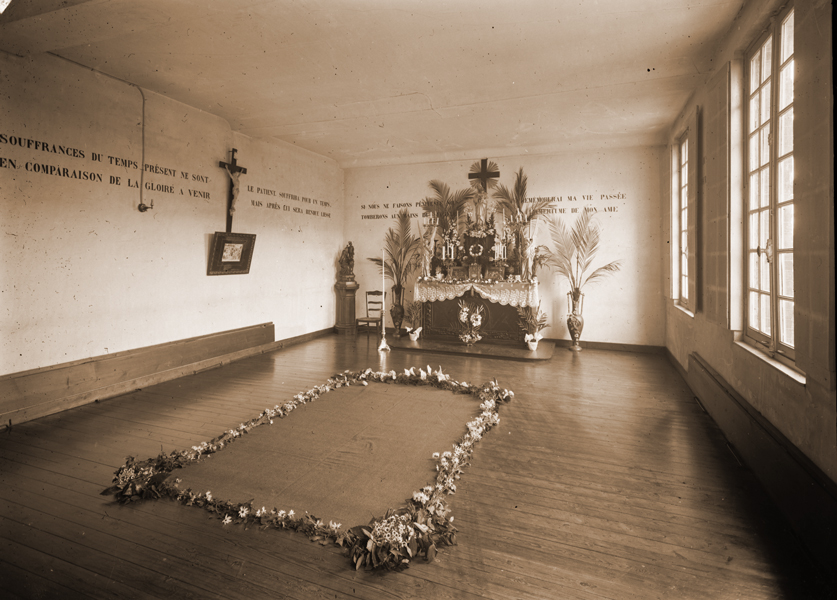
On the morning of September 8, 1890, after Mass, the community escorted Therese, in procession, to the chapter room on the second floor, where the ceremony of professing vows was always held. This ceremony was a private one for Therese's Carmelite family. Click here to see a photograph of the chapter room decorated for a Profession. The young nun prostrated herself on the carpet for part of the ceremony. Over her heart Therese wore her "profession note," a little letter to Jesus expressing her desires. Please see both the English typescript and the handwritten note in French. During the ceremony the prioress placed on her head this crown of white roses:
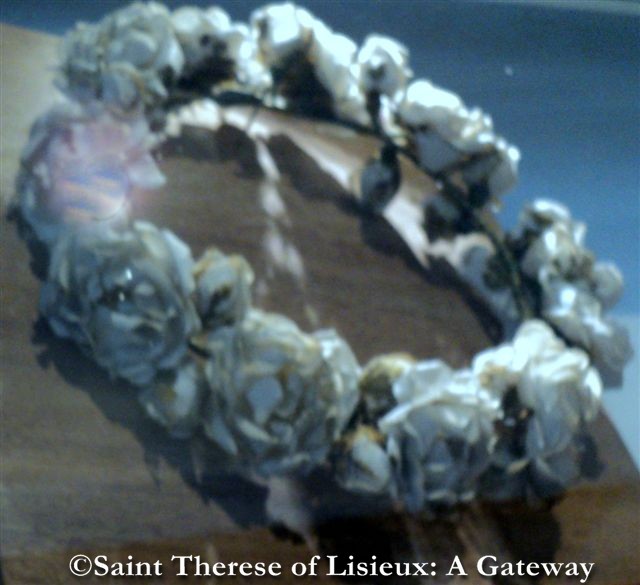
This particular crown of roses had been worn by Mother Genevieve, a foundress of the Lisieux Carmel, for her jubilee, and Therese's sisters Pauline, Mother Agnes of Jesus, and Marie, Sister Marie of the Sacred Heart, also wore it for their professions. A few days before Therese's profession it was entrusted to Celine, who brought it to her father at the Bon Saveur mental hospital in Caen so that he might bless it.
During the ceremony Therese received her Profession crucifix from the prioress:
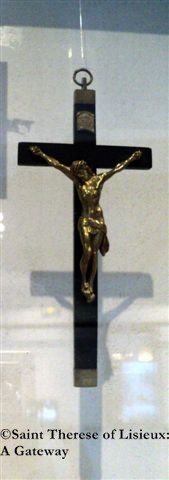
From Therese's own writings we know that she was "obliged" to ask for her father's cure that day, but would only pray "My God, I beg You, let it be Your will that Papa be cured." Much bolder was her prayer for Leonie: "Let Leonie become a Visitation nun, and, if she has no vocation, I beseech You to give her one; You cannot refuse me that." For how Therese remembered her profession later, see both the English typescript and the French handwritten manuscript of Therese's description of her Profession in her memoir, Story of a Soul.
For the two photos displayed here, I thank Adele Giambrone. For the linked photos, I thank the Web site of the archives of the Carmel of Lisieux. For the text, I thank the Washington Province of Discalced Carmelites, which owns the English text, and the Web site of the archives of the Carmel of Lisieux, which dislayed it online. Special thanks to the Internet Archive.
[Note that the new Web site of the Archives of the Carmel no longer displays the above-referenced translation].
1. Story of a Soul: The Autobiography of St. Therese of Lisieux, tr. John Clarke, O.C.D., Third Edition. Washington, D.C.: ICS Publications, 1996, p. 167.
Maureen O'Riordan
in Leonie Martin, St. Therese of Lisieux, St. Therese's vows, crown of roses, profession crucifix, religious profession of St. Therese
|
Post a Comment
| Email
| Print
Pope Francis to use excerpts from St. Therese's poem "Why I Love You, O Mary" in the prayer vigil for peace September 7
The Vatican has published in Italian a worship aid for the Vigil of Prayer for Peace that is going to be conducted in Rome on September 7, 2013. The vigil will include the five joyful mysteries of the rosary, and, after each decade, the stanza of St. Therese's poem "Why I Love You, O Mary" that corresponds to that mystery will be read. See Deborah Thurston's English translation of the vigil worship aid at her blog, Karmalight. You may download the Italian booklet here. Be aware the download may be slow.
Therese wrote "Why I Love You, O Mary," her last poem, in May 1897. It is a long meditation on Mary in the gospels: Mary's humble, hidden, ordinary life; Mary's union with Jesus; Mary, our mother. It is impossible to exhaust the poem's riches here. Please read the twenty-five verses and see the handwritten manuscript of "Why I Love You, O Mary" here.
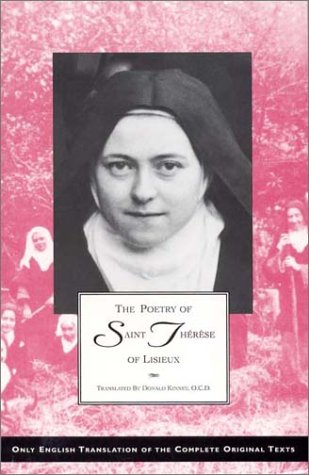
To explore the riches of all Therese's poetry, please see The Poetry of Saint Therese of Lisieux, translated by Donald Kinney, O.C.D. Washington, D.C.: Washington Province of Discalced Carmelite Fathers, 1995. The introductions and notes to each poem are invaluable in setting each poem in the context of Therese's life and community.
One of Therese's most extraordinary assertions is "Mary, you love us as Jesus loves us." May we place our prayer for peace in the hands of St. Therese and in the hands of Mary, and may they obtain for us the gift of peace in the world.
Maureen O'Riordan
in Pope Francis, St. Therese of Lisieux, Why I Love You O Mary, poetry of St. Therese
|
Post a Comment
| Email
| Print
The writing-case of St.Therese of Lisieux is touring the United States. sponsored by the Pontifical Mission Societies, until the end of October 2013
August 29, 2013.
The Pontifical Mission Societies announced today that the wooden writing-case (the “écritoire”) that belonged to St. Thérèse of Lisieux began a tour of the United States this week. The tour is sponsored by the Pontifical Mission Societies in collaboration with the Carmel of Lisieux, which has generously lent the writing-case.
Father Andrew Small, OMI, National Director of the Pontifical Mission Societies in the United States, traveled to Lisieux to pick up the writing-case, which has never before been outside the monastery. The United States is blessed to be the first country to welcome this important possession of St. Thérèse. Except for the manuscripts themselves, no souvenir of St. Thérèseis closer to her extraordinary memoirs, published in book form as Story of a Soul in 1898, than the écritoire. All three manuscripts of this great spiritual classic, which has transformed so many lives, were written on this little wooden writing-desk.
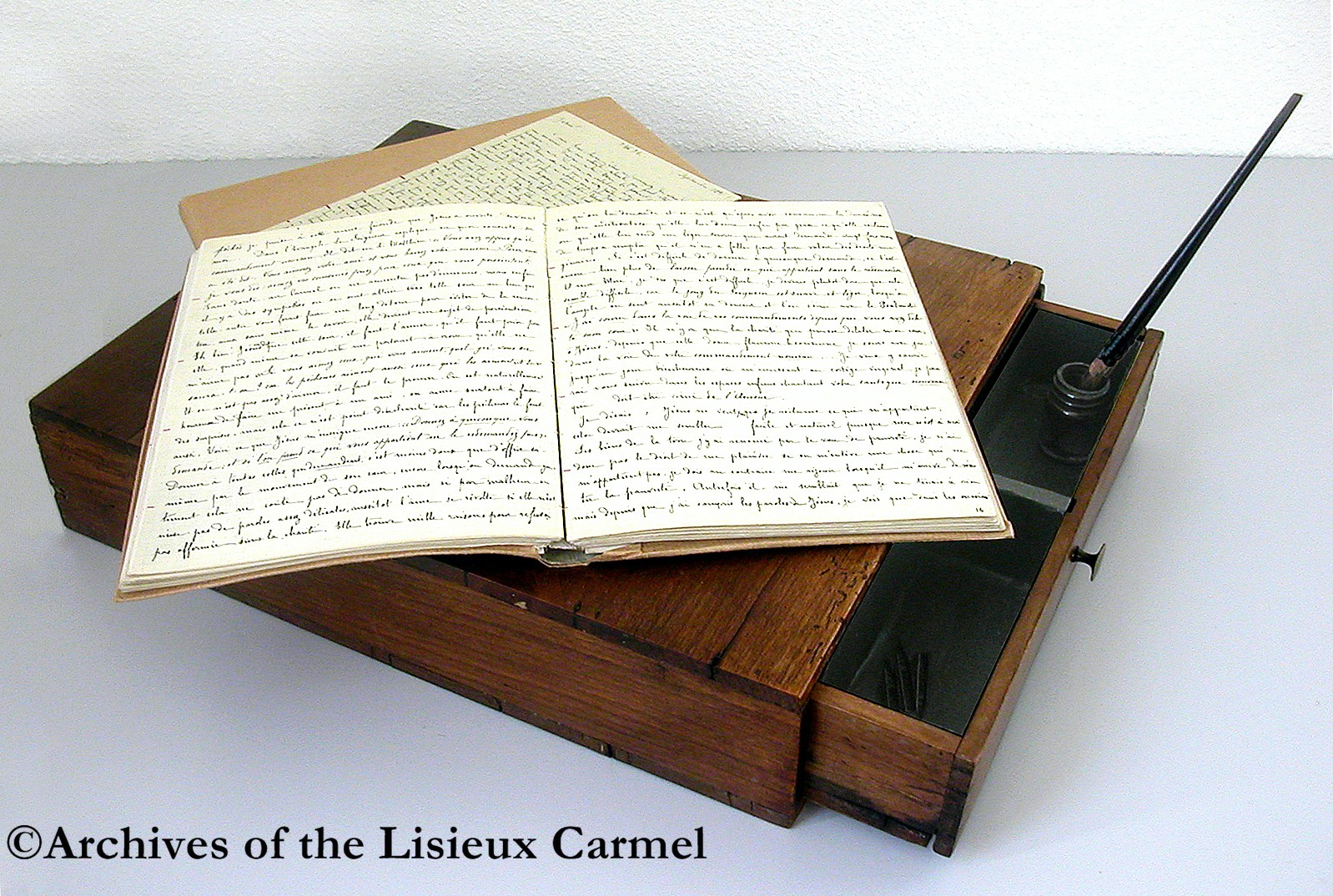
The tour opened on Wednesday, August 28, the anniversary of the death of St. Thérèse’s mother, Blessed Zélie Martin. The first stop was Las Vegas, where several Catholic Hispanic organizations had been meeting. The writing-case is scheduled to be venerated in about twenty dioceses between now and late October, when the tour is scheduled to end on the East Coast.
The first event of the tour was a prayer service at St. Joseph, Husband of Mary parish in Las Vegas. During the prayer service, which began at 5:30 p.m., each person present was invited to write her or his name on a piece of paper and place it on the writing-case. “This simple act is a way for pilgrims to unite their hearts with the heart of St. Thérèse and to place all their hopes and sorrows in heaven with her,” said Father Andrew. “Returning the writing case to Lisieux, I will also carry with me the many names of those who have entrusted their cares and hopes to the intercession of St. Thérèse.”
See the current tour schedule, which is constantly being updated.
For more about the role of the écritoire in St. Thérèse’s life, please watch "Saint Therese of Lisieux: A Gateway." You will learn when and where she used it; why she used this writing-case only after 1894; what happened to her first writing-case; and which of her writings she composed using this little writing-desk. I will also write about the links between the Pontifical Mission Societies and St. Therese, both during her lifetime and after her death. For more about the mission tour, please watch www.OneFamilyinMission.org, where you can learn more about the Pontifical Mission Societies.
by Maureen O’Riordan for “Saint Therese of Lisieux: A Gateway”
Maureen O'Riordan
in Pontifical Mission Societies, St. Therese of Lisieux, ecritoire, writing-case
|
Post a Comment
| Email
| Print
The launch of the new Web site "Léonie Martin, Disciple and Sister of St. Thérèse of Lisieux"
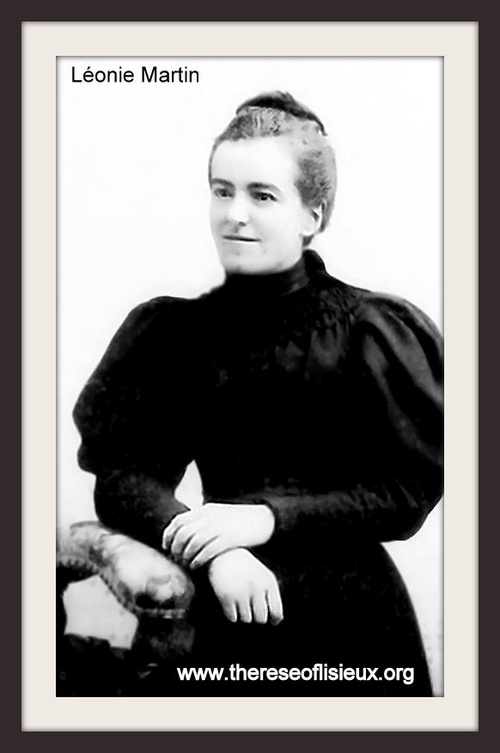
I am happy to announce the launch of my new Web site "Léonie Martin: Disciple and Sister of St. Thérèse of Lisieux." During her earthly life and for many years after her death, Léonie lived on the margin and in the shadows. Now Mgr Boulanger, the bishop of Bayeux and Lisieux, has granted the imprimatur for the prayer that she might be declared venerable; Father Sangalli, the vice-postulator for the cause of her parents, declared publicly that he hopes her cause for beatification and canonization can be opened soon, as so many letters request. More than seventy years after her death, Léonie is emerging into the light. Without destroying the hiddenness that was so much a part of her spirituality, and while still looking at her in the context of her relationships, I want to examine Léonie in her own right. I believe that, the more we study her, the more she will teach us about her pilgrimage on the way of confidence and love.
This new Web site contains all the information about Léonie that was on "Saint Therese of Lisieux: A Gateway." You can still access it from the link at left. It also has two jewels, never in English before, that are unique to it:
- My English translation of the new illustrated booklet "The Life of Léonie Martin," prepared in 2012 by Léonie's sisters at the Monastery of the Visitation of Caen. Copies of this booklet are offered to the pilgrims who come to pray at Leonie's tomb. Now this online copy offers English-speaking pilgrims the chance to make a "virtual pilgrimage" to Léonie's monastery and to her tomb. Please join me in thanking the present-day nuns of Léonie's community, who have been kindness itself to me, for their generous permission to translate and share this doorway to Léonie's world with her English-speaking disciples. May God bless them for it.
- With the very generous permission of Famille Chretienne, my Engish translation of the contemporary article "The hidden life of Léonie Martin, the rebel sister of St. Thérèse emerges from oblivion," which appeared in the June 8, 2013 issue. I thank Anne Slater for her help in translating this groundbreaking article, and I recommend it highly to those who want to learn about the rise of devotion to Léonie, the present state of her cause, and her influence on the lives of those who have received graces through her intercession.
To visit "Léonie Martin: Disciple and Sister of St. Thérèse of Lisieux" directly, please visit http://leoniemartin.org This is the first "daughter site" of "Saint Thérèse of Lisieux: A Gateway." Please God, it will not be the last.
Please join me in thanking my friend and benefactor Juan Marrero, a good friend and fervent devotee of Léonie, Thérèse, and Louis and Zélie, whose generous gift made Léonie's Web site possible. Please remember him gratefully in your prayers.
Maureen O'Riordan
in Disciple and Sister of St. Therese of Lisieux, Leonie Martin
|
Post a Comment
| Email
| Print