Saint Therese of the Child Jesus
of the Holy Face
Entries by Maureen O'Riordan (558)
The 130th annniversary of the First Communion of St. Therese of Lisieux
Therese Martin, the 11-year-old girl who would become St. Therese of the Child Jesus of the Holy Face, received her First Communion on May 8, 1884 at the Benedictine Abbey of Notre Dame du Pre in Lisieux, where she was a student.
Therese's preparation for her First Communion
Therese's careful preparation was aided by her family as well as by the Abbey. Every night her oldest sister and godmother, Marie, instructed her in the spiritual life. Pauline, who was already in formation as a Carmelite nun, wrote Therese a little letter every week to encourage her to be as generous as possible to prepare for the great day. Pauline also prepared a notebook which compared Therese's soul to a garden, and Therese used the notebook to record her sacrifices, prayers, and acts of love every day.

The Carmelite friars of Verona in Italy have prepared in English a booklet, "40 Days of Preparation for First Communion with St. Therese of Lisieux," which may be ordered in the United States. Please click on the image for more information.
Thanks to the Web site of the Archives of the Carmel of Lisieux, you can read online Therese's memories, written eleven years later, of these months of preparation.
Therese receives Jesus
About the experience of receiving her First Communion, Therese wrote famously:
Ah! how sweet was that first kiss of Jesus. It was a kiss of love; I felt that I was loved, and I said: "I love You, and I give myself to You forever!" There were no demands made, no struggles, no sacrifices; for a long time now, Jesus and poor little Therese had looked at and understood each other. That day, it was no longer simply a look, it was a fusion. Therese had vanished as a drop of water is lost in the immensity of the ocean. Jesus alone remained; He was the Master, the King." Read more.
Another page of the Web site of the Archives of the Lisieux Carmel gives details of the first communions of each of the Martin daughters. Visit it and, in the far right column, about Therese's first communion, follow the links to:
- period photos of the Benedictine Abbey, including one photo of a First Communion Mass and one of a catechism class like Therese's;
- a photo of the copy of the Imitation of Christ Therese received for her First Communion;
- at the very bottom of the page, a photo (from the 1930s) of the First Communion class gathered before the statue of Mary while one child recites, in the name of all her classmates, the Act of Consecration to the Blessed Virgin.
The Act of Consecration to the Blessed Virgin
Therese writes
In the afternoon, it was I who made the Act of Consecration to the Blessed Virgin. It was only right that I speak in the name of my companions to my Mother in heaven, I who had been deprived at such an early age of my earthly mother. I put all my heart into speaking to her, into consecrating myself to her as a child throwing itself into the arms of its mother, asking her to watch over her.
In fact, Celine, at her First Communion four years earlier, had been chosen to make this Act of Consecration. But in Therese's First Communion class were two young girls, Marie and Alexandrine Domin, the nieces of Father Louis Domin, the chaplain of the Benedictine Abbey. Father Domin taught the students catechism and prepared them for their First Communion. As a compliment to him, the teachers had planned to confer this honor on one of his nieces. Therese was so distressed at the prospect that her aunt, Mme. Guerin, who was a distant cousin of Father Domin, and Marie visited Mother Saint-Placid to ask her to reverse the decision. In the end the whole family went to visit Father Domin, who yielded. Celine wrote years later that she could still see the place in his reception room where she sat, could see Therese's suppliant air and pale face. (Manuscrits autobiographiques de Sainte-Therese de l'Enfant Jesus by Father Francois de Sainte-Marie, O.C.D. Office Central de Lisieux, 1956, Volume II, p. 23).
We no longer have to wait till we're eleven to receive the Eucharist, and many of us have the joy of receiving much more often than Therese did. She wrote prophetically "We are also the hosts whom Jesus wants to transform into Himself." May she obtain that grace for us on this anniversary.
 Maureen O'Riordan
in 40 days of preparation for First Communion with St. Therese, First Communion of St. Therese, First Communions of St. Therese's sisters, books about St. Therese, preparation for First Communion
|
Maureen O'Riordan
in 40 days of preparation for First Communion with St. Therese, First Communion of St. Therese, First Communions of St. Therese's sisters, books about St. Therese, preparation for First Communion
|
 Post a Comment
|
Post a Comment
|  Email
|
Email
|  Print
Print
"Saint John XXIII and Saint John Paul II in Lisieux," by Father Olivier Ruffray, rector of the Shrine at Lisieux
“Holy Popes, friends of Thérèse, pray for us!”
– Father Olivier Ruffray, rector of the Shrine at Lisieux
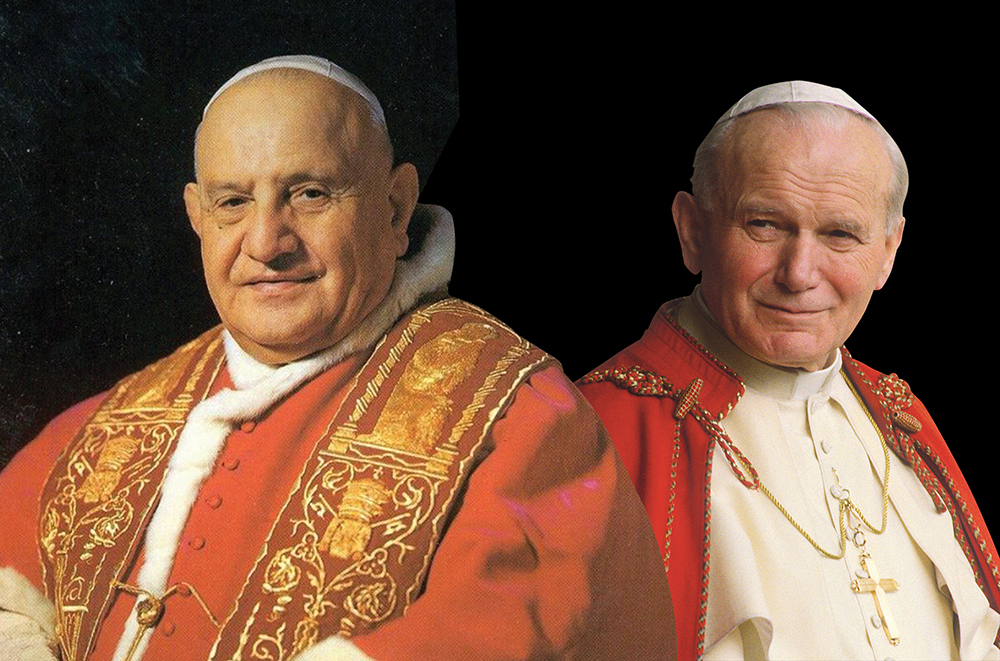
This editorial was written by Father Olivier Ruffray, rector of the Shrine at Lisieux, for
Thérèse of Lisieux (a publication of the Shrine at Lisieux), no. 954, May 2014.
Translated by Maureen O'Riordan, it appears with Father Ruffray's kind permission.
We rejoice fully in the holy Popes whom Pope Francis offers to the official prayer of the Church. They are the friends of Saint Thérèse.
Saint John XXIII came to Lisieux in 1930, on September 11, then three times more as Apostolic Nuncio in France. We keep at the Shrine a photo-souvenir taken in the court of St. John’s House on August 15, 1951. He loved to talk about Thérèse and about “her quiet and precious way of bringing to souls the riches of God.” He also emphasized her powerful intercession as Patron of Missions. The “Good Pope John,” as he was called by those who had tasted his charity, which was matched only by his simplicity, opened for us the Second Vatican Council. Thanks to him, we “rediscover the Word of God;” we welcome the Church as “a light to the nations;” we think of “the Church in the Modern World;” we receive the Virgin Mary as “Mother of the Church;” we hear as a spiritual and ecclesial encouragement the “universal call to holiness.” We understand how the Holy Spirit is at work in the Church and in the world. We divine how the spirituality of St. Thérèse could have inspired, for its part, the Council. It pleases us to think also that the Blessed Louis and Zélie Martin, by the witness of their lives and their social commitment to the little ones, opened with others, in the seething nineteenth century, the paths of the Social Doctrine of the Church. It was under the pontificate of Pope John Paul II that they were declared venerable, on March 26, 1994.
Saint John Paul II came to Lisieux on June 2, 1980 after his appeal at Le Bourget (the airport near Paris) that still rings in our hearts : “France, the eldest daughter of the Church! What have you done with your baptism? ...” At that time, Cardinal Marty presented the Pope to young people gathered at the Parc des Princes as the “sportsman of God!" At Lisieux, Pope John Paul II reminded us that the saints never get old because they are “witnesses of the future world." He thought of St. Thérèse, whom he was going to name the youngest Doctor of the Church on October 19, 1997 in St. Peter's Square, calling her doctrine the "science of love." Yes, Thérèse teaches us to love according to the heart of God, as it seems to us we read in the luminous gaze of Pope John Paul II, contemplating the Basilica in the photograph that shows him in the Esplanade of the Basilica, June 2nd 1980. In Rome, recently, the young Pietro Schilirò and his parents met with Pope Francis. They told him about the little Carmen in Spain (the child whose healing has been submitted to the Congregation for the Causes of Saints to be considered as the miracle for the canonization of Blessed Louis and Zélie Martin). The Pope reportedly replied that he knows it . . . How beautiful the Church in the light of Easter! She is our Mother, and we love her. With the Virgin Mary in her month of May, with all the saints of Heaven, a happy and holy Easter time.
Holy Popes, friends of Thérèse, pray for us!
Maureen O'Riordan
in Lisieux, Saint John Paul II, Saint John XXIII
|
Post a Comment
| Email
| Print
"The Marital Spirituality of Blessed Louis and Zelie Martin: Spouses Carrying Each Other to God"
An Encounter with St. Thérèse of Lisieux
and her parents, Blessed Louis and Zélie Martin
Pray in the presence of their relics on Sunday, June 1, 2014
from 10:00 a.m. to 4:00 p.m.
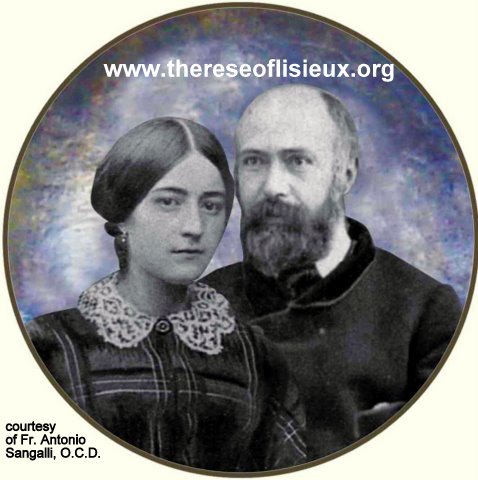
“The Marital Spirituality of Blessed Louis and Zelie Martin:
Spouses Carrying Each Other to God"
- a conference by Maureen O’Riordan at 1:00 p.m.
Benediction of the Most Blessed Sacrament at 3:30 p.m.
with a special blessing for couples
Carmelite Monastery Bookstore Open
1400 66th Avenue 10:00 a.m. to 3:30 p.m.
(66th Avenue and Broad Street) Spiritual books,
Philadelphia, Pa. children's books, DVDs,
Free parking in monastery lot and religious articles.
on 66th Avenue Cash and checks only
Chapel is handicapped-accessible.
Download the flyer
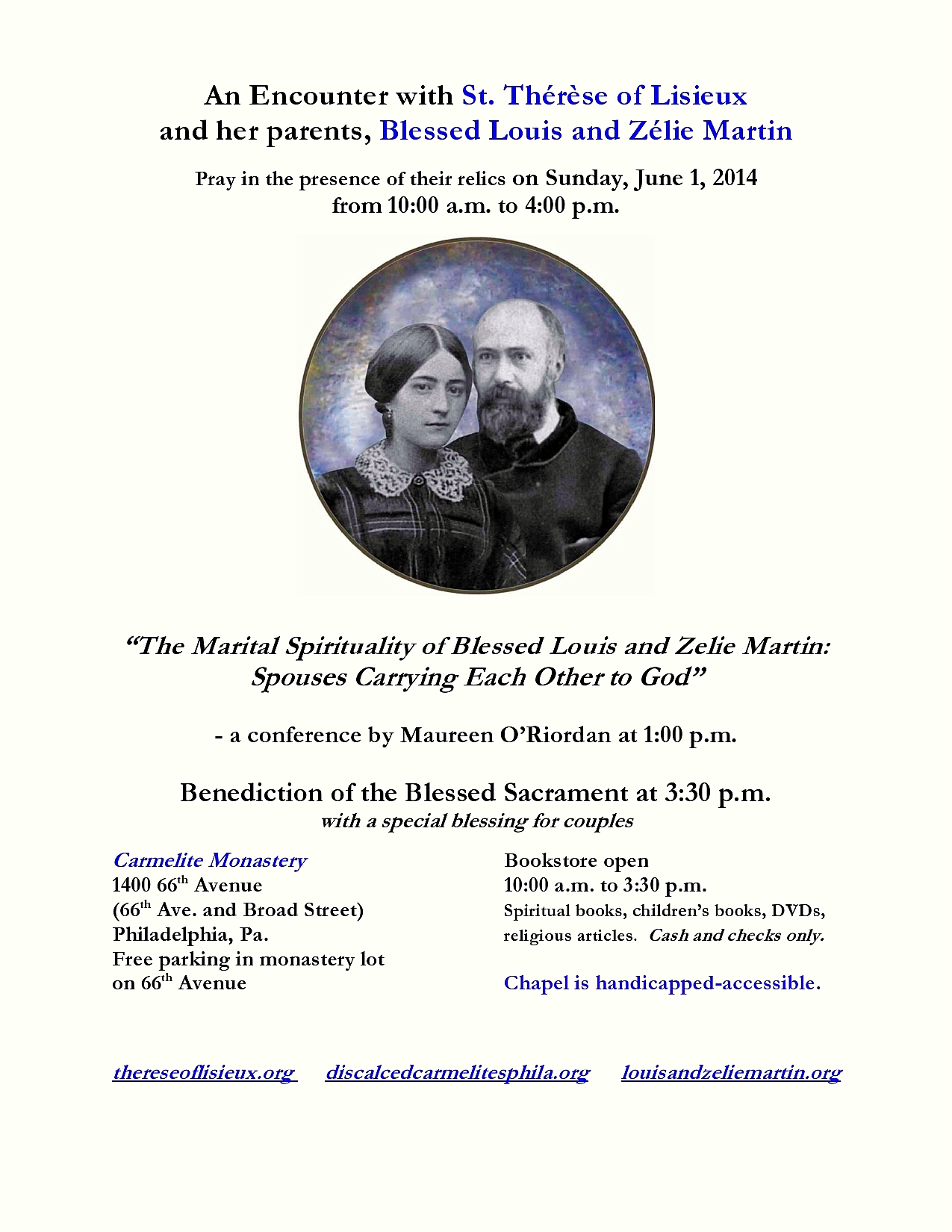
Learn more about Blessed Louis and Zelie Martin at the Web site "Blessed Louis and Zelie Martin."
Maureen O'Riordan
in Blessed Louis and Zelie Martin, Philadelphia Carmel, marital spirituality, spouses
|
Post a Comment
| Email
| Print
Virtual visit to the choir of the Carmelite monastery at Lisieux
See a short video of the Carmelite nuns of Lisieux today gathering in the choir to make their silent evening prayer in the same place where St. Therese of Lisieux made hers. The French audio consists of readings from what St. Therese wrote about prayer, but you don't need to understand French to enjoy this rare look at the place where St. Therese spent several hours every day of her Carmelite life.
Maureen O'Riordan
in video of the choir, virtual visit to the Carmelite monastery of Lisieux
|
Post a Comment
| Email
| Print
Our new saints!
 St. John XXIII and St. John Paul II
Maureen O'Riordan
in photo of St. John Paul II, photo of St. John XXIII
|
1 Comment
| Email
| Print