Saint Therese of the Child Jesus
of the Holy Face
Entries by Maureen O'Riordan (558)
"Therese of Lisieux, Woman of Culture, Education, and Peace" honored by UNESCO for the 150th anniversary of her birth: January 2, 2023

On 11 November 2021, the General Conference of UNESCO member countries validated the inclusion of Thérèse of Lisieux in the anniversaries with which UNESCO will be associated for the years 2022/2023, on the occasion of the 150th anniversary in 2023 of the birth of Thérèse Martin in Alençon, on 2 January 1873.
A young French woman known throughout the world, a woman of culture, education and science, Thérèse of Lisieux, through her personality and her work, scans the depths of the human heart and opens up possible answers to the men and women of this world in search of meaning, in search of personal and universal peace.
UNESCO's recognition of Thérèse of Lisieux at the suggestion of France opens up new prospects for the spread of her message of life, peace and love to "the remotest islands", as Thérèse of Lisieux herself put it, to the "peripheries", according to the expression of Pope Francis.
The official reception of this recognition took place on Saturday 4 December 2021 at 3.30 pm in Lisieux at the Halle Saint-Jacques, rue au Char.
Father Olivier Ruffray Rector of the Shrine of Lisieux
Every two years, Unesco honours personalities who, in their own way, have worked and continue to work in the fields of education, the advancement of women, culture, science and peace-building
Known throughout the world, Thérèse, through her works and her testimony, contributes to the promotion of universal values. Through the quality and depth of her life, she speaks a language that transcends borders; that of Love.
Father Thierry Hénault-Morel Rector of the Shrine of Alençon
[This article is excerpted from a press release published on the Web site of the Shrine at Lisieux (https://www.therese-de-lisieux.catholique.fr). I reproduce it here with fervent thanks to the Shrine at Lisieux, the Shrine at Alencon, UNESCO, and all their partners in celebrating this worldwide honor done to Therese]. Look for more information about the universal significance of this award in the days to come.
 Maureen O'Riordan
in Therese woman of culture, UNESCO, and science, education, events related to St. Therese of Lisieux
|
Maureen O'Riordan
in Therese woman of culture, UNESCO, and science, education, events related to St. Therese of Lisieux
|
 Post a Comment
|
Post a Comment
|  Email
|
Email
|  Print
Print
The anniversary of the publication of St. Therese's "Story of a Soul" on its anniversary
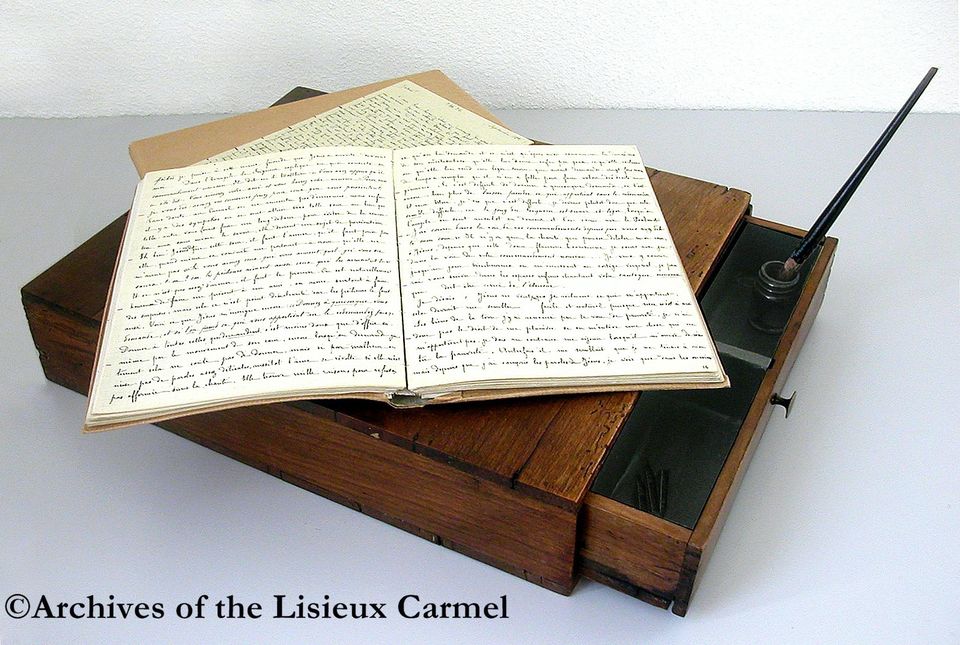 For many years, the world believed that Therese's Story of a Soul, which took the world by storm, had been published on September 30, 1898, the first anniversary of her death. In fact, it was published on October 20, 1898. The Archives of the Lisieux Carmel preserve a note by Therese's sister Celine, Sister Genevieve of the Holy Face, giving the date October 21, 1898, but Father Conrad De Meester, in his critical edition Histoire d'une Ame (Paris, Presses de la Renaissance, 2001), shows that it was received at Lisieux on October 21, but was published by Librairie St. Paul at Bar-le-Duc on October 20. The influence of Therese's published manuscripts has been so great that we must consider October 21, 1898 as a crucial date for the Christian faith.
The splendid Web site of the Archives of the Carmel of Lisieux tells the story of the publication in its article "Story of a Soul in the making - 1897-1898 - in the details," recounting how Therese's uncle, Isidore Guerin, agreed to finance an edition of 2,000 copies and how he sought bids from several printers. There you can also read in English translation the first reactions of the readers (some of whom had known Therese) who wrote to Carmel.
We are so accustomed to having these powerful manuscripts that it's hard to imagine the world before they appeared. I have had the joy of giving them to many young persons on their confirmation and to the bereaved and those in many kinds of trial. How blessed we are that Therese wrote this story and that it has been shared with the world!
Maureen O'Riordan
|
Post a Comment
| Email
| Print
October 19, 2022: the 25th anniversary of the day St. John Paul II proclaimed St.Therese of Lisieux a Doctor of the Church
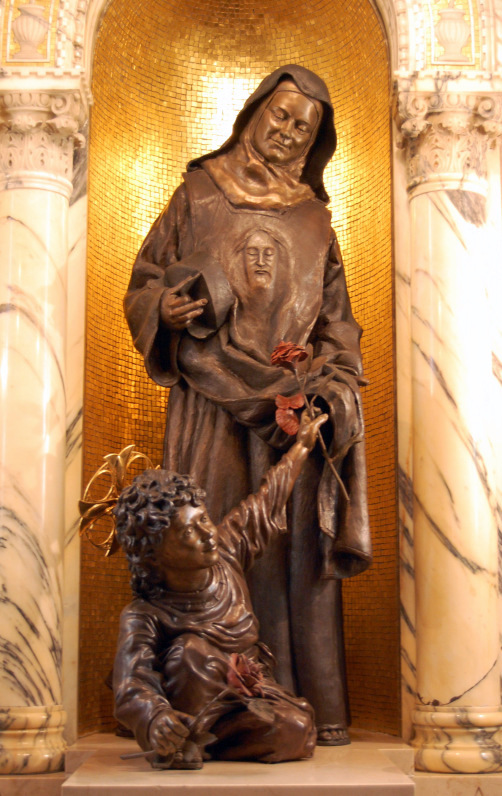 Statue of St. Therese of Lisieux as a Doctor of the Church. Courtesy of the Philadelphia Carmel.
A quarter of a century ago, Pope St. John Paul II proclaimed St. Therese of Lisieux a Doctor of the Universal Church: the youngest Doctor and only the third woman. His reasons, and the reasons of the Church, for doing so are powerfully presented in the Apostolic Letter he issued on that occasion: Divini Amoris Scientia, the "science of the love of God." This document, his homily at the doctoral Mass, and several other documents on which one can fruitfully reflect on this occasion are gathered on my page "Doctor of the Universal Church" on "Saint Therese of Lisieux: A Gateway."
So many valuable documents and homilies were offered for that occasion that I want to reflect on what we have experienced, and what Therese has experienced, in her first 25 years as a Doctor.
- St. Therese has seen the continued travels of her relics throughout the world. This reverse pilgrimage, in which Therese comes to the people, began in 1994, and continues to this day. It has been greeted with remarkable enthusiasm, and has been an extraordinary experience of grace. Among other places, the relics were received by vast crowds in the United States in 1999, in Ireland (where 75% of the population turned out to venerate them) in 2001, and in Australia (where 400,000 people venerated them) in 2002. More remarkable than the many who came to venerate St. Therese's relics and to pray in their presence has been the atmosphere of deep prayer and the experiences of grace that accompanied them on their travels.
- St. Therese has seen her parents, Louis and Zelie Martin, beatified in 2008 and canonized, the first saints canonized as a couple, in 2015. They are a model for achieving holiness as spouses, living out the universal call to holiness of all the baptized, and becoming saints while engaged unreservedly in the life of the family, the Church, and the community.
- St. Therese has seen the opening of the cause for the beatification of her sister, Leonie Martin, Sister Francoise-Therese of the Visitation at Caen, a woman whose life shows that special-needs persons, abused and wounded persons, and those who find their true vocation only late in life can become whole and holy.
- the exposure of the clergy sex-abuse crisis all over the world;
- in much of the West, a decline in vocations to the priesthood and the religious life.
- parishes being merged or closed;
- many Christians no longer participating regularly in the life of the Church;
- the intensified persecution of Christians throughout the world
- the concentration of wealth in the hands of a few individuals, and the consequent growth of poverty in the lives of countless others
- division and polarization within and among the nations
- an increase in war and violence
Maureen O'Riordan
|
Post a Comment
| Email
| Print
For St. Therese's feast, view the film "In Search of the Little Flower: The Full Life Story of St. Therese"
To my knowledge, the film "In Search of the Little Flower: The Full Life Story of St. Therese" is the only excellent full-length documentary about St. Therese in English legally available for free viewing on the Internet. It was produced in 2019 by Sancta Familia Media (Brian Timmons and John Patrick Mallon), two devout young Catholic Scotsmen who traveled to France with their pastor, Fr. James Grant, then press secretary to the Bishops' Conference of Scotland, to make the film in order to help the people of Scotland prepare for the historic first visit of the relics of St.Therese to Scotland. From then until 2022, more than 58,000 people have viewed it online. I strongly recommend it. Feast on it!
Maureen O'Riordan
|
Post a Comment
| Email
| Print
Anniversary of Therese's offering of herself to Merciful Love on June 9, 1895
To recreate this offering on the anniversary, please visit the page "Offering of myself to Merciful Love, June 9, 1895."